


So, what exactly is Customer Experience Management (CEM)? Think of it as the art and science of managing every single interaction a customer has with your company. It’s not about just putting out fires when something goes wrong. It's about intentionally designing a smooth, positive journey from the very first time they hear about you all the way to becoming a loyal fan.
Getting to the Heart of Customer Experience

Let's use an analogy. Imagine you're hosting a party. A decent host will help a guest who spills a drink. But a great host? They’ve already thought about everything: the music, the lighting, who to introduce to whom. They make sure every single person feels valued from the second they walk in the door. That's what CEM does for a business.
This is a huge step up from old-school customer service, which was almost always reactive and transactional. CEM, on the other hand, is about the big picture—the total of every feeling and perception a customer builds up about your brand over time. It’s no surprise that 89% of businesses now say they compete mostly on the customer experience they provide. It's the new battleground.
What Does This Look Like in Practice?
At its core, managing the customer experience is all about listening, understanding, and then taking action. It’s a continuous cycle that involves a few key activities:
- Mapping the Customer Journey: This means walking in your customer's shoes and identifying every single touchpoint, from the moment they see an ad to the day they unbox your product or call support.
- Gathering Feedback: You have to ask! This involves using everything from surveys and online reviews to social media comments to get a pulse on how customers really feel.
- Analyzing the Data: All that feedback is just noise until you turn it into real insights. This is where you connect the dots to find out what's working and, more importantly, what’s causing frustration.
- Orchestrating Improvements: This isn't just a job for the support team. CEM gets everyone—marketing, sales, product developers—on the same page to create a truly consistent and seamless experience.
The real goal of CEM is to close the gap between the experience you believe you’re providing and what your customers are actually feeling.
Ultimately, this isn’t just about creating warm, fuzzy feelings. It's a smart business strategy. A great customer experience builds loyalty, stops customers from leaving, and turns them into your most powerful marketing tool: genuine brand advocates.
Building Your CEM Strategy From the Ground Up
A great customer experience isn't something you stumble upon; it’s built, piece by piece, with a clear plan. Creating a solid CEM strategy is all about shifting from assuming you know what customers want to actually knowing what they need, based on real data from every step of their journey. It's your blueprint for delighting them.
So, where do you start? You listen. And you listen everywhere. This means gathering feedback directly from things like customer surveys and online reviews, but it also means paying attention to the indirect clues they leave behind. Think about their behavior—how they click through your website, what support articles they read, or where they drop off in the buying process.
All this listening helps paint a vivid picture of what your customers are really thinking and feeling.
Deconstructing the Customer Journey
With this feedback in hand, your next move is customer journey mapping. This is where you visualize every single interaction someone has with your brand, from the moment they first hear about you to when they reach out for support long after a purchase.
By laying it all out, you can spot the "moments that matter"—those make-or-break interactions that either solidify a customer's loyalty or send them running in the other direction. You might find a snag in your checkout process that’s causing abandoned carts or a confusing step in your onboarding that frustrates new users. These are your golden opportunities to make things better.
This visual shows how all these efforts pay off in the long run.
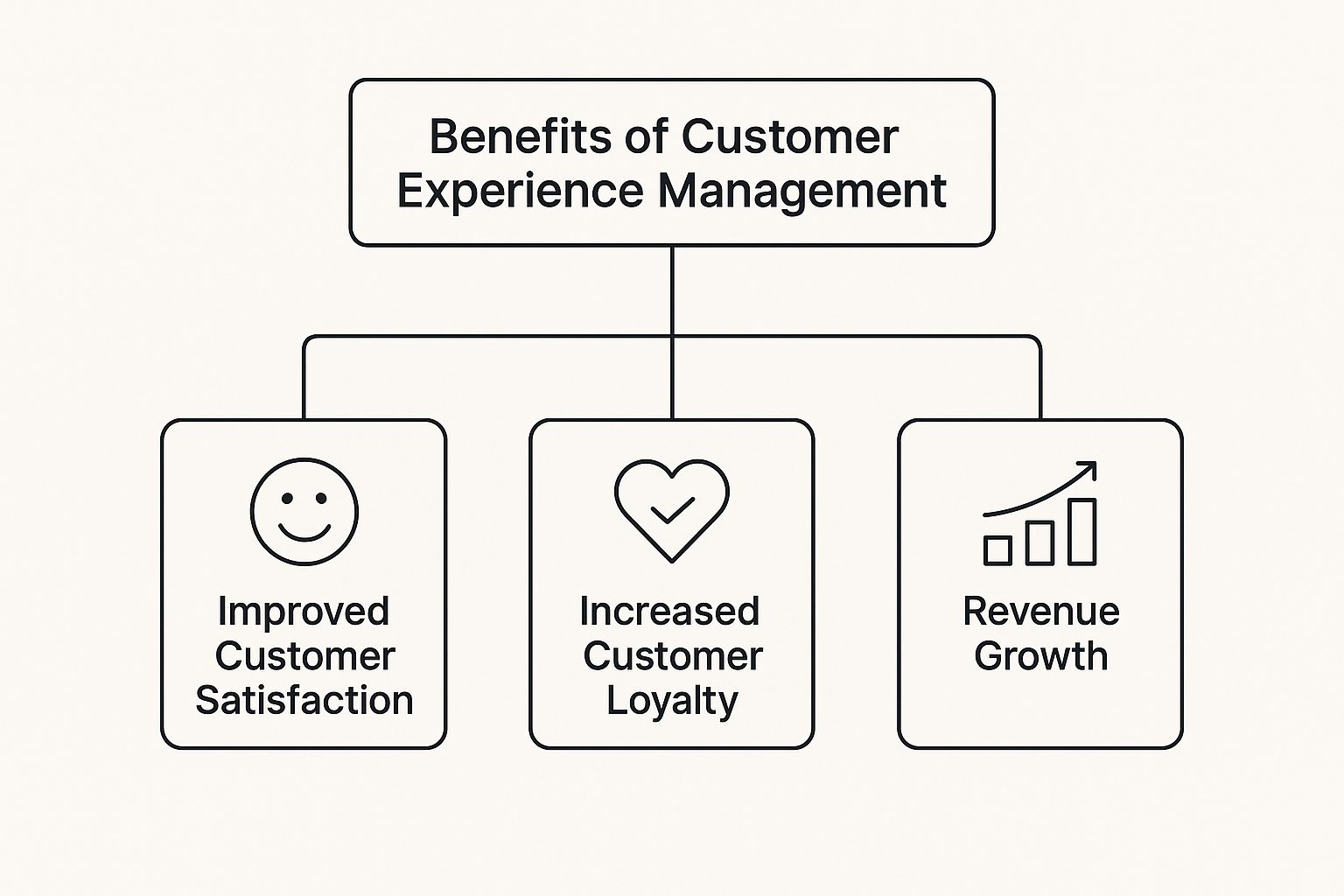
As you can see, a better experience leads directly to happier customers, which is the foundation for loyalty and, ultimately, business growth.
To bring it all together, a strong CEM strategy is built on three core pillars that work in tandem.
Three Pillars of Customer Experience Management
| Pillar | Primary Goal | Key Activities & Tools |
|---|---|---|
| Perception | Understand how customers feel about your brand. | Collecting feedback through surveys (NPS, CSAT), monitoring social media, and analyzing online reviews. |
| Interaction | Improve every touchpoint where a customer engages with you. | Mapping the customer journey, personalizing communications, and ensuring seamless support across all channels. |
| Resolution | Respond effectively to feedback and solve problems quickly. | Implementing a feedback loop, using CRM systems, and empowering support teams to resolve issues on the first contact. |
These pillars provide a complete framework for not just listening to customers, but also acting on what you learn to consistently improve their experience.
Finally, you can't improve what you don't measure. Using the right metrics is crucial for tracking your progress and proving the value of your CEM efforts.
- Net Promoter Score (NPS): This classic metric asks a simple question: "How likely are you to recommend us to a friend?" It's a powerful gauge of overall customer loyalty.
- Customer Effort Score (CES): This one measures how easy it was for a customer to get help or find an answer. The lower the effort, the better the experience.
It's no surprise that companies are investing heavily here. The global customer experience management market was valued at USD 19.34 billion and is projected to rocket to USD 68.24 billion by 2032. This explosive growth is driven by one simple fact: customers now expect and demand personalized, effortless interactions. You can read more about the growth of the CEM market to see just how big this trend has become.
Why a Great Customer Experience Is Your Best Marketing
Let's be honest, focusing on customer experience isn't just a "nice to have" anymore. It's the most powerful growth engine you can build for your business. A truly great experience moves beyond a single sale; it forges a real connection. This is how you turn one-time buyers into loyal fans who genuinely root for your brand. It’s the difference between having a customer base and building a community.
This focus pays off in a big way. Happy customers don't just stick around—they spend more. Time and again, studies show that companies who nail their customer experience blow their competitors out of the water, both in revenue and stock market performance.

When you consistently deliver a positive journey, you're essentially creating your best marketing team: your own customers.
From Transactions to Brand Advocacy
Word-of-mouth has always been a big deal, but in today's connected world, it's on steroids. A single glowing review, a quick recommendation in an online group, or a shout-out on social media can bring in dozens of new customers. That kind of organic marketing is not only more authentic, but it's also way cheaper than running ads.
Think about it. Say a retail brand gets a bad review because of a shipping delay. Instead of a canned apology, the support team reaches out personally, explains what happened, and offers a small gift card. That simple interaction can flip a frustrated customer into someone who tells everyone how much the company cares. You just turned a potential PR nightmare into a loyalty-building win.
The business world is putting its money where its mouth is. The global customer experience management market was valued at USD 15.17 billion and is projected to hit USD 64.51 billion by 2034, growing at a staggering 15.6% each year. This massive investment sends a clear signal: loyalty and genuine engagement are the future. You can discover more about CEM market growth and what's fueling it.
A strong CEM strategy is one of the most sustainable competitive advantages a business can build. It creates a moat around your business that competitors can't easily replicate with features or pricing alone.
At the end of the day, prioritizing the customer experience delivers real-world results that drive long-term growth:
- Increased Customer Retention: Loyal customers are far less likely to leave, giving you a stable and predictable revenue stream.
- Higher Customer Lifetime Value (CLV): Satisfied customers come back for more and often buy higher-value products over time.
- Stronger Brand Reputation: Positive experiences build trust and pull in new customers organically through word-of-mouth and great reviews.
Learning From Brands That Master the Customer Journey

It’s one thing to talk about customer experience in theory, but seeing it done right is where the real lessons are. The brands we love don't just sell great stuff; they obsess over every single touchpoint, making each interaction feel easy, personal, and positive. They make customers feel seen, and that’s how they earn our loyalty.
Think about a big-name coffee company. Their app does more than just take your money. It’s a brilliant example of personalization, remembering your go-to drink, tempting you with new recommendations, and offering rewards that feel like a fun game. This simple system turns a routine coffee purchase into a smooth, personalized ritual that keeps people coming back day after day.
This is what sets the best apart. They don’t just react to problems; they get ahead of them.
Empowering Teams to Create Memorable Moments
Another game-changing move is giving your frontline team real power. Take a famous online retailer known for its legendary customer service. Their support staff don't read from a script. They have the freedom to solve problems on the spot, turning a frustrating issue like a missing delivery into a surprisingly positive experience.
When you trust your team like that, customer service stops being a cost and starts becoming your best tool for keeping customers. A genuine, human solution builds a connection that no chatbot ever could.
Great customer experience management is about orchestrating countless small, positive interactions that, together, create an overwhelmingly positive perception of your brand.
By getting these details right, these companies build an experience so dependable it becomes part of their DNA. These are the foundational efforts behind understanding how to build customer loyalty that lasts.
So what does this look like in practice? Winning CEM strategies often include:
- Frictionless Returns: Making a return just as easy as making a purchase. This tells customers you respect their time and removes the hesitation to buy in the first place.
- Proactive Communication: Letting a customer know about a shipping delay before they have to ask. It’s a simple act that builds incredible trust.
- Consistent Omnichannel Experience: Making sure the experience feels the same whether a customer is using the app, browsing the website, or walking into a store.
When you look at what these successful brands are doing, you can start to pull out specific ideas and apply them to your own business, no matter how big or small.
Using Technology to Power a Human-Centered Experience
Let's be realistic: trying to deliver a fantastic customer experience consistently, especially as you grow, is almost impossible without the right technology. Your tech stack is the engine that drives your whole customer experience strategy. But here's the key—it's not about replacing people. It's about making every human interaction more personal, more meaningful, and a whole lot more efficient.
Think of your Customer Relationship Management (CRM) system as the command center for all your customer knowledge. It's the single source of truth, holding everything from their purchase history to notes from their last support call. This complete picture is what allows your team to treat every customer like a person they know, not just another ticket in the queue.
Unlocking Deeper Insights and Faster Resolutions
Beyond just collecting data, the right tools help you actually understand it. Analytics platforms are brilliant for spotting hidden patterns in customer behavior, shining a light on frustrating moments in their journey you might not even know about. This is a huge part of effective customer experience optimization.
On top of that, specialized tools can bring an incredible level of personalization and speed to your support. They give your team the power to be more proactive and, frankly, more human.
- Co-browsing Tools: Imagine being able to see a customer’s screen securely and in real-time. You can guide them visually through a tricky process instead of trying to explain it over the phone. No more "what do you see now?" confusion.
- Real-time Support Platforms: Tools like Screendesk let your agents instantly start a video call or ask for a screen recording without the customer needing to download a thing. This can turn a technical headache that would take hours of back-and-forth emails into a problem solved in just a few minutes.
The real goal of technology in customer experience isn't just about automation. It's about using smart tools to handle the repetitive, clunky tasks. This frees up your team to focus on what humans do best: building genuine relationships and solving tough problems with empathy.
The money pouring into this area shows just how critical it's become. The customer experience management market is projected to jump from USD 22.44 billion to an expected USD 51.11 billion by 2030. This boom is driven by a new wave of platforms that combine powerful analytics with tools to connect with customers everywhere they are. You can read more about these customer experience management market trends to see just how fast things are moving.
Got Questions About Customer Experience Management?
Switching to a truly customer-first approach is a big shift, and it's natural for practical questions to pop up. Moving from the idea of "customer experience" to what it actually looks like day-to-day can feel a bit overwhelming.
Let's clear things up by tackling some of the most common questions we hear.
What’s the Difference Between Customer Experience and Customer Service?
This is probably the most common point of confusion, but it’s easy to grasp when you think about the big picture versus a single moment.
Customer service is reactive. It’s a specific event, a single interaction. Think of a customer calling your support line or using live chat to ask about a charge. It’s a critical piece of the puzzle, but it’s still just one piece.
Customer experience (CX), on the other hand, is proactive and covers everything. It’s the grand total of every single interaction a customer has with your company, from the very first ad they see to the day they stop using your product. It includes their experience on your website, the packaging of your product, and, yes, that customer service call.
A simple way to think about it: Customer service is one scene in a movie. The customer experience is the entire film.
How Can a Small Business Start with Customer Experience Management?
You don't need a huge budget or a dedicated CX department to get started. The secret is to begin small and focus on what will make the biggest difference right away.
Start by trying to see things from your customer's point of view. Walk through their journey and ask some honest questions:
- Where do people get stuck or seem to complain the most?
- Is our checkout process a pain to get through?
- Are our follow-up emails actually helpful?
Just pick one or two of these friction points to work on first. At the same time, you can start gathering feedback with a simple survey after a purchase. The goal here is progress, not perfection. Making small, steady improvements shows customers you're listening and helps build momentum for bigger changes down the road.
What Are the Most Important Metrics to Track?
You could track dozens of different numbers, but you'll get a solid, balanced view of how you're doing by focusing on three core metrics.
- Net Promoter Score (NPS): This classic metric asks customers how likely they are to recommend you to a friend. It’s the ultimate pulse check on brand loyalty.
- Customer Satisfaction (CSAT): This one measures happiness with a specific interaction, like how a support ticket was handled. It gives you instant insight into individual touchpoints.
- Customer Effort Score (CES): This metric asks a simple question: how easy was it for the customer to get what they needed? A low-effort experience is a massive driver of loyalty.
How Long Does It Take to See Results?
Improving customer experience is a marathon, not a sprint. Think of it like building a great relationship—it doesn’t happen overnight. It takes consistent effort.
You might see some quick wins. Fixing a confusing part of your website, for example, could boost your CSAT or CES scores in just a few weeks.
But the real, lasting rewards of a great CEM strategy—like fiercely loyal customers, higher retention, and a stellar reputation—often take several months to a full year to truly show up in your bottom-line numbers. For more on this, check out our guide on how to reduce customer churn.
Ready to turn your support interactions into clear, fast, and satisfying experiences? Screendesk gives your team the video tools they need to solve problems faster and make customers happier. See how it works at Screendesk.
