


Understanding what your customers truly think, feel, and need is no longer optional. It's the bedrock of sustainable success. The Voice of the Customer (VoC) isn't just a buzzword; it's a strategic process that transforms raw feedback into actionable business intelligence. Capturing this voice allows support teams to move from reactive problem-solving to proactive experience-shaping.
By systematically collecting and analyzing customer feedback, you can pinpoint hidden pain points, identify service gaps, and uncover opportunities for innovation that drive loyalty and growth. Simply put, a strong VoC program is the most direct path to improving your products and services based on what matters most to the people who use them.
This article explores seven powerful voice of customer examples, offering a practical roadmap for support teams and managers. We'll move beyond theory and break down specific, replicable methods, providing deep strategic analysis and tactical takeaways for each. You will learn not only how to capture valuable customer insights but also how to translate them into meaningful actions that enhance the customer experience and deliver measurable business results. Let's dive into the examples.
1. Net Promoter Score (NPS) Surveys
The Net Promoter Score (NPS) is more than just a metric; it's a powerful system for gauging customer loyalty. It’s one of the most direct voice of customer examples because it asks a single, powerful question: "On a scale of 0-10, how likely are you to recommend our company/product/service to a friend or colleague?" This simplicity is its strength, providing a clear, quantifiable benchmark for customer sentiment.
Based on their response, customers are segmented into three distinct categories:
- Promoters (9-10): Your most loyal and enthusiastic customers. These are brand advocates who fuel growth through positive word-of-mouth.
- Passives (7-8): Satisfied but unenthusiastic customers. They are vulnerable to competitive offerings.
- Detractors (0-6): Unhappy customers who can damage your brand and impede growth through negative feedback.
The final NPS score is calculated by subtracting the percentage of Detractors from the percentage of Promoters.
The NPS Calculation Process
The calculation is a straightforward process that converts raw feedback into a strategic KPI. This process flow infographic illustrates how raw ratings are transformed into a single, actionable score.
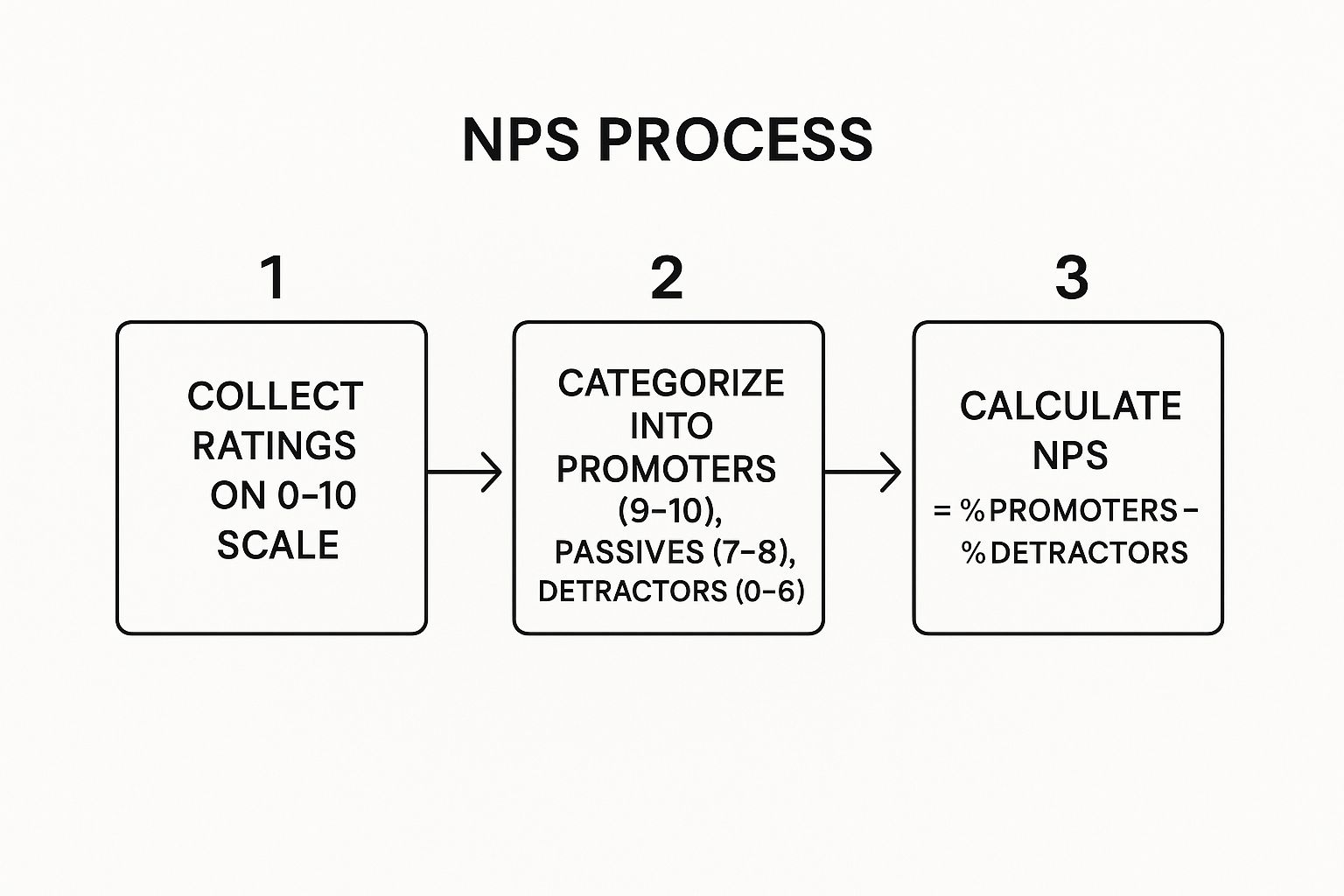
This visual breakdown shows that the power of NPS comes from its structured categorization, turning a simple 0-10 rating into a clear indicator of brand health by focusing on the most passionate customer segments.
Strategic Application and Takeaways
Companies like Apple and Airbnb use NPS not just to measure, but to act. Apple tracks loyalty across its product lines, while Airbnb uses post-stay surveys to refine the experience for both guests and hosts. The key is to move beyond the score itself.
Actionable Tips:
- Ask "Why?": Always follow the rating question with an open-ended question like, "What is the primary reason for your score?" This qualitative feedback is where the real insights lie.
- Close the Loop: Create a system to respond to feedback. Thank Promoters and encourage advocacy. More importantly, contact Detractors within 24-48 hours to understand their issues and offer solutions.
- Segment Your Data: Analyze NPS scores by customer journey stage, demographic, or product line to identify specific friction points and opportunities. This helps pinpoint exactly where improvements are needed.
2. Customer Journey Mapping with Voice of Customer
Customer journey mapping is a method for visualizing the entire experience a customer has with your brand. It becomes one of the most powerful voice of customer examples when you enrich it with direct customer feedback, emotions, and pain points at every single touchpoint. This process combines behavioral data with qualitative insights to create a comprehensive narrative, showing the customer's experience from their perspective.
A journey map tracks a customer's path from initial awareness through to purchase and long-term advocacy. By layering VoC data, such as survey feedback, support tickets, and review comments, onto this path, you transform a simple process diagram into a dynamic tool for understanding customer feelings and frustrations.
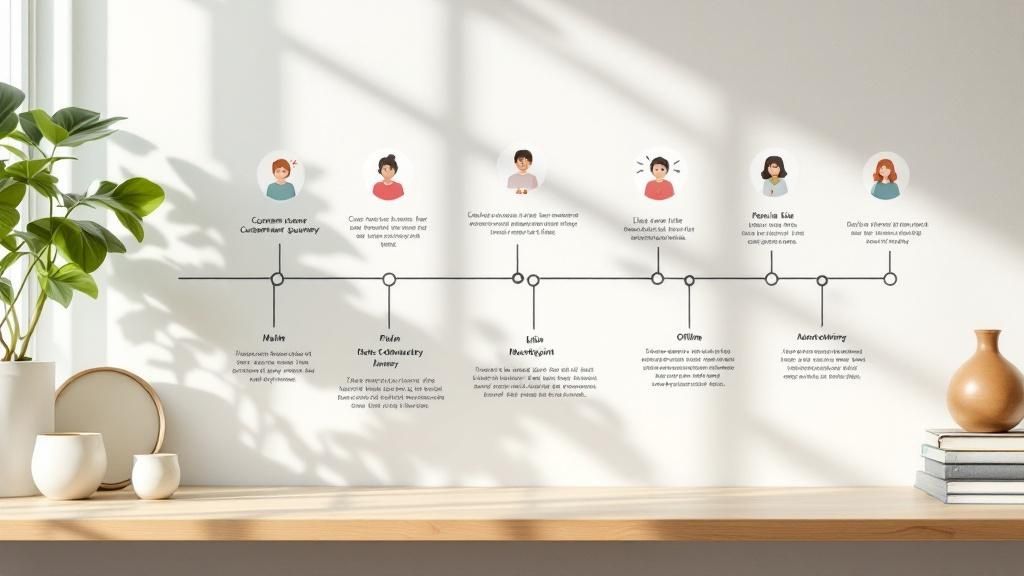
This visual approach helps teams empathize with customers, identify critical friction points, and pinpoint opportunities for improvement that might otherwise go unnoticed.
Strategic Application and Takeaways
Companies renowned for their customer experience, like Disney and Starbucks, use journey mapping to orchestrate seamless interactions. Disney maps guest experiences to manage emotions and create "magical moments" in its theme parks, while Starbucks analyzes journeys across its mobile app and in-store channels to ensure consistency. The goal is to see the business through the customer's eyes.
Actionable Tips:
- Focus on a Persona: Start with one specific customer segment or persona. Trying to map everyone's journey at once can become overwhelming and less effective.
- Incorporate Real Feedback: Use actual customer quotes, ratings, and emotional indicators (like happy or frustrated emojis) throughout the map to represent their feelings at each stage.
- Collaborate Cross-Functionally: Involve representatives from all customer-facing departments, including support, sales, and marketing. This ensures a holistic view and fosters shared ownership of the customer experience.
- Keep it Current: A journey map is a living document. Update it regularly with new customer insights to reflect changes in your products, services, or customer expectations. You can get started with a customer journey mapping template from blog.screendesk.io.
3. Social media listening and sentiment analysis
Social media listening offers one of the most unfiltered voice of customer examples by tapping into spontaneous, unsolicited conversations. It involves monitoring social platforms, forums, and review sites to capture what customers are saying about your brand, products, and competitors in real-time. This method moves beyond direct surveys to gather raw, authentic opinions.

This process is enhanced by sentiment analysis, which uses AI to automatically categorize mentions as positive, negative, or neutral. It helps teams quantify public perception and identify emerging trends or potential crises before they escalate, turning the vast noise of the internet into structured, actionable data.
Social Listening in Action
The real power of this approach lies in its proactive nature. Instead of waiting for customers to submit a support ticket, you can identify and address issues as they surface publicly.
- Netflix actively monitors social media chatter, especially on platforms like X (formerly Twitter), to gauge immediate reactions to new show releases and trailers. This feedback helps them understand audience reception and informs marketing strategies.
- Tesla famously uses social media as a direct line for product feedback. Engineers and executives often analyze online discussions to identify common complaints or feature requests, which can directly influence software updates and future product designs.
Strategic Application and Takeaways
Companies like McDonald's use social listening not just for crisis management but also to track brand health and campaign effectiveness. The key is to establish a system that translates social chatter into business intelligence.
Actionable Tips:
- Set Up Smart Alerts: Go beyond your brand name. Monitor keywords related to your products, common customer problems, and competitor names to get a comprehensive view of the market conversation.
- Engage Authentically: When you respond to social media feedback, avoid generic corporate-speak. Personalize your interactions to show that a real person is listening and genuinely wants to help.
- Combine AI with Human Insight: Automated sentiment analysis is a great starting point, but it can miss sarcasm and nuance. Have a human team review flagged conversations to understand the full context before taking action.
- Track Trends, Not Just Mentions: Focus on the overall shift in sentiment over time. A single negative post is an anecdote; a sustained increase in negative sentiment is a trend that requires strategic intervention.
4. Post-Interaction Customer Satisfaction (CSAT) Surveys
Customer Satisfaction (CSAT) surveys are a targeted method for measuring customer contentment with a specific, recent interaction. Unlike broader loyalty metrics, CSAT provides immediate, high-context feedback. It’s a crucial voice of customer example for its ability to pinpoint satisfaction at key touchpoints, asking a direct question like, "How satisfied were you with your recent support call?" This immediacy makes the feedback highly relevant and actionable.
The survey typically uses a simple scale (e.g., 1-5, emojis, or "Unsatisfied" to "Very Satisfied") to gauge the customer's feeling about a single event. A CSAT score is then calculated as the percentage of "satisfied" respondents (e.g., those who chose 4 or 5 on a 5-point scale).
Capturing In-the-Moment Feedback
CSAT's strength lies in its timing. By deploying the survey immediately after a purchase, support ticket resolution, or service appointment, companies capture the customer's feelings while the experience is still fresh. This immediate loop prevents memory decay and delivers a precise verdict on a specific operational process. For example, Uber prompts for a ride rating the moment a trip ends, and Zappos sends a survey right after a customer service call is completed, linking the feedback directly to the interaction and the agent involved.
This process transforms a routine interaction into a data collection opportunity. It gives a voice to customers at the most critical moments, allowing teams to measure the performance of individual agents, channels, or processes with exceptional clarity.
Strategic Application and Takeaways
Companies like Amazon and Uber use CSAT not just to measure, but to manage their service ecosystems in real-time. Amazon uses post-delivery ratings to monitor seller and delivery carrier performance, while Uber uses post-ride ratings to maintain driver quality and passenger safety standards.
Actionable Tips:
- Keep it Brief: Limit your survey to one to three questions. The primary CSAT question is essential; any follow-up should be a simple, open-ended "Why?" to gather qualitative context.
- Time it Right: Deploy the survey immediately after the interaction concludes. For a support chat, this could be in the chat window itself. For a purchase, it could be on the confirmation page or in an email sent minutes later.
- Segment Your Results: Analyze CSAT scores by agent, team, support channel (phone, email, chat), or interaction type (e.g., billing query vs. technical issue). This segmentation reveals specific strengths and weaknesses in your service delivery.
- Act on Dissatisfaction: Create an automated workflow to alert a manager or senior agent when a customer leaves a low CSAT score. A prompt follow-up can turn a negative experience into a positive one and prevent customer churn.
5. Customer Advisory Boards and Focus Groups
Customer Advisory Boards (CABs) and focus groups are structured, high-touch methods for gathering deep qualitative insights. They represent one of the most direct voice of customer examples, bringing a curated group of customers into direct conversation with a company. While focus groups are often one-time events centered on a specific topic, CABs involve building long-term relationships with key strategic customers.
These forums go beyond simple feedback collection; they create a collaborative environment. Customers can discuss their needs, challenges, and aspirations in detail, providing a rich, contextual understanding of their experience.
- Customer Advisory Boards (CABs): Ongoing panels of strategic customers who provide high-level guidance on company direction, product roadmaps, and market trends.
- Focus Groups: One-off, facilitated discussions with a targeted customer segment to explore reactions to a new feature, marketing campaign, or specific user experience.
Companies use these methods to validate strategic decisions and co-create solutions with their most important users.
The In-Depth Feedback Process
The power of CABs and focus groups lies in their interactive and conversational nature. Unlike asynchronous surveys, they allow for follow-up questions, group discussion, and the observation of non-verbal cues. This direct engagement uncovers nuanced insights that quantitative data alone cannot reveal. The process involves careful participant selection, guided facilitation, and thorough analysis to transform conversations into strategic actions.
For instance, a B2B software company might use a CAB to get executive-level input on its five-year roadmap, while a consumer brand could run a focus group to test packaging concepts for a new product.
Strategic Application and Takeaways
Tech giants like Microsoft and Salesforce lean heavily on these methods. Microsoft's customer advisory boards are integral to its enterprise software development, ensuring new products meet complex user needs. Similarly, Slack uses customer panels to guide its product roadmap, ensuring updates resonate with its core user base. The goal is to make customers feel like valued partners.
Actionable Tips:
- Diversify Recruitment: Select a representative mix of customers. Include loyal advocates, new users, and even at-risk customers to get a balanced and holistic view of the market.
- Use a Discussion Guide: Prepare a structured agenda with key questions to ensure all critical topics are covered. However, allow for flexibility to explore unexpected insights that arise organically.
- Record and Transcribe: With permission, record all sessions. This allows your team to analyze the conversations later, capturing exact quotes, tone, and sentiment without relying on memory alone.
- Share the Impact: Close the feedback loop by informing participants how their input influenced decisions. This validates their contribution and strengthens their relationship with your brand.
6. Customer Support Interaction Analysis
Your customer support channels are a goldmine of direct, unfiltered customer feedback. Customer Support Interaction Analysis involves systematically reviewing conversations from chat logs, emails, and call recordings to pinpoint recurring issues and opportunities. This method provides one of the richest voice of customer examples by capturing the exact language customers use when they are frustrated, confused, or in need of help.

By transforming raw support conversations into structured data, you can uncover deep insights into product flaws, service gaps, and customer friction points that might otherwise go unnoticed. This process uses a combination of manual review and AI-powered text analytics to make sense of large volumes of unstructured data.
The Support Interaction Analysis Process
The core of this method is turning qualitative conversations into quantitative, actionable insights. Companies like Spotify use it to identify app functionality bugs reported by users, while American Express analyzes call center data to enhance card member services. The goal is to move from reactive problem-solving to proactive improvement.
This analysis focuses on:
- Theme Identification: What are the most common reasons customers contact support?
- Sentiment Analysis: Are customers expressing frustration, confusion, or satisfaction during interactions?
- Root Cause Discovery: Why are these issues occurring in the first place?
This structured approach ensures that the valuable voice of the customer heard by support agents is systematically captured and shared across the organization, informing product development, marketing, and operational strategies.
Strategic Application and Takeaways
Simply resolving support tickets is not enough. The true value lies in learning from each interaction to prevent future issues. Zendesk, a leader in customer service software, analyzes its own support interactions to find ways to improve its platform and help its customers succeed.
Actionable Tips:
- Standardize Your Tagging: Create a clear, consistent tagging system for all support tickets. Categorize issues by topic (e.g., "billing," "bug-report"), feature, and severity to enable accurate tracking.
- Use Verbatim Feedback: When presenting findings to product or engineering teams, use direct customer quotes. Hearing a problem in the customer's own words is far more impactful than a summarized report.
- Track Resolution Metrics: Analyze resolution times and customer satisfaction scores by issue type. This helps identify complex problems that may require better documentation or product changes. Improving first call resolution is a key outcome of this analysis. Learn more about improving first call resolution.
- Analyze Unresolved Cases: Don't just focus on successfully closed tickets. Escalated or unresolved cases often highlight the most significant gaps in your product or service.
7. Online Review and Rating Analysis
Online reviews are one of the most public and influential voice of customer examples available. This method involves the comprehensive monitoring and analysis of customer feedback left on third-party platforms like Google, Yelp, Amazon, or industry-specific sites like TripAdvisor. It provides a raw, unsolicited view of what customers truly think about your products, services, and overall brand experience.
The process goes beyond simply looking at star ratings. It requires a deep dive into the qualitative content of reviews to identify recurring themes, pain points, and moments of delight. These public platforms act as a continuous, real-time focus group, offering insights that are both direct and highly visible to potential new customers.
The Review Analysis Process
The analysis process transforms unstructured public commentary into strategic business intelligence. It starts with aggregating reviews from multiple sources, then categorizing the feedback to pinpoint specific drivers of satisfaction or dissatisfaction. This systematic approach allows companies to see patterns that might otherwise be missed.
For instance, Domino's actively monitors reviews on delivery apps to optimize everything from pizza quality to driver efficiency. Similarly, a hotel chain might use TripAdvisor feedback to identify underperforming locations or discover that a specific amenity, like a seamless check-in process, is a major driver of positive reviews across its properties. This converts public opinion into a roadmap for operational improvement.
Strategic Application and Takeaways
Companies that master review analysis gain a significant competitive edge. Samsung tracks Amazon and Best Buy reviews to inform product development and quality assurance, catching potential hardware issues early. The key is to treat these public platforms as a direct line to your customer base and a valuable source of market intelligence.
Actionable Tips:
- Centralize Your Monitoring: Use specialized customer feedback analysis tools to aggregate reviews from all relevant platforms into a single dashboard. This prevents silos and provides a holistic view.
- Respond Strategically: Develop a clear policy for responding to reviews. Thank positive reviewers and, more importantly, address negative feedback promptly and professionally to show you are listening and to mitigate public brand damage.
- Analyze Competitor Reviews: Don't just look at your own feedback. Monitor your competitors' reviews to identify their weaknesses and discover market gaps you can fill.
- Segment Review Data: Break down review trends by location, product, or date to uncover granular insights. Are negative reviews spiking for a particular product variant or in a specific region? This data helps you pinpoint problems with precision.
Voice of Customer Methods Comparison
| Method | Implementation Complexity 🔄 | Resource Requirements ⚡ | Expected Outcomes 📊 | Ideal Use Cases 💡 | Key Advantages ⭐ |
|---|---|---|---|---|---|
| Net Promoter Score (NPS) Surveys | Low (Simple rating scale, easy deployment) | Low (Basic survey tools needed) | Clear metric of customer loyalty, trend tracking | Track overall customer satisfaction and loyalty | Easy to implement; industry benchmarks; strong business correlation |
| Customer Journey Mapping with Voice of Customer | High (Requires extensive data collection and collaboration) | High (Cross-departmental involvement, ongoing research) | Holistic view of customer experience; identifies pain points and emotions | Understand end-to-end experience for targeted improvements | Detailed insights; promotes organizational alignment; empathy building |
| Social Media Listening and Sentiment Analysis | Medium-High (Setup of monitoring and AI tools required) | Medium (Software platforms, analyst resources) | Real-time sentiment trends and crisis detection | Monitor unsolicited feedback and industry trends | Captures authentic feedback; large volume data; competitive insights |
| Post-Interaction Customer Satisfaction (CSAT) Surveys | Low (Short surveys triggered by specific events) | Low (CRM and survey integrations) | Immediate satisfaction feedback tied to specific interactions | Measure satisfaction post support or purchase | High response rates; specific actionable feedback; quick issue ID |
| Customer Advisory Boards and Focus Groups | High (Scheduling, facilitation, and qualitative analysis) | High (Time, incentives, logistics) | Deep, nuanced qualitative insights; relationship building | In-depth feedback on products or concepts | Rich insights; real-time discussion; tests concepts pre-launch |
| Customer Support Interaction Analysis | Medium-High (Requires advanced text analytics tools and skills) | Medium-High (AI tools, skilled analysts) | Identification of recurring issues and systemic problems | Analyze support communications for improvement | Uses existing data without extra customer effort; identifies root causes |
| Online Review and Rating Analysis | Medium (Aggregation and sentiment tools needed) | Medium (Monitoring multiple platforms) | Understanding public customer sentiment and competitive positioning | Reputation management and competitive benchmarking | Publicly available data; large volume; SEO and marketing impact |
Turning Customer Insights into Your Competitive Advantage
Throughout this guide, we've explored a diverse collection of voice of customer examples, moving beyond simple definitions to showcase real-world applications. From the high-level metrics of Net Promoter Score (NPS) surveys to the deep, qualitative insights gained from analyzing customer support interactions, one truth becomes clear: a successful Voice of Customer (VoC) program is not built on a single method. It’s a dynamic, multi-layered strategy that weaves together different listening posts to create a comprehensive understanding of your customer's experience.
The journey from data collection to strategic action is where true value is created. It's not enough to simply launch a CSAT survey or monitor social media mentions. The real power lies in connecting the dots between these disparate sources of feedback.
Key Takeaways: From Listening to Leading
To transform your support team from a reactive problem-solver to a proactive growth engine, focus on these core principles:
- Blend Quantitative and Qualitative Data: Combine the "what" (metrics like NPS and CSAT scores) with the "why" (insights from support ticket analysis, focus groups, and customer journey maps). A number tells you a problem exists; a customer's own words tell you how to fix it.
- Embed VoC Across the Journey: Don't wait for a customer to complain. Proactively seek feedback at key touchpoints, such as after a purchase, following a support interaction, or during onboarding. This provides a continuous stream of relevant, timely insights.
- Empower Your Support Team: Your customer support agents are on the front lines, hearing the unfiltered voice of the customer every single day. Equip them with the tools and training to not only solve issues but also to capture, categorize, and escalate the valuable feedback they receive.
Actionable Next Steps for Your VoC Program
The most impactful voice of customer examples demonstrate a clear commitment to action. Listening without acting is worse than not listening at all, as it erodes customer trust.
- Start Small, Then Scale: You don't need to implement all seven methods at once. Begin with one or two that address your most pressing business needs. For instance, start with post-interaction surveys to immediately improve your support quality.
- Create a Feedback Loop: The most critical step is closing the loop. When you implement a change based on customer feedback, communicate it back to your customers. This shows you are listening and that their voice has a tangible impact, fostering immense loyalty.
- Invest in the Right Technology: Modern tools are essential for capturing and analyzing customer feedback efficiently. Technology can help you see the real-time context behind a customer's issue, turning a vague complaint into a clear, actionable insight.
Ultimately, mastering the voice of the customer means shifting your organization's mindset. It’s about cultivating a culture of curiosity and empathy where every team member feels responsible for the customer experience. By actively listening, deeply analyzing, and decisively acting on what you learn, you don’t just build better products or services. You build unbreakable customer relationships and a sustainable competitive advantage.
Ready to capture the most authentic Voice of Customer feedback? Screendesk empowers your team to see issues exactly as your customers do with asynchronous video recordings and co-browsing. Stop guessing and start seeing by integrating clear, visual customer context directly into your support workflow. Learn more about Screendesk and transform your customer support today.
