


In today's competitive market, simply providing 'good' service is no longer a differentiator. True success lies in a systematic and relentless pursuit of service quality improvement. This isn't just about smiling agents and quick responses; it's about building robust processes that consistently exceed customer expectations and turn satisfaction into loyalty. For any business aiming to achieve exceptional service, understanding and optimizing the critical role of customer care is fundamental to growth and customer retention.
But where do you begin? How do you move from abstract goals to concrete actions? This article provides a roundup of seven proven methodologies and frameworks designed to systematically elevate your service delivery. From data-driven analysis to customer-centric mapping, these strategies offer a clear roadmap for tangible progress.
We'll explore how modern tools like Screendesk can supercharge these traditional models, making complex issue resolution faster and more human. For example, when applying Customer Journey Mapping, a support agent can use Screendesk's video recordings to see exactly where a user gets stuck, providing a level of insight that traditional surveys can't match. Prepare to transform your approach to service and build a lasting competitive edge.
1. Implement the SERVQUAL Model to Measure and Manage Expectations
A fundamental step in any service quality improvement strategy is to first understand where you stand. The SERVQUAL model provides a proven, structured framework for doing just that. It moves beyond simple satisfaction scores to measure the specific gap between what customers expect from your service and the service they perceive they actually received.
This method dissects the customer experience into five distinct dimensions:
- Tangibles: The physical appearance of your facilities, equipment, personnel, and communication materials. For a software company, this includes the design and usability of your website and support portal.
- Reliability: Your ability to perform the promised service dependably and accurately. Can customers count on your software to work as advertised?
- Responsiveness: The willingness to help customers and provide prompt service. How quickly and eagerly do your agents respond to support requests?
- Assurance: The knowledge and courtesy of your employees and their ability to inspire trust and confidence.
- Empathy: The caring, individualized attention you provide to customers. Do customers feel heard and understood?
By surveying customers on these five pillars, you can collect quantifiable data that pinpoints exactly where your service is falling short.
Putting SERVQUAL into Action
Imagine your SERVQUAL survey reveals a low score in the Responsiveness dimension. Customers feel that resolving their issues takes too long and involves too much back-and-forth. This is a clear, data-backed signal that your support processes need an upgrade.
Instead of another lengthy email chain, an agent can use a tool like Screendesk to immediately escalate the interaction. They can launch a co-browsing session to see the customer’s screen in real-time or start a video call to provide a face-to-face explanation. This direct intervention dramatically cuts down resolution time and directly addresses the responsiveness gap identified by your survey.
Key Takeaway: The SERVQUAL model transforms the abstract goal of "improving service" into a concrete, measurable mission. It gives you a roadmap, showing you not only that you need to improve but precisely where to focus your efforts for the greatest impact.
2. Adopt Six Sigma to Eliminate Service Defects
Originally developed for manufacturing, Six Sigma is a powerful, data-driven methodology that has been brilliantly adapted for service quality improvement. It focuses on a single, crucial goal: reducing process variation to eliminate defects. In a service context, a "defect" is anything that fails to meet customer expectations, from a long wait time to an incorrect billing statement.
Six Sigma uses a systematic five-phase framework called DMAIC to tackle problems:
- Define: Clearly identify the problem, the project goals, and the customer deliverables. What specific service process is failing?
- Measure: Collect data to quantify the performance of the current process. How often does this defect occur?
- Analyze: Use the data to find the root cause of the defect. Why is this problem happening?
- Improve: Develop, test, and implement solutions to eliminate the root cause.
- Control: Put measures in place to sustain the gains and monitor the improved process over time.
This disciplined approach allows companies like GE Capital to slash loan processing times and American Express to streamline credit card applications, achieving massive gains in efficiency and customer satisfaction.
Putting Six Sigma into Action
Imagine a software company analyzing its support process using Six Sigma. The Define phase identifies that "multiple agent handoffs" is a major problem leading to customer frustration. In the Measure phase, data shows that 40% of complex tickets are transferred at least twice, significantly increasing resolution time. The Analyze phase reveals the root cause: first-line agents lack the tools to diagnose and resolve issues on the initial call.
To Improve this, the company implements Screendesk. Now, instead of transferring the ticket, an agent can initiate a co-browsing or video chat session. This empowers them to see the customer's issue firsthand, guide them through a fix, and resolve the problem on the spot. The final Control phase involves monitoring first-contact resolution rates to ensure the improvement is sustained.
Key Takeaway: Six Sigma provides a rigorous, statistical framework to systematically dismantle your most persistent service problems. It moves beyond guesswork, using hard data to drive decisions that produce consistent, predictable, and high-quality service outcomes.
3. Map the Entire Customer Journey with Service Blueprinting
While measuring perception is crucial, another powerful tool for service quality improvement involves visualizing the entire service process from start to finish. Service blueprinting is a technique that creates a detailed diagram of your service delivery, mapping every action, interaction, and process that a customer experiences, both seen and unseen.
It provides a holistic view of the service ecosystem, connecting the customer's journey with the employee actions and behind-the-scenes support processes that make it all happen. This visual map helps you identify potential bottlenecks, redundancies, and critical failure points that might otherwise go unnoticed.
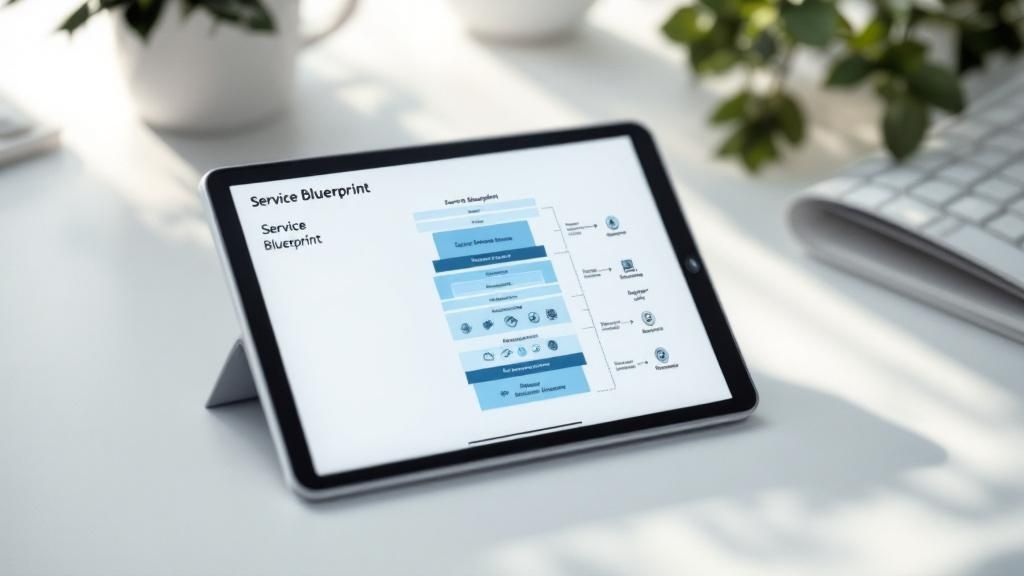
This method breaks down the service into key components:
- Customer Actions: The steps the customer takes as they interact with your company (e.g., visiting the website, submitting a ticket, joining a call).
- Onstage Actions: The visible activities performed by front-line employees that the customer sees (e.g., an agent's email response, a live chat message).
- Backstage Actions: The behind-the-scenes activities that support the onstage actions but are invisible to the customer (e.g., an agent consulting a knowledge base or escalating an issue to a Tier 2 team).
- Support Processes: The internal systems and steps that enable employees to deliver the service (e.g., CRM software, ticketing systems, internal communication channels).
Putting Service Blueprinting into Action
Imagine your service blueprint reveals a major pain point: when a customer reports a complex software bug, the support process involves multiple handoffs between agents and developers. This backstage inefficiency creates long delays and frustrating onstage interactions for the customer.
By visualizing this, you can redesign the workflow. Instead of a linear handoff, a support agent using a tool like Screendesk can initiate a collaborative session that includes both the customer and a developer. The agent can co-browse with the customer to replicate the bug, while the developer observes in real-time or even joins the video call to ask targeted technical questions. This instantly streamlines the backstage process, leading to a faster, more transparent resolution for the customer.
Key Takeaway: Service blueprinting acts like an X-ray for your service operations. It reveals the complete anatomy of the customer experience, allowing you to surgically improve processes, eliminate friction, and ensure that every backstage action is perfectly aligned with delivering an exceptional onstage performance.
4. Map the Customer Journey to Identify Critical Touchpoints
To truly elevate your service, you must see the experience through your customer's eyes. A customer journey map is a powerful strategic tool that provides this perspective. It visually charts every single interaction a customer has with your company, from their first moment of awareness to post-purchase support and beyond, helping you achieve significant service quality improvement.

This process goes far beyond a simple flowchart. A comprehensive map details the customer's actions, thoughts, and emotional state at each touchpoint. It uncovers the "moments of truth" where service quality can make or break the entire experience. By identifying points of friction and opportunities for delight, you can strategically allocate resources to the areas that matter most.
Key components of an effective journey map include:
- Stages: The major phases of the customer lifecycle (e.g., Awareness, Consideration, Purchase, Service, Loyalty).
- Touchpoints: The specific interactions within each stage (e.g., visiting the website, reading a review, contacting support).
- Customer Actions & Thoughts: What the customer is doing and thinking at each touchpoint.
- Emotional State: The customer's feelings, often charted as a line graph showing highs and lows.
- Pain Points: The specific frustrations or obstacles the customer encounters.
Putting Customer Journey Mapping into Action
Imagine your map reveals a major emotional dip during the "Service" stage. Customers who need technical support start with a positive outlook but quickly become frustrated when they have to explain their complex issue repeatedly through email. This is a critical pain point that is damaging their overall perception of your brand.
Armed with this insight, a support team can proactively improve this touchpoint. When a customer describes a complicated software problem, the agent can use a tool like Screendesk to bypass the frustrating back-and-forth. By initiating a co-browsing or video chat session, the agent can see the problem live, take control to fix it directly, and resolve the issue in a single, positive interaction. This transforms a moment of friction into a moment of assurance and relief.
Key Takeaway: Customer journey mapping shifts your focus from isolated internal processes to the complete, end-to-end customer experience. It provides a clear, empathetic blueprint for identifying and fixing the exact moments that undermine service quality, turning potential frustrations into memorable, positive outcomes. You can use a customer journey mapping template to start this process.
5. Adopt Lean Service Management to Eliminate Waste
Originating from the world-renowned Toyota Production System, the principles of Lean management are incredibly effective for service quality improvement. This approach systematically seeks to eliminate "waste" from your service processes, where waste is defined as any activity that consumes resources but doesn't create value for the customer. The goal is to streamline your operations, reduce variation, and improve the flow of service delivery from start to finish.
This method identifies several types of waste in a service context, including:
- Delays: Customers waiting for a response, an answer, or a resolution.
- Duplication: Asking a customer for the same information multiple times.
- Unnecessary Movement: Transferring a customer between multiple agents or departments.
- Errors: Providing incorrect information or faulty solutions that require rework.
- Over-processing: Creating complex internal processes for simple customer requests.
By identifying and systematically removing these non-value-added activities, you can deliver a faster, more efficient, and higher-quality service experience.
Putting Lean Service Management into Action
A core practice in Lean is Value Stream Mapping, where you visualize every step of a customer interaction, from initial contact to resolution. Imagine you map your technical support process and discover that customers with complex software issues are frequently transferred between Level 1 and Level 2 agents, creating delays and duplication. This is a clear point of waste.
To eliminate this, a Level 1 agent can use a tool like Screendesk to instantly escalate the issue without a handoff. By initiating a co-browsing or video call session, the agent can bring a Level 2 specialist directly into the ongoing conversation. The specialist can see the problem on the customer's screen, diagnose it in real-time, and guide the customer to a solution immediately. This lean approach cuts out the wasteful transfer step, reducing resolution time and improving the customer's perception of your service.
Key Takeaway: Lean Service Management shifts the focus from simply working harder to working smarter. By mapping your processes and ruthlessly cutting out activities that don't add value for the customer, you can achieve significant gains in both efficiency and service quality.
6. Foster a Culture of Continuous Improvement with Total Quality Management (TQM)
While specific models and tools are powerful, a truly sustainable service quality improvement strategy requires a cultural shift. This is where Total Quality Management (TQM) comes in. TQM is a management philosophy where every single employee, from the CEO to the frontline agent, is committed to continuously improving processes, products, and services to meet and exceed customer expectations.
TQM isn't a one-off project; it’s a comprehensive, organization-wide mindset. It integrates all functions of a business with a singular focus on quality. This philosophy is built on several core principles:
- Customer-Focus: The entire organization orients itself around the needs and feedback of the customer.
- Total Employee Involvement: All employees are empowered and trained to participate in quality improvement efforts, not just a dedicated quality team.
- Process-Centered: Problems are seen as issues within processes, not failures of individuals. The focus is on refining the system.
- Continuous Improvement (Kaizen): The organization perpetually seeks small, incremental improvements to its operations and services.
This approach was famously used by companies like Ritz-Carlton to embed legendary service standards and by Federal Express to build unmatched reliability into its logistics.
Putting TQM into Action
Imagine a software support team notices a recurring type of customer complaint about a specific feature being confusing. In a traditional setup, agents might just keep answering the same ticket. In a TQM culture, this pattern is flagged as a process issue.
A cross-functional team, including a support agent, a developer, and a UX designer, is formed. The agent uses Screendesk to pull up anonymized session replays and screen recordings of customers struggling with the feature. Seeing the issue firsthand gives the developer and designer immediate, clear context. The team collaborates to redesign the feature's interface and update the knowledge base, addressing the root cause of the problem. This prevents countless future tickets and dramatically improves the user experience.
Key Takeaway: TQM institutionalizes the pursuit of quality. Instead of being a periodic initiative, it becomes part of the company's DNA, ensuring that every employee is an active participant in the mission of service quality improvement. It transforms your team from reactive problem-solvers into proactive quality champions. To track your progress, you'll need robust data, so be sure to establish clear quality metrics and measure them regularly.
7. Launch a Mystery Shopping Program for Unbiased Insights
To truly understand the customer experience, you need to see your service through their eyes. A mystery shopping program is a powerful market research technique that provides an objective, firsthand look at your actual service delivery. It involves sending trained, anonymous evaluators to pose as regular customers and assess their experience against predefined criteria.
This method moves beyond internal metrics to reveal what really happens during a customer interaction. It uncovers discrepancies between documented standards and on-the-ground performance. A mystery shopper can evaluate key elements like:
- Process Compliance: Did the agent follow the correct troubleshooting or onboarding steps?
- Brand Standards: Was the tone of voice and language used consistent with brand guidelines?
- Service Environment: For digital services, this includes the ease of navigating the support portal or initiating a chat.
- Agent Attitude: Was the agent patient, professional, and genuinely helpful?
- Resolution Quality: Was the problem solved efficiently and effectively on the first contact?
By gathering this qualitative data, you gain a clear, unbiased picture of the service your customers receive, which is a cornerstone of any genuine service quality improvement effort.
Putting Mystery Shopping into Action
Imagine a software company wants to ensure its support agents are providing not just technically correct answers, but also a reassuring and user-friendly experience. A mystery shopper could be tasked with contacting support with a common, but slightly tricky, user problem. The evaluator would report on the entire journey: from the initial wait time to the agent's problem-solving approach and communication style.
If the mystery shopper reports that the agent struggled to explain a complex solution over the phone, leading to confusion, this provides a specific coaching opportunity. Instead of just relying on a verbal explanation, the agent could be trained to use a tool like Screendesk. By initiating a co-browsing or screen-sharing session, the agent can guide the customer visually, pointing directly to the features and settings in question. This hands-on approach simplifies complex instructions and dramatically improves the customer's understanding and confidence. Similarly, companies like Starbucks have long used these principles to ensure a consistent, high-quality experience at every location, a concept you can adapt for your digital touchpoints. You can learn more about the customer support lessons from the Starbucks experience.
Key Takeaway: Mystery shopping provides an unvarnished view of your service reality. It helps you identify specific behavioral and procedural gaps, turning abstract standards into concrete, coachable actions that directly enhance the customer experience.
Service Quality Improvement: 7-Method Comparison
| Methodology | Implementation Complexity 🔄 | Resource Requirements ⚡ | Expected Outcomes 📊 | Ideal Use Cases 💡 | Key Advantages ⭐ |
|---|---|---|---|---|---|
| SERVQUAL Model | Moderate: standardized 22-item survey | Low to moderate: survey design and analysis | Quantitative gap analysis of service quality; benchmarking | Measuring customer satisfaction across hospitality, banking, healthcare, retail | Actionable metrics; industry-validated; easy to understand |
| Six Sigma for Services | High: requires DMAIC training and cultural change | High: training, data analysis, certification | Process improvement; defect reduction; cost savings; increased satisfaction | Complex service processes needing systematic quality improvements | Data-driven; measurable results; fosters continuous improvement |
| Service Blueprinting | Moderate to high: visual mapping and collaboration | Moderate: workshops and updates | Holistic understanding of service processes; identification of failure points | Service design; cross-functional process improvements | Comprehensive process visualization; improves collaboration |
| Customer Journey Mapping | Moderate: requires customer data and cross-team inputs | Moderate: research and mapping tools | Enhanced customer empathy; identification of pain points and opportunities | Customer experience optimization; omnichannel strategies | Customer-centric; reveals emotional journey; supports targeted improvements |
| Lean Service Management | High: cultural change and process standardization | Moderate to high: training and process redesign | Reduced waste; improved flow; cost and time savings; increased reliability | Services with repetitive processes needing waste elimination | Waste reduction; faster service; sustainable improvement culture |
| Total Quality Management | High: organization-wide commitment and training | High: comprehensive involvement and measurement | Long-term quality culture; improved satisfaction and competitive advantage | Large organizations aiming for total quality integration | Holistic quality management; employee empowerment; continuous improvement |
| Mystery Shopping Programs | Low to moderate: evaluator recruitment and assessment design | Moderate: evaluator training and reporting | Objective assessment of service performance; identification of gaps and training needs | Retail, hospitality, banking sectors wanting unbiased service audits | Unbiased insights; benchmarking; accountability for standards |
From Plan to Performance: Your Next Steps in Service Excellence
Embarking on a journey of service quality improvement is not just a project; it's a fundamental commitment to your customers and your company's future. Throughout this guide, we've explored a powerful arsenal of seven distinct frameworks, each offering a unique lens through which to view and elevate your customer interactions. The common thread connecting them all is a strategic shift away from reactive problem-solving toward a proactive, systematic approach to building excellence.
The path to exceptional service isn't about finding a single magic bullet. It's about understanding the specific challenges and opportunities within your organization. Whether you're drawn to the diagnostic precision of the SERVQUAL model to pinpoint gaps or the efficiency-driven principles of Lean Service Management to eliminate waste, the right framework exists to guide your efforts.
Turning Insights into Action
The key is to move from theory to practice. Don't let these powerful methodologies remain as concepts in a document. True transformation happens when you commit to a plan and empower your team to execute it. As we've seen, modern tools are essential accelerators in this process, turning abstract principles into tangible results.
Your most critical takeaways from this journey should be:
- Systematic Approach is Key: Lasting service quality improvement rarely happens by accident. It requires a structured framework like Six Sigma, TQM, or Service Blueprinting to create repeatable, high-quality outcomes.
- Customer Perspective is Paramount: Methodologies like Customer Journey Mapping and Mystery Shopping force you to walk in your customers' shoes. This outside-in perspective is invaluable for uncovering friction points you would otherwise miss.
- Technology is a Catalyst: Implementing these frameworks is significantly easier and more effective with the right tools. Platforms like Screendesk close communication gaps and provide the data-driven insights needed to validate your improvement initiatives.
Your Next Steps on the Path to Excellence
The ultimate goal of any service quality improvement initiative is to transform your support function from a necessary cost center into your most potent competitive advantage. In a crowded marketplace, superior service is a powerful differentiator that builds loyalty, drives positive word-of-mouth, and directly impacts your bottom line.
Start small but think big. Select one framework that resonates most with your current challenges. Assemble a dedicated team and launch a pilot project focused on a specific service or customer segment. Measure your baseline, implement the changes, and track your progress meticulously. This initial success will build the momentum and internal buy-in needed to scale your efforts across the entire organization. The journey to service excellence is continuous, but it begins with a single, decisive step.
Ready to supercharge your service quality improvement efforts? Screendesk provides the visual context and collaborative tools your team needs to resolve issues faster and understand the customer experience on a deeper level. See how our no-download, interactive screen sharing can transform your support workflows by visiting Screendesk today.
