


In today's competitive subscription economy, acquiring new customers is only half the battle. True, sustainable growth comes from keeping the customers you have already earned. The challenge, however, is that customer loyalty is more fragile than ever. A single poor experience or a failure to see value can quickly lead to cancellation.
This article moves beyond generic advice and dives deep into eight powerful, actionable strategies for reducing customer churn. We will explore how modern approaches, from predictive analytics to advanced video-based support tools, can transform your retention efforts from reactive damage control into a proactive growth engine.
By implementing these proven methods, you can not only lower your churn rate but also significantly increase customer lifetime value. You'll learn how to build a more resilient business by focusing on proactive retention. This guide provides the specific, practical steps needed to turn customer satisfaction into a predictable and scalable source of revenue for 2025 and beyond.
1. Perfect Your Customer Onboarding for Immediate Value
First impressions dictate the entire customer lifecycle. A clunky, confusing, or unguided start is a primary driver of early customer churn. The goal of onboarding isn't just to show new users your product’s features; it’s to guide them to their first moment of success, the "aha moment," as quickly as possible. This initial win solidifies their purchase decision and demonstrates tangible value, setting a positive tone for the relationship. A strong onboarding process is a critical first step in reducing customer churn from the very beginning.
How to Implement Proactive Onboarding
Effective onboarding moves beyond a simple product tour. It’s a strategic process that actively guides users toward achieving their goals. This requires a shift from feature-focused introductions to outcome-oriented guidance.
- Segment Your Onboarding: Not all users have the same goals. Create personalized onboarding paths based on user roles, goals, or subscription tiers. A marketing manager needs a different starting point than a sales representative.
- Use an Onboarding Checklist: Provide a clear, step-by-step checklist within your app. This gamifies the process and gives users a sense of accomplishment as they complete key setup tasks, such as importing data or inviting a team member.
- Leverage Video: Instead of long help articles, use short, screen-recorded videos to show users exactly how to perform critical tasks. A two-minute video demonstrating how to set up their first project is far more effective than a page of text.
Key Insight: A successful onboarding experience makes the user feel smart and capable. It should empower them by showing them how to solve their specific problem with your tool, not just overwhelm them with a tour of every button and menu.
By focusing on immediate value and a clear path to success, you build a strong foundation. This early engagement ensures customers integrate your product into their workflow, making it indispensable and significantly lowering the likelihood of them looking for alternatives.
2. Leverage Predictive Churn Analytics to Intervene Early
Waiting for customers to complain or cancel is a reactive strategy that guarantees lost revenue. A proactive approach involves using predictive churn analytics to identify at-risk customers before they decide to leave. This strategy uses machine learning and data analysis to spot subtle shifts in user behavior, such as decreased feature usage, fewer logins, or a drop in support tickets. By predicting who is likely to churn, you can intervene with targeted support, special offers, or educational content, effectively preventing churn before it happens. This data-driven method is crucial for reducing customer churn at scale.
How to Implement Predictive Churn Analytics
Implementing predictive analytics doesn't require a team of data scientists from day one. You can start with simple models and build complexity over time. The key is to focus on leading indicators, which are behaviors that precede churn, rather than lagging indicators like a cancellation request.
- Combine Data Sources: For the most accurate predictions, pull data from multiple sources. Combine product usage data (e.g., features used, session length) with CRM data (e.g., support history, contract value) and customer feedback.
- Focus on Key Behavioral Metrics: Track leading indicators like a decline in Customer Health Score, which aggregates multiple engagement points into a single metric. Also, monitor Engagement Velocity, or the rate at which a user's activity is increasing or decreasing.
- Automate Proactive Outreach: Set up automated workflows that trigger when a customer's churn risk score passes a certain threshold. This could initiate a personalized email from a customer success manager or an in-app offer for a training session.
Key Insight: Predictive analytics shifts your customer retention efforts from reactive problem-solving to proactive relationship-building. Instead of asking "why did they leave?", you start asking "who is at risk of leaving, and how can we help them succeed?"
The following chart visualizes three core metrics used in a predictive churn model: churn probability segments, customer health score trends, and engagement velocity.
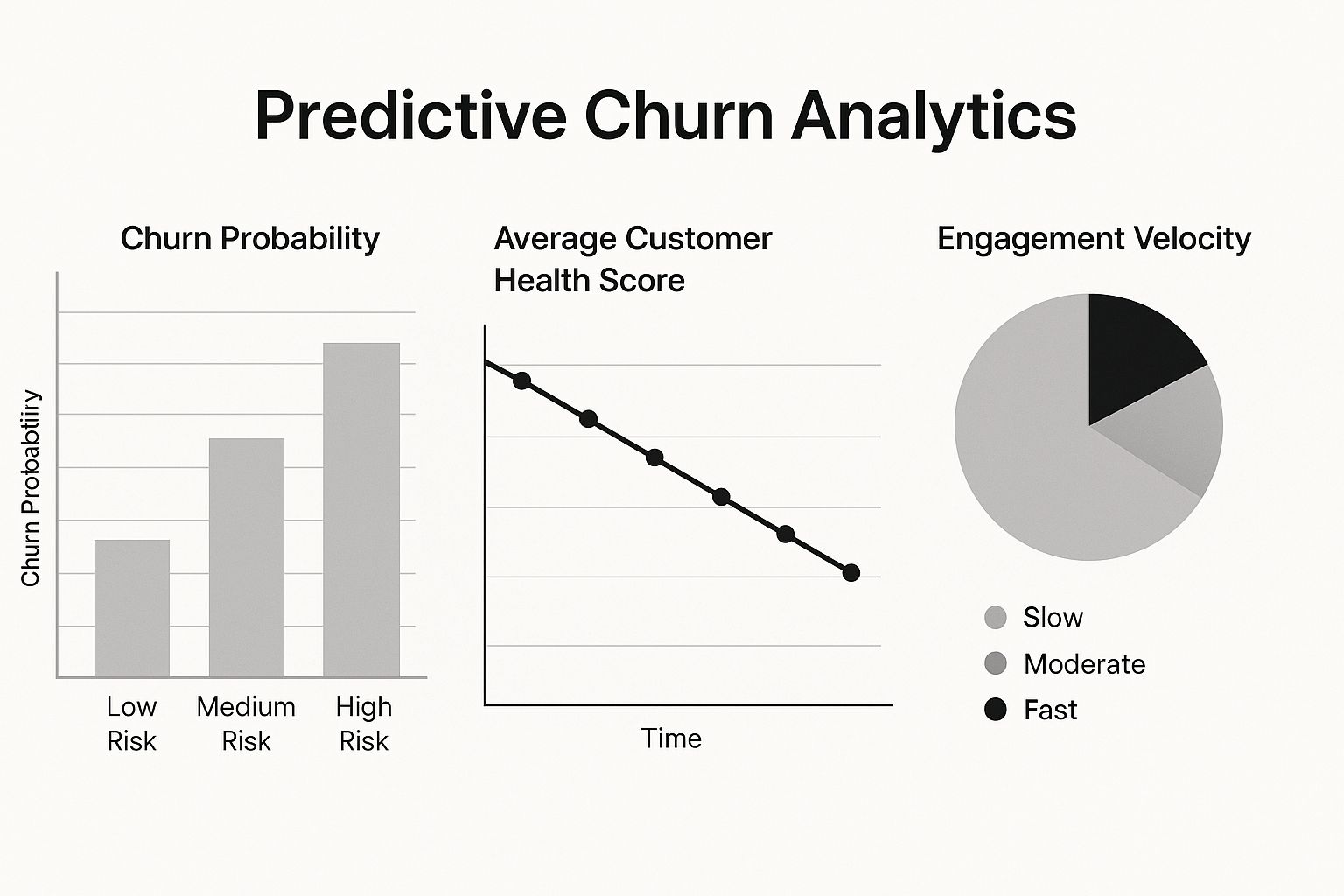
This data shows that as the customer health score declines over time, churn probability in the high-risk segment rises, highlighting a direct correlation between engagement and retention. By identifying customers whose health scores are trending downward, you can deploy retention campaigns before they enter a critical churn-risk phase.
3. Proactive Customer Success Management
Waiting for customers to report problems is a reactive stance that inevitably leads to churn. Proactive Customer Success Management (CSM) flips this model by dedicating resources to ensure customers are consistently achieving their desired outcomes. Instead of simply providing support, a customer success manager (CSM) builds a relationship, monitors account health, and actively guides the customer toward greater value. This human-focused strategy is a powerful method for reducing customer churn by transforming your role from a vendor into an indispensable partner.

How to Implement Proactive Customer Success
Effective CSM is not just about check-in calls; it's a data-driven, strategic function designed to drive product adoption and prove ROI. This requires a formal process for engaging with and monitoring your customer base. A proactive approach moves beyond passive support and actively nurtures the customer relationship.
- Segment Your Customer Base: Not every customer needs the same level of attention. Segment your accounts by value, potential, or complexity, and assign appropriate touch levels. High-value enterprise clients might get a dedicated CSM, while smaller accounts could be managed through tech-touch or one-to-many programs.
- Establish and Track Health Scores: Use a customer success platform like Gainsight to create a customer health score. This metric should combine product usage data (e.g., login frequency, feature adoption) with relationship data (e.g., support tickets, survey responses) to identify at-risk accounts before they churn.
- Focus on Outcomes, Not Features: A CSM's primary goal is to help the customer achieve what they hired your product to do. Work with them to define clear success metrics and milestones, and then use regular business reviews to demonstrate progress and reinforce value.
Key Insight: Customer success is about ensuring your customers achieve their goals through your product. A great CSM makes the customer feel like you are a member of their team, personally invested in their success and constantly looking for ways to help them win.
By investing in proactive success management, you create a powerful retention engine. You shift the conversation from troubleshooting to strategic partnership, solidifying your product’s place in your customer's tech stack and making the idea of switching to a competitor far less appealing. You can learn more about how a proactive CSM strategy drives retention by exploring our guide on proactive customer service on blog.screendesk.io.
4. Implement a Value-Based Communication Strategy
Customers don't churn because they dislike your product; they churn because they forget the value it provides. A value-based communication strategy is designed to constantly and clearly remind customers of the benefits they’re realizing. Instead of generic newsletters, this approach focuses on delivering personalized, data-driven messages that prove your product’s worth. By consistently highlighting their return on investment (ROI), you transform your service from a monthly expense into an indispensable asset, which is a powerful tactic for reducing customer churn.
How to Implement Value-Based Communication
The core of this strategy is moving from "what our product does" to "what our product has done for you." It requires tracking customer outcomes and using that data to tell a compelling story about their success. This reinforces their decision to choose your solution and builds a strong case for renewal.
- Track and Report on Key Outcomes: Automatically generate and send personalized reports that showcase tangible results. HubSpot excels at this by sending marketing reports that detail leads generated and ROI. Similarly, Zoom provides usage statistics that highlight cost savings on travel.
- Share Peer Success Stories: Leverage social proof by sharing case studies or benchmarks from similar companies. Seeing how peers are succeeding with your tool can inspire customers to deepen their own usage and explore new features.
- Time Communications Strategically: While ongoing communication is key, intensify these value-focused messages in the weeks leading up to a renewal date. A well-timed report showing significant cost savings or revenue growth can make the renewal decision an easy one.
Key Insight: Value is not inherent; it must be demonstrated. Customers are busy and won't always connect the dots themselves. Your job is to proactively present them with undeniable proof that their investment in your product is paying off.
This strategy shifts the customer relationship from transactional to collaborative. By consistently proving your value, you're not just selling a product; you're nurturing a partnership focused on their success. This makes your service sticky and provides a strong defense against competitors, effectively reducing customer churn in the long run.
5. Launch Personalized Retention Campaigns
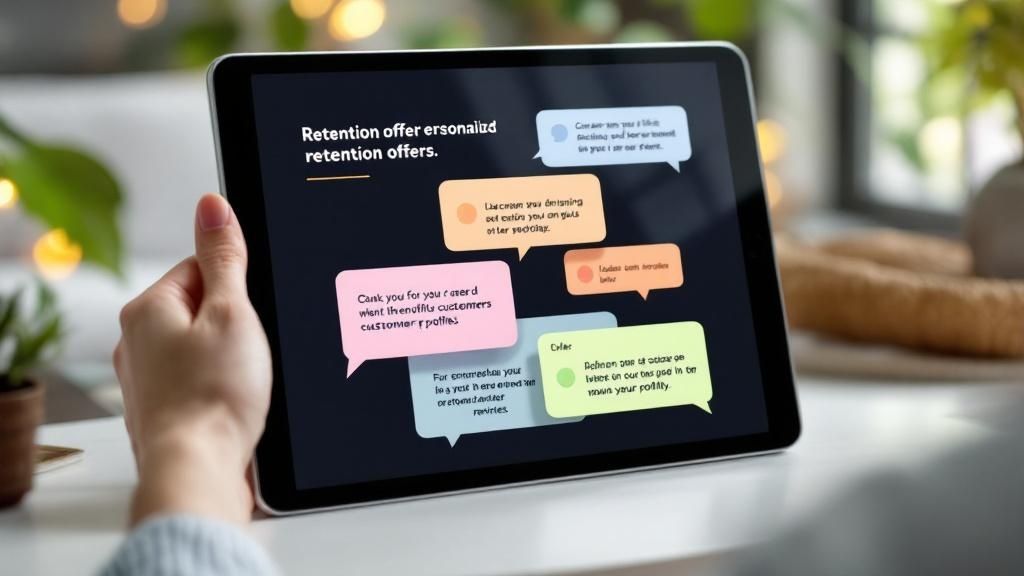
A one-size-fits-all approach to communication is a surefire way to alienate customers and increase churn. Personalized retention campaigns combat this by delivering targeted messages and offers based on a user's specific behavior, lifecycle stage, and potential risk factors. Instead of broadcasting generic emails, you engage with segments of your user base with content that is directly relevant to their needs. This demonstrates that you understand their unique situation, fostering a stronger connection and reinforcing the value of your service.
How to Implement Personalized Campaigns
Effective personalization goes beyond using a customer's first name. It involves leveraging data to create meaningful, timely interactions that feel like a one-to-one conversation. This strategic communication is a powerful tool for proactively reducing customer churn before it happens.
- Segment by Usage and Risk: Group users based on their activity levels. For example, create a segment for "at-risk" users who haven't logged in for 30 days and send them a targeted campaign with new feature highlights or a special offer to re-engage them. Highly engaged "power users" could receive exclusive previews of upcoming features.
- Leverage Lifecycle Stages: Tailor your messages to where the customer is in their journey. A customer nearing their annual renewal date should receive a campaign highlighting the value they've received over the past year, which is very different from the messages a new user receives.
- Test and Measure Everything: Don't assume you know what works. A/B test different subject lines, offers, and channels (email, in-app messages, push notifications) for each segment. Continuously measure engagement and conversion rates to refine your approach and maximize impact. You can learn more about how to increase customer retention with these advanced tactics.
Key Insight: The goal of a personalized retention campaign is to make the customer feel seen and valued, not just marketed to. Your message should answer the silent question, "Why is this relevant to me right now?"
By strategically targeting your communications, you address the specific reasons a customer might consider leaving. Whether it's a lack of engagement, a missed feature, or the end of a contract, a well-timed, personalized campaign can provide the exact nudge needed to keep them loyal.
6. Optimize Product Usage to Deepen Engagement
Customers don't churn because they dislike your product; they churn because they aren't getting enough value from it. Product usage optimization is the process of analyzing how customers interact with your platform and actively guiding them toward features that deliver the most value. By removing friction and encouraging the adoption of core functionalities, you embed your product into their daily workflow, making it indispensable. This strategy is a powerful method for reducing customer churn by ensuring users consistently experience the benefits they signed up for.
How to Implement Product Usage Optimization
Effective usage optimization requires a deep understanding of your customers' goals and your product's core value proposition. It’s about making your most powerful features the easiest and most obvious ones to use.
- Identify Core Value Features: Analyze your most successful, long-term customers. What features do they use most? These are your "sticky" features. Your goal is to guide new and at-risk users toward adopting these same high-impact functionalities.
- Track Feature Adoption: Use analytics tools like Mixpanel or Amplitude to monitor feature adoption rates across different customer segments. If a valuable feature has low adoption, it’s a red flag indicating a potential point of friction or lack of awareness that needs to be addressed.
- Provide Contextual Guidance: Don't wait for users to get lost. Implement in-app prompts, tooltips, or short video guides that appear contextually when a user is interacting with a complex or high-value feature. For example, Canva recommends templates based on a user’s design history, making it easier for them to start their next project.
Key Insight: True product value isn't just about having great features; it's about how easily and consistently your customers can use them to solve their problems. Your job is to build clear, frictionless pathways to these moments of success.
By focusing on how customers use your product, you shift from a passive role to an active one. This proactive approach not only helps customers succeed but also transforms your product from a simple tool into an essential partner, solidifying their loyalty and dramatically reducing the risk of churn.
7. Flexible Pricing and Contract Options
Rigid pricing structures and long-term, unchangeable contracts are a significant source of preventable churn. Customers' needs and financial situations evolve, and a pricing plan that was once perfect can become a burden. Offering flexibility shows you understand and respect their circumstances, building goodwill and providing alternatives to outright cancellation. Instead of a take-it-or-leave-it approach, flexible models create pathways for customers to stay, even if their usage changes. This strategy is a powerful lever for reducing customer churn by addressing affordability and value perception head-on.
How to Implement Flexible Pricing
Moving to a flexible model involves creating options that serve as off-ramps from cancellation. This means building pricing and contract terms that can adapt to a customer's changing reality, ensuring your service remains a viable solution rather than a sunk cost.
- Offer Downgrade Paths: Before a customer hits the "cancel" button, present them with a clear option to downgrade to a lower-priced tier. This allows them to retain their data and history while reducing their cost, making it easier to upgrade again in the future.
- Create a "Pause" Option: Many customers leave due to temporary circumstances, like a seasonal business slowdown or a project hold. Allow them to pause their subscription for one to three months. This retains them as a customer and almost guarantees their return, unlike a full cancellation.
- Provide Annual Incentives: Offer a significant discount for annual prepayment. This secures a customer for a full year, drastically improving retention metrics and cash flow. It gives the customer a clear financial win for their long-term commitment.
Key Insight: The moment a customer considers leaving is a critical opportunity for retention. Making it easier to downgrade or pause than to cancel completely changes the dynamic, turning a potential loss into a retained, albeit different, relationship.
By building elasticity into your pricing, you transform a transactional relationship into a partnership. This adaptability proves you value the customer's business beyond their immediate subscription fee, making them far less likely to seek out a competitor when their needs shift.
8. Launch a Strategic Win-Back Campaign
Not every churned customer is lost forever. A strategic win-back campaign is a targeted effort to re-engage former customers and convince them to return. This isn’t about sending a generic "we miss you" email; it's a calculated approach that acknowledges their departure, addresses potential reasons for leaving, and presents a compelling reason to come back. Executed correctly, this strategy can be a cost-effective way of reducing customer churn’s long-term impact on revenue by reviving otherwise lost relationships.
How to Implement a Win-Back Campaign
A successful win-back campaign relies on timing, personalization, and a genuinely valuable offer. It demonstrates that you’ve not only noticed their absence but have also made improvements that might solve their original problem.
- Segment Your Churned Users: Don't treat all churned customers the same. Group them based on their reason for leaving (if known), their previous usage level, or the value of their subscription. A high-value power user who left due to a missing feature deserves a different message than a low-engagement user who canceled after a free trial.
- Time Your Outreach Carefully: Contacting a customer the day after they cancel can seem desperate. Wait for an appropriate "cooling-off" period, typically 30 to 90 days. This gives them time to experience life without your product and makes your re-engagement effort feel less intrusive. For example, Netflix often waits a few months before sending emails highlighting new exclusive shows they've missed.
- Offer Genuine Value, Not Just a Discount: While a discount can be tempting, a better approach is to highlight new features or improvements that directly address common pain points. Frame your offer around new value, such as, "You asked, we listened. Our new integration with X is now live. Come back and try it for 50% off your first three months."
Key Insight: The goal of a win-back campaign is not just to reclaim a subscriber but to restart the relationship on a better footing. Your message must show you understand why they left and have taken concrete steps to become the solution they were originally looking for.
By strategically targeting former users with personalized, value-driven offers, you can turn a churn statistic into a comeback story. This proactive measure for reducing customer churn proves that you are committed to earning back their business, strengthening your brand's reputation in the process.
8 Key Strategies for Reducing Customer Churn
| Strategy | Implementation Complexity 🔄 | Resource Requirements ⚡ | Expected Outcomes 📊 | Ideal Use Cases 💡 | Key Advantages ⭐ |
|---|---|---|---|---|---|
| Customer Onboarding Excellence | Medium-High | High (content creation, multi-channel) | Reduces early churn by up to 40%, improves adoption | New customers needing guided product use | Strong foundation, reduces churn early |
| Predictive Churn Analytics | High | Very high (data infrastructure, ML) | Increases retention by 20-30%, proactive risk alerts | Large datasets, data-driven retention teams | Proactive retention, data-driven insights |
| Proactive Customer Success Management | High | High (skilled personnel, ongoing management) | Higher lifetime value, improved NPS | High-value accounts needing personal touch | Builds strong relationships, deep insights |
| Value-Based Communication Strategy | Medium | Medium (content, tracking customer outcomes) | Reinforces purchase decisions, supports renewals | Customers needing value reinforcement | Enhances perceived value, supports renewal |
| Personalized Retention Campaigns | High | High (marketing tech, customer data) | Higher engagement, targeted churn reduction | Segment-specific communication | Relevant content, scalable automation |
| Product Usage Optimization | Medium | Medium-High (analytics, in-app guidance) | Increases engagement and product stickiness | Improving feature adoption, reducing churn | Directly boosts engagement and retention |
| Flexible Pricing and Contract Options | Medium | Medium (pricing models, sales training) | Retains price-sensitive customers, reduces cancellations | Customers with variable affordability | Retains customers via flexible options |
| Win-Back Campaign Strategy | Medium | Medium (campaign management, special offers) | Re-engages churned customers, lower acquisition cost | Customers who recently churned | Cost-effective recovery of lost customers |
Transforming Churn Reduction into a Core Business Strategy
Reducing customer churn is far more than a defensive tactic; it's a foundational pillar for sustainable growth. Throughout this guide, we've explored a comprehensive toolkit of strategies, from creating an exceptional onboarding experience to deploying sophisticated win-back campaigns. The common thread weaving through each of these methods is a shift in perspective: moving from a reactive, problem-fixing mindset to a proactive, value-delivery culture. This is the essence of transforming churn reduction from an isolated task into a core business strategy.
Recapping Your Path to Higher Retention
We've covered critical milestones on the journey to minimizing customer attrition. Let's recap the most important takeaways:
- First Impressions Matter: A stellar onboarding process sets the stage for long-term success. It’s your first and best chance to demonstrate value and guide users to their "aha!" moment.
- Data is Your Compass: Predictive churn analytics aren't just for large enterprises. They provide the foresight needed to identify at-risk customers before they even consider leaving, allowing you to intervene effectively.
- Proactivity Wins: Don't wait for customers to complain. Proactive success management, value-based communication, and personalized retention campaigns show customers you are invested in their success, building deep-seated loyalty.
- Adaptability is Key: Static business models are fragile. By offering flexible pricing, optimizing product usage based on feedback, and developing smart win-back strategies, you create a resilient business that can adapt to changing customer needs.
The ultimate goal of reducing customer churn is not just to keep a customer's subscription active. It is about fostering a genuine partnership where their success is intrinsically linked to yours.
Your Actionable Next Steps
Feeling overwhelmed by the options? Don't be. The key is to start small, measure your results, and build momentum.
- Conduct a Churn Audit: Begin by analyzing why customers are leaving. Use exit surveys and interviews to gather qualitative data that complements your quantitative metrics.
- Pick One High-Impact Area: Choose one strategy from this article that directly addresses a major reason for churn in your business. Is your onboarding confusing? Start there. Are customers not using key features? Focus on product usage optimization.
- Integrate Modern Tools: The strategies discussed, especially those involving proactive communication and onboarding, are significantly amplified by the right technology. Implementing a video support tool can provide massive leverage, allowing your team to deliver clear, personalized guidance at scale. This is a crucial step in modernizing your approach to reducing customer churn.
Embracing these principles creates a powerful flywheel effect. Lower churn leads to higher customer lifetime value, which provides more resources to reinvest in your product and customer experience, further reducing churn. It’s a virtuous cycle that separates market leaders from the rest. The journey begins with a single, deliberate step.
Ready to supercharge your onboarding and support to actively reduce customer churn? See how Screendesk makes it effortless to create and share personalized video tutorials, interactive guides, and instant screen recordings. Start building stickier customer relationships today by visiting Screendesk and see the difference clear communication can make.
