


When we talk about quality assurance procedures, we're not just talking about a set of rules. Think of it as the master blueprint for everything your team does—a proactive plan designed to make sure your products or services are consistently excellent from the start.
It's less about catching mistakes and more about building a system where mistakes are far less likely to happen in the first place.
What Are Quality Assurance Procedures?

Let's use a simple analogy: building a car. Long before the first piece of metal is cut, engineers have already laid out a detailed plan. They’ve defined the exact materials, the step-by-step assembly process, and the specific standards every single component must meet. That's the heart of quality assurance (QA). It's the framework that ensures quality is baked into the product from day one.
This is fundamentally different from Quality Control (QC), which is the inspection phase. QC is what happens after the car is built—checking for paint scratches, testing the brakes, and making sure the electronics work. To really get a handle on QA, it's crucial to understand the difference between quality assurance vs quality control. They work together, but they are not the same thing.
A strong QA framework isn't just a box to tick; it's a strategic advantage. It builds incredible trust with your customers and lays the groundwork for delivering reliable, consistent value. For any team, especially in service, getting a firm grasp on customer support quality assurance is the first real step toward earning that trust.
QA is Proactive, Not Reactive
The main idea behind quality assurance procedures is simple: prevention is better than correction. It’s a systematic approach to verifying that every activity involved in creating a product or service is planned and performed correctly—from the initial design phase all the way to final delivery.
Quality assurance is… all those planned and systematic actions necessary to provide confidence that a product or service will satisfy given requirements for quality.
This focus on proactive systems helps you get ahead of problems. Instead of putting out fires, you're preventing them from starting.
To make this distinction clearer, let's look at how QA and QC differ in practice.
Quality Assurance vs Quality Control at a Glance
| Aspect | Quality Assurance (QA) | Quality Control (QC) |
|---|---|---|
| Focus | Process-oriented (how things are made) | Product-oriented (inspecting the final result) |
| Goal | To prevent defects from happening | To identify and fix defects that have occurred |
| Timing | Before and during the process | After the process is complete |
| Approach | Proactive | Reactive |
| Example | Creating a standardized script for support agents. | Reviewing a specific support ticket for quality. |
As you can see, QA sets the standards, and QC checks if those standards were met. You truly need both for a complete quality management system.
When you invest in solid QA procedures, your business starts to see some real benefits:
- Fewer Mistakes: By catching potential issues early in the process, QA dramatically reduces the chance of a flawed product or poor service interaction reaching your customer.
- Stronger Customer Trust: Consistency is key. When customers know they can rely on you for high-quality outcomes every time, their loyalty skyrockets.
- Improved Efficiency: Finding and fixing problems early is always cheaper and faster than dealing with them after the fact. This saves a ton of time, money, and headaches.
Ultimately, quality assurance procedures give your team a clear roadmap for achieving excellence. They ensure every single thing you produce—whether it's software, a physical item, or a customer conversation—hits the high standard you've set.
The Core Components of Effective QA Procedures
To build a quality assurance system that actually works, you need the right building blocks. Think of it like building a house—you can't just throw up walls and hope for the best. You need a solid foundation, a sturdy frame, and a clear blueprint. In the same way, solid QA procedures rely on a few key components that work together to make sure everything is consistent and reliable.
These parts are what turn the fuzzy idea of "quality" into something your team can do every single day. Without them, your efforts will feel scattered and, frankly, won't get you the results you want. Let's break down what these components are.
1. Documenting Every Critical Process
First things first: if a process isn't written down, it might as well not exist. This is where detailed process documentation comes in. These documents, often called Standard Operating Procedures (SOPs), act as the single source of truth for how work gets done. They take the guesswork out of tasks and make sure everyone is on the same page, following the same steps, every single time.
Imagine a software team where every developer had their own unique way of coding. The final product would be a chaotic mess that’s nearly impossible to maintain. An SOP would spell out the team's coding standards, how they test their work, and the exact steps for deployment. This kind of clarity is essential for success.
Following Process Documentation Best Practices is key to making sure your guides are clear, consistent, and easy for everyone in the organization to follow.
2. Defining Clear Quality Standards
Once your processes are documented, you need to define what "good" actually looks like. Clear quality standards are the specific, measurable benchmarks your product or service has to meet. We're not talking about vague goals like "be great." We're talking about concrete criteria.
For example, a restaurant's QA procedures might have a standard for its ingredients, like, "All tomatoes must be vine-ripened with a Brix score of 5 or higher." This gives the kitchen staff a clear, objective target.
A quality standard is the difference between hoping for quality and engineering it. It provides an objective ruler to measure your output against, ensuring that subjective opinions are replaced with verifiable data.
Without these explicit standards, quality becomes a matter of opinion, which leads to inconsistent results that will frustrate your team and your customers.
3. Training Your Team for Success
You can have the best-written procedures and the clearest standards on the planet, but they’re worthless if your team doesn't know about them or how to follow them. This is where comprehensive employee training comes in. Training is what breathes life into your procedures, ensuring every person has the skills to do their job the right way.
Good training isn't a one-and-done event. It should be an ongoing effort that includes:
- Initial Onboarding: Teaching new hires the "why" behind your QA system, not just the "how."
- Process Updates: Getting everyone up to speed quickly whenever a procedure or standard changes.
- Skill Reinforcement: Holding regular refreshers to make sure bad habits don't start creeping back in.
When you invest in training, quality becomes a shared responsibility instead of just one person's job.
4. Managing Your Supplier Chain
Your quality is only as strong as its weakest link, and often, that link is outside your company. Strict supplier management means setting clear quality expectations for your vendors, partners, and contractors. After all, your internal processes don't mean much if the raw materials you start with are second-rate.
A clothing brand, for instance, might require its fabric suppliers to meet specific durability and colorfastness tests. They might even audit the supplier's factory. This extends your QA system beyond your own four walls, creating a complete chain of quality from the very beginning to the final product.
The Business Impact of Strong QA Procedures

Good quality assurance is far more than just a box-ticking exercise. It’s a strategic move that pays real dividends, directly fueling your business's growth. It's easy to mistakenly label QA as a "cost center," but a better way to see it is as an engine for customer loyalty and a stronger bottom line.
Think about it: when quality is woven into every part of your process, the positive effects are felt everywhere.
The most obvious win is in customer satisfaction. When people know they can count on your product or service to work as expected, you build trust. That kind of consistency doesn’t happen by accident; it's the direct outcome of solid QA procedures.
Driving Efficiency and Slashing Waste
A well-oiled QA system is your secret weapon for operational efficiency. By catching mistakes early and standardizing how work gets done, you can slash waste across the board. We're not just talking about saving on materials—it’s also about cutting down on wasted time, effort, and money spent fixing problems that should have never happened in the first place.
Here’s what that looks like in the real world:
- In a factory: A parts manufacturer tightens up its process controls. The result? They cut down on wasted materials from bad parts by 30% in the first year, saving a small fortune.
- In a tech company: A software team starts using strict code reviews and automated tests. This single change reduces critical bugs in the live product by over 50%, letting developers build new things instead of just putting out fires.
This kind of efficiency saves money and frees up your team to focus on work that actually adds value. In fields like pensions administration, where one wrong calculation can be a disaster, strong QA isn't just nice to have—it's essential.
When you get right down to it, trust is everything. Solid QA procedures are how you show customers you’re accountable and transparent. That builds incredible confidence, especially when people are counting on you for their financial future.
Building an Unshakeable Brand Reputation
Your brand’s reputation is one of your most precious assets, and every faulty product or bad service experience puts a dent in it. Think of strong QA as a shield that protects your brand, making sure that what you deliver always lives up to what you promise.
This dedication to quality sets you apart from the crowd. It’s a clear signal to customers and competitors that you are reliable and trustworthy. A big part of this is making sure everyone on your team has access to the right information, which is where understanding the benefits of robust knowledge management systems comes in handy.
In the end, a great QA system doesn't just prevent problems—it actively builds a stronger, more resilient business. It helps you stay compliant, boosts profits, and secures your place in the market for the long haul. It's the framework that makes sustainable growth possible.
How to Implement Your QA Procedures
Alright, let's get practical. Turning the idea of quality into something your team does every single day takes a solid, actionable plan. Putting quality assurance procedures in place isn't like flipping a switch; it's a step-by-step process that turns your big goals into small, consistent actions.
Think of it as building a living system, not just creating a dusty binder of rules that sits on a shelf. Each step you take builds on the one before it, creating a cycle of improvement that eventually becomes second nature to your company.
This flow chart breaks down the fundamental steps for setting up your own quality assurance procedures, starting with the initial analysis and moving all the way to execution.
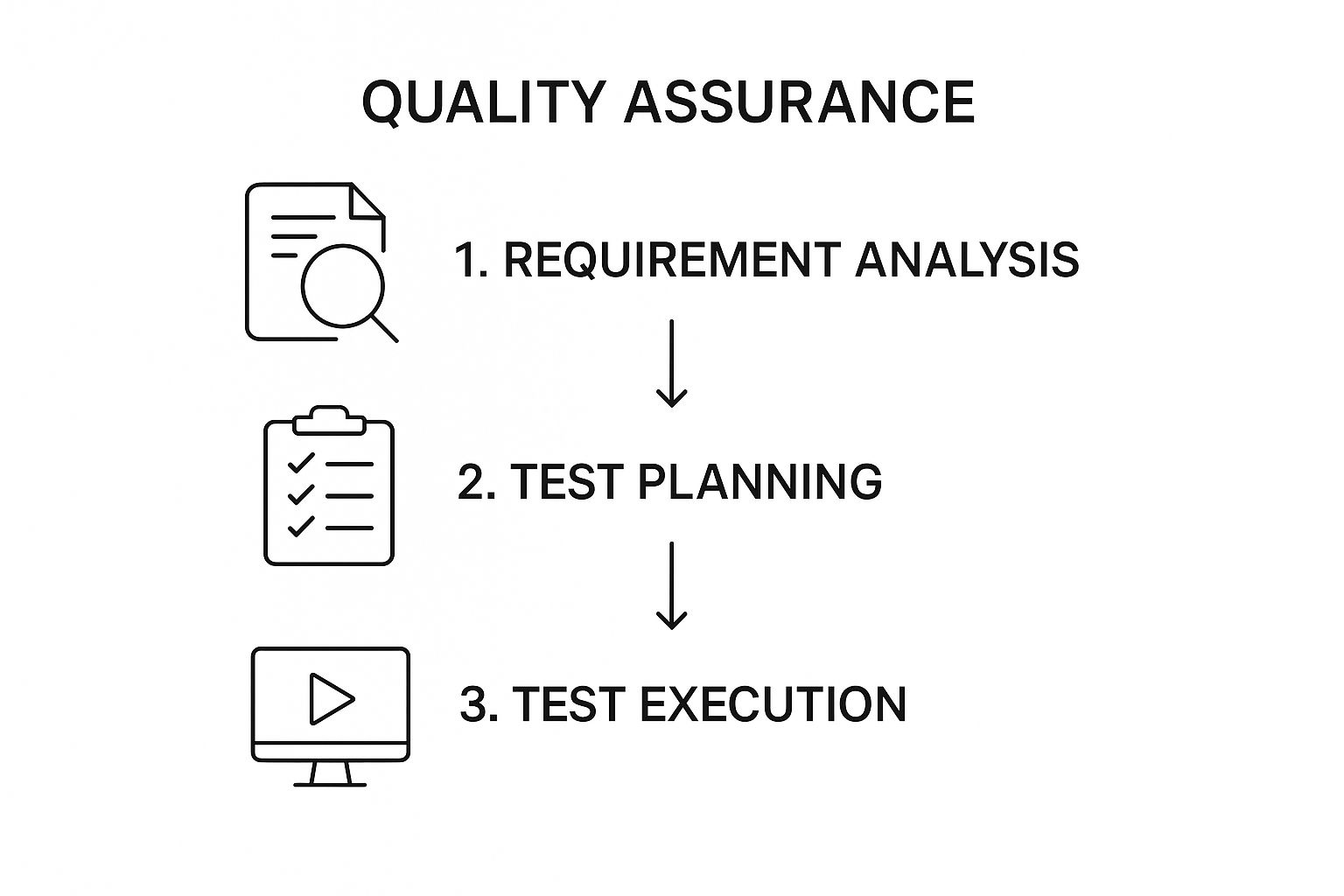
As the graphic shows, a great QA process always starts with a deep dive into what's actually required before you start planning or doing anything else.
1. Define Your Quality Goals
Before you can build anything, you need a blueprint. Your first job is to figure out what "quality" really means for your product or service. These goals need to be crystal clear, measurable, and directly linked to what your customers care about most.
Vague statements like "we want to improve customer satisfaction" won't cut it. Get specific.
- Reduce product defects by 15% in the next quarter.
- Get our first-contact resolution rate up to 85% for all support tickets.
- Maintain a 95% accuracy rate for all data entry.
Concrete targets like these give your team a clear destination and a simple way to know if they're winning.
2. Map Your Existing Processes
You can't fix what you can't see. The next step is to map out your current workflows, from the very beginning to the very end. You'd be surprised what this uncovers—hidden bottlenecks, communication breakdowns, and weird inconsistencies you never knew were there.
Make sure you bring in the people who actually do the work every day. Their on-the-ground insights are priceless, and getting them involved from the start builds a sense of ownership.
Pro Tip: Mapping your processes is like turning on the lights in a messy garage. Suddenly, you can see the clear paths, the junk getting in the way, and exactly where you can make things better.
3. Document Your Standard Operating Procedures (SOPs)
Once you have your processes mapped out, it's time to write them down as Standard Operating Procedures (SOPs). An SOP is just a simple, step-by-step guide that explains how to do a specific task the right way, every time. This is where your quality assurance procedures become official.
For tasks that are complex or highly visual, a wall of text in a document just doesn't work. Words get misinterpreted, and that leads to mistakes. This is where showing is so much better than telling.
Using a quick video lets you demonstrate a process, making your instructions incredibly clear and easy for anyone to follow.
4. Roll Out Comprehensive Training
Your shiny new SOPs are useless if the team doesn't understand them or, worse, doesn't use them. That’s why training is an absolute must. Good training makes sure every single person has the skills and knowledge they need to follow the new quality standards.
Visuals are a game-changer here. Instead of just handing someone a manual, use a screen recording to walk them through new software or a tricky workflow. If you want to get really good at this, you can learn how to create training videos that actually stick, helping your team learn faster and remember more.
5. Monitor Performance and Review Continuously
Finally, remember that quality assurance isn't a "one-and-done" project. It's a constant commitment. You need a system to keep an eye on how things are going and measure performance against the goals you set. This typically involves a few key activities:
- Regular Audits: Popping in to systematically check if procedures are being followed correctly.
- Data Analysis: Keeping an eye on your key metrics to spot trends or find areas that need a little more love.
- Feedback Loops: Creating easy ways for employees and customers to report problems and suggest improvements.
This last part closes the loop, turning your QA framework from a static document into a living system that learns and gets better over time. By constantly reviewing and tweaking your quality assurance procedures, you build a stronger, more reliable organization.
The Digital Evolution of Quality Assurance

Quality assurance used to mean checklists and last-minute inspections. Not anymore. We're in the middle of a massive shift where technology is fundamentally changing how companies think about quality. QA is no longer the final gatekeeper; it’s now an integrated partner, working alongside teams from the very beginning.
The days of QA being a siloed department that only gets a look at the very end are over. Today’s quality assurance procedures are living, breathing systems—data-driven and woven directly into the daily grind of software development, manufacturing, and customer support. Technology hasn't just made QA faster; it's made it much, much smarter.
This evolution is most obvious in the software industry. A huge transformation is underway, with countries like the U.S., Germany, and a rapidly growing India investing heavily in advanced QA to deliver world-class digital products. The old model of just finding bugs is being replaced by continuous quality checks powered by AI test automation and even generative AI. For a deeper dive into this, check out a recent QA trends report from ThinkSys.com.
From Manual Checks to Automated Processes
One of the biggest game-changers has been the move from manual to automated testing. Picture a software team getting ready for a new release. In the old days, this meant a small army of testers would spend days, sometimes weeks, manually clicking through every nook and cranny of the app, hoping to catch any bugs.
Now, automated scripts can run thousands of tests in just a few minutes. These scripts can check everything from simple button functionality to incredibly complex user workflows. This frees up the human testers to focus on the creative, out-of-the-box thinking that machines just can't replicate.
Key Takeaway: Automation doesn't replace human testers; it supercharges them. By taking over the repetitive, tedious work, automation allows QA professionals to focus on big-picture strategy and complex problem-solving.
This shift has had an enormous impact on both speed and accuracy. Automated tests are not only faster but also far more consistent, removing the risk of human error that naturally creeps into repetitive manual tasks.
The Rise of AI in Quality Assurance
Automation was just the first step. The next major leap is being driven by Artificial Intelligence (AI), which is giving quality assurance a new level of intelligence. AI is now being used to make the entire QA process predictive and even self-sufficient.
Here’s a glimpse of how AI is changing the game:
- AI-Powered Test Creation: Instead of developers painstakingly writing every test script by hand, AI can analyze an application and generate relevant test cases automatically. This slashes the initial setup time.
- Self-Healing Scripts: A classic headache in test automation is when scripts break because of a minor UI change. AI-powered tools can now spot these changes and "heal" the scripts on their own, saving countless hours of frustrating maintenance.
- Predictive Analytics: By sifting through historical data, AI can predict which areas of an application are most likely to contain bugs. This helps teams concentrate their testing efforts where they will have the most impact.
Embedding Quality in CI/CD Pipelines
Finally, modern development workflows like Continuous Integration/Continuous Deployment (CI/CD) have completely changed where QA fits into the puzzle. In a CI/CD pipeline, every time a developer commits new code, an automated process kicks off that builds, tests, and prepares it for release.
This means quality checks aren't a separate phase at the end of the line anymore. They are a built-in, automated part of the development cycle itself. If an automated test fails, the pipeline halts, stopping a faulty piece of code dead in its tracks before it can ever reach a customer. This tight integration makes quality a shared responsibility—built in, not bolted on.
How to Future-Proof Your QA Procedures
To keep your quality assurance procedures effective for years to come, you can't just stick with what works today. You have to look ahead and build a system that’s ready for tomorrow's challenges. This really means changing how you think about QA—moving it from a necessary cost to a strategic part of your business that drives real growth and resilience.
Thinking about the future of quality is about more than just buying new software. It’s about weaving new trends and technologies into the very fabric of your strategy. The aim is to create a quality framework that doesn't just catch today’s mistakes but actually gets ahead of tomorrow's problems before they happen.
Evolving from Cost Center to Value Driver
For a long time, QA was just the final gatekeeper, an expense you had to swallow to catch errors before they went live. The future, however, sees QA as an active part of the entire process, focused on cutting costs, making things run smoother, and even sparking new ideas. More and more companies are catching on that proactive quality is a serious competitive advantage. For a deeper dive into this shift, you can find some great insights on evolving QA trends from LabV.io.
This evolution is all about using the data and insights from your quality checks to make smarter business decisions. When your QA team’s feedback leads to a better product design or a more efficient workflow, it stops being a line item on an expense report. It becomes a direct contributor to your bottom line.
Embracing Hyperautomation and Sustainability
Two big ideas are shaping where QA procedures are headed next: hyperautomation and sustainability.
Hyperautomation is the natural next step after basic test automation. It’s a smart mix of different technologies working together to automate as much of the QA process as you possibly can.
- Artificial Intelligence (AI): It can be used for predictive analytics to flag areas where problems are most likely to pop up.
- Machine Learning (ML): This is the magic behind self-healing test scripts that can automatically adjust when your application changes.
- Robotic Process Automation (RPA): It’s perfect for taking over those repetitive, rule-based tasks and doing them flawlessly every single time.
At the same time, sustainability is becoming a core part of what "quality" means. This isn’t just about being green; it’s about designing procedures that are both effective and incredibly efficient.
Quality is no longer just about the product's performance; it's also about the efficiency and environmental impact of the process that created it. Future-proofed QA procedures will minimize waste in all its forms—time, resources, and energy.
By bringing these forward-thinking concepts into your process, you build a much stronger and more adaptable quality system. Of course, this approach makes training more important than ever. Clear documentation and visual aids, like the ones you’d find in a solid customer service training manual, are essential for getting your team comfortable with these more advanced processes.
Frequently Asked Questions
Diving into quality assurance can feel like learning a new language. You're not alone if you have questions! We've gathered some of the most common ones we hear and answered them in a straightforward way to get you started.
Let's clear up some of the confusion and give you the confidence to build a quality process that actually works.
How Is Quality Assurance Different From Quality Control?
This is a classic question, and it's easy to get them mixed up. The best way to remember the difference is to think about it like this: Quality Assurance (QA) is proactive, while Quality Control (QC) is reactive.
- Quality Assurance (QA) is all about the process. It’s about setting up smart systems and clear standards to stop mistakes before they ever happen. Imagine it as creating the perfect recipe and making sure the chef knows exactly how to follow it.
- Quality Control (QC) is all about the product. It’s the final check to catch any defects that might have slipped through. This is like taste-testing the dish right before it's sent out to the customer.
In a nutshell, QA builds quality into the way you work, while QC inspects the final result. You absolutely need both. They work together, and one can't be truly effective without the other.
What Is the First Step to Create QA Procedures for a Small Business?
If you're running a small business, building formal QA procedures can sound like a mountain of work. But the first step is surprisingly simple: define what "quality" actually means for your business.
Before you write a single line of a procedure, you have to know what you're aiming for. Ask yourself, what does a great outcome look like for my customers? Is it a product with zero physical flaws? Or maybe it's a customer support chat that solves a problem in less than five minutes?
Once you've set those goals, your next step is to map out your most important processes. Pick one or two that directly touch the customer experience. Don't try to document everything at once. Just get the key steps written down so your team can perform them consistently every single time.
How Often Should QA Procedures Be Updated?
Think of your QA procedures as living documents, not tablets set in stone. They need to change and grow as your business does. As a general rule, it's smart to review them formally at least once a year.
But don't wait for that annual calendar reminder if something important happens. You'll want to update your procedures right away in a few key situations:
- When a Process Changes: If you adopt new software or overhaul a workflow, your documentation has to keep up.
- After You See Repeated Mistakes: If the same problem keeps popping up, that's a huge red flag. Your procedure is likely the culprit and needs a rethink.
- When Customers Give You Feedback: Your customers are a goldmine of information. If you hear the same complaint over and over, it’s time to look at the process behind it.
Keeping your procedures current is what keeps your whole quality system sharp and effective.
Ready to make your quality assurance procedures clearer and more effective? Screendesk helps your team create and share high-definition video guides for your SOPs and training, ensuring everyone understands the process perfectly. Discover how Screendesk can elevate your QA today.
