


We all know that good team communication is important, but how do you actually make it happen? It starts with a few foundational pieces: creating a shared playbook for how you talk to each other, picking tools that actually help instead of hinder, and building a culture where honest, helpful feedback is the norm. These aren't just lofty goals; they're the practical steps that turn "better communication" into a daily reality, making everyone's work life a lot smoother.
The True Cost of Poor Team Communication
Everyone pays lip service to the idea that “communication is key,” but what’s the real price when it falls apart? It's far more than just a few awkward silences during a video call. When communication breaks down, it quietly eats away at a company's foundation, leading to some very real, very negative outcomes.
Think about it. A simple misunderstanding about a project deadline can easily snowball into a missed launch. Vague feedback on a design mock-up can lead to hours of rework that didn't need to happen. And when people don't feel psychologically safe to voice their opinions, brilliant ideas get buried before they ever see the light of day. These aren't just one-off problems; they're signs of a deeper issue.
The Financial and Cultural Drain
This all hits the bottom line, hard. Research consistently shows that effective communication can lift a team's productivity by as much as 25%. On the flip side, a whopping 86% of employees and executives say a lack of good communication is a major reason for workplace failures. Given that about a third of professionals aren't happy with how their teams communicate, you start to see just how big this problem really is.
This disconnect fuels a vicious cycle of inefficiency and low morale. Projects drag on, the quality of work dips, and eventually, your best people start updating their resumes. The true cost isn't just a missed deadline—it's the slow erosion of trust, engagement, and the innovative spirit that keeps a company competitive. Interestingly, many of the lessons from client communication best practices can offer powerful insights for improving things internally, too.
The Communication-Productivity Link
It's helpful to see the contrast side-by-side. The difference between poor and effective communication isn't just about feeling better; it's about performing better across the board.
| Metric | Impact of Poor Communication | Impact of Effective Communication |
|---|---|---|
| Productivity | Projects stall, deadlines are missed, and rework is common. | Teams are aligned, work flows smoothly, and goals are hit faster. |
| Innovation | Good ideas are never shared for fear of criticism. | People feel safe to brainstorm and contribute creative solutions. |
| Employee Morale | Frustration, disengagement, and higher turnover rates. | Higher job satisfaction, stronger team bonds, and better retention. |
| Error Rates | Misunderstandings lead to more mistakes and quality issues. | Clarity reduces errors, leading to higher-quality outcomes. |
Ultimately, investing in clear, consistent communication is one of the highest-leverage activities a team can undertake. The positive ripple effects touch every aspect of the business.
Flipping the Script to Positive Outcomes
But here's the good news. When you get intentional about improving how your team communicates, the results are just as powerful, only in the right direction. When you set clear guidelines and expectations, you eliminate the guesswork that causes so much friction.
The goal isn't just to talk more; it's to create shared understanding with less effort. When communication flows effectively, teams build momentum instead of constantly battling friction and misunderstandings.
This isn't just theory. The data below shows the direct impact a focused communication workshop had on key performance metrics for one team.
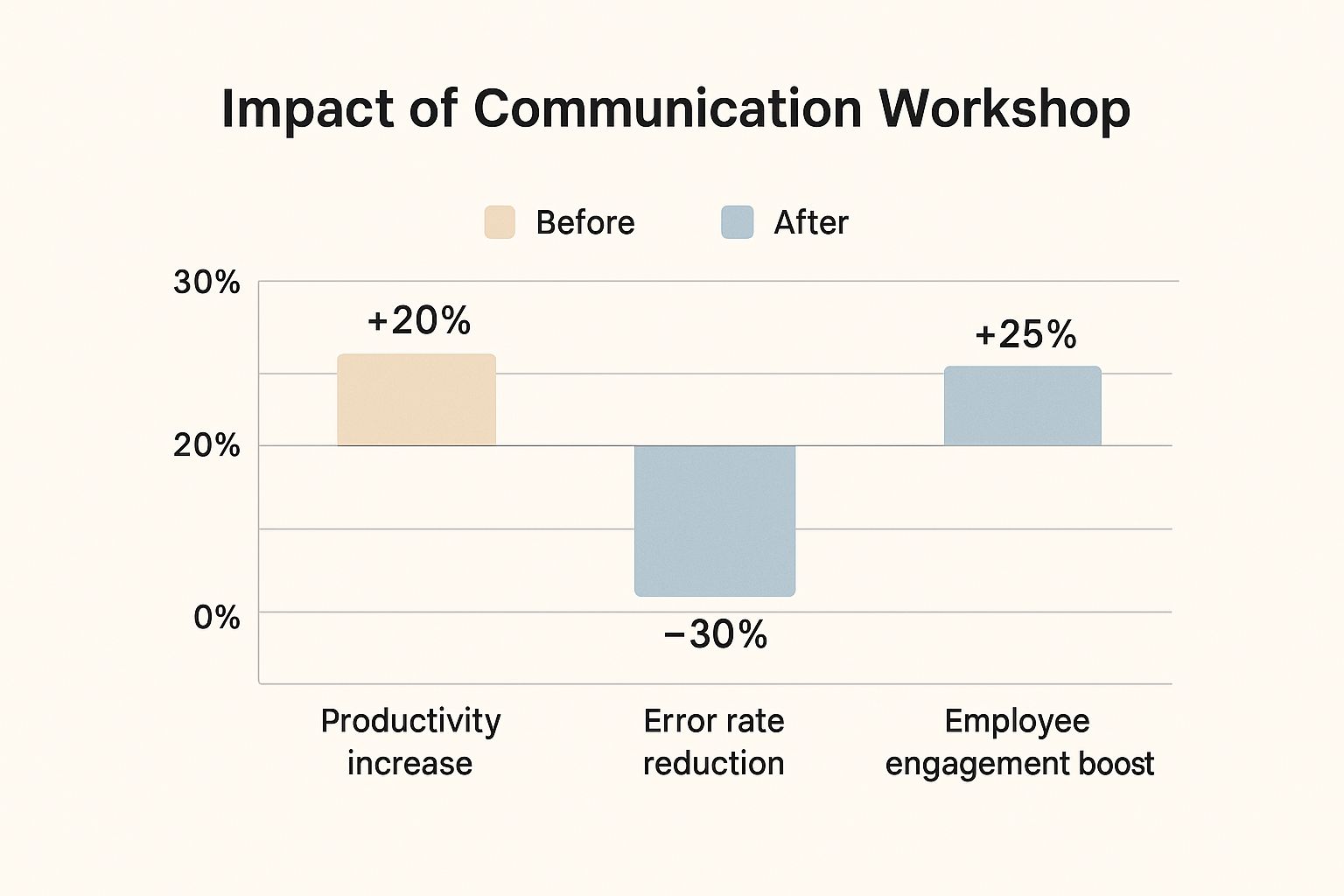
The numbers speak for themselves. Putting real effort into better communication pays off with tangible improvements in productivity, accuracy, and overall team morale. It's an investment that always delivers a return.
Crafting Your Team Communication Playbook

Before you can fix what’s broken, you need a shared rulebook. Think of it as a team communication playbook—a simple guide that gets everyone on the same page. This isn't some dusty policy handed down from on high. It’s a living document you build with your team, not for them.
Its real power is in the collaboration. The whole point is to remove the guesswork and friction that bogs down a team's day. When everyone helps build the playbook, they're much more likely to actually use it. It becomes a shared agreement, not just another rule to follow.
Defining Your Channels and Setting Clear Expectations
First things first: take stock of your current tools. What does your team actually use to communicate every single day? Make a list. It probably includes email, a chat app like Slack or Microsoft Teams, a project management board, and maybe even old-fashioned phone calls.
Now, give each tool a specific job. This is where you get granular. For example:
- Email: Use this for more formal, external communications or for sending detailed weekly summaries that need to be easily searchable later.
- Team Chat (Slack, etc.): This is your go-to for quick, informal questions, real-time chatter on a project, and general team announcements. It's for the here and now.
- Project Management Tool: This should be your single source of truth for all things project-related. Who's doing what? When is it due? All project-specific conversations live here.
- Video Calls: Save these for the important stuff—brainstorming sessions, complex problem-solving, or any sensitive one-on-one discussion where nuance is key.
Once you’ve assigned a purpose to each channel, set clear expectations for response times. This is a game-changer. Maybe you all agree that emails get a reply within 24 hours, but a direct message in Slack should be answered within a couple of hours. This simple step eliminates that "are they ignoring me?" anxiety and keeps small issues from snowballing.
A good playbook creates clarity, not more rules. The goal isn't to micromanage every interaction. It's to provide simple guardrails so communication just flows, which is a welcome relief for the 30% of workers who feel frustrated by unclear direction.
Building and Maintaining Your Playbook
With your channels and expectations outlined, it's time to put it all in writing. Keep it simple! A basic two-column table is often perfect: one column for the communication tool, and the other for its purpose and expected response time.
Next, get your team's buy-in. Share the draft and schedule a quick meeting to go over it together and make any final tweaks. This step is crucial. If people don't feel heard, they won't feel committed. For leaders, the next part is even more important: you have to model the behavior. If the playbook says project updates go in your project management tool, don't be the one sending them in a group chat.
This playbook should also serve as a jumping-off point for exploring broader internal communication best practices that help build a more connected team culture.
Finally, remember that this isn't a one-and-done task. Make the playbook part of your onboarding for new hires. And every six months or so, revisit it as a team. Tools change, projects evolve, and your team grows. Your communication strategy should be able to adapt right along with it.
Choosing Communication Tools That Actually Help

We all know technology can make or break team collaboration. But throwing a new app at a problem often just adds to the noise. The real trick is to find tools that solve your team's specific communication hurdles, not just jump on the latest bandwagon. Before you pull out the company card for another subscription, it’s worth taking a moment to figure out what you truly need.
It all boils down to understanding the two fundamental ways we talk at work: synchronous (live chats and meetings) and asynchronous (everything else, like emails, project comments, and video messages). A well-functioning team needs a thoughtful mix of both. Too many real-time pings and you kill deep work; too much waiting for replies and you grind to a halt.
Striking the Right Balance
Finding that sweet spot is everything. A culture drowning in real-time notifications creates a constant sense of urgency, making it nearly impossible for anyone to focus. But relying only on slow-moving text can cause simple misunderstandings to fester, especially when you're dealing with something complicated.
Think about your team's daily grind and ask yourself what's needed for different tasks:
- Quick questions & urgent alerts: This is what instant messaging was made for. It’s perfect for the quick tap on the shoulder that doesn't need a formal email.
- Complex problem-solving: Meetings still have their place, but they should be for genuine collaboration, not just reading off a list of updates.
- Detailed feedback & updates: This is the ideal territory for asynchronous communication, and video, in particular, shines here.
When you're evaluating collaboration platforms, it's smart to look at how they're actually used in practice. For example, looking into the setup and best practices for something like Microsoft Teams can give you a clearer picture of how a robust tool could slot into your existing workflow.
The Power of Asynchronous Video
This is where things get interesting. Modern tools like Screendesk, with its asynchronous video messaging, can drastically improve how your team communicates without clogging everyone's calendar. Instead of typing out a novel to describe a software bug or scheduling yet another 30-minute call, you can just hit record.
On my own team, adopting asynchronous video has slashed the number of "quick sync" meetings we used to have. A five-minute screen recording that shows a developer exactly what’s going wrong is infinitely clearer and faster than a 10-paragraph email chain. You get the clarity of a live demo with the flexibility of an email.
This approach is a game-changer for so many common tasks:
- Giving design feedback: You can literally walk through a mockup, pointing out exactly what needs to change.
- Reporting a technical issue: Show the engineering team the exact steps to reproduce a bug, screen, and all.
- Explaining a new process: Record a quick tutorial that your team can watch and rewatch whenever they need it.
By deliberately choosing tools for specific jobs, you give your team the ability to communicate with real clarity and depth while respecting everyone's time to focus. It’s not about finding one perfect app, but building a smart ecosystem where every tool has a clear purpose and helps you get on the same page with less friction.
Building a Culture of Constructive Feedback
Great communication is a two-way street. It’s not just about how clearly you send a message, but also how well you receive one. If you want to really level up your team's communication, you have to build a culture where feedback is seen as a gift, not a threat. This is how you turn potential conflicts into genuine growth moments and stop small issues from spiraling into huge problems.
The whole thing rests on a foundation of psychological safety. That’s just a term for a shared feeling that it’s safe to take risks. People need to know they can voice concerns, float a half-baked idea, or admit a mistake without getting shut down or embarrassed. When that safety exists, people open up, and that’s where any real feedback loop begins.
Make Feedback Specific and Actionable
Let’s be honest: vague feedback is useless. Saying things like "This isn't good enough" or "You need to be more proactive" doesn't help anyone. It just makes people anxious and defensive because they have no idea what to do next.
A much better way to handle it is with the Situation-Behavior-Impact (SBI) model. It's a simple framework I've seen work wonders because it strips out the judgment and sticks to the facts.
Here’s how it works:
- Situation: Pinpoint the exact moment. "During this morning's client call…"
- Behavior: Describe what you observed. "…when you shared the project timeline…"
- Impact: Explain what happened as a result. "…it seemed to create some confusion for the client about the launch date, and we had to spend extra time clarifying it."
See how that’s different? It's direct and professional, giving you a clear starting point for a conversation. It's not about pointing fingers; it's about solving a problem together.
The goal of feedback isn't to criticize; it's to clarify. By focusing on specific behaviors and their real-world impact, you transform a potentially difficult conversation into a collaborative problem-solving session.
Normalize Regular Feedback in Every Direction
Feedback shouldn't be a big, scary event that only happens once a year during a performance review. To make it a real part of your culture, it has to be a normal, everyday thing. That means encouraging peer-to-peer feedback and even making it easy for people to give feedback to their managers.
Here are a few ideas I've seen work well:
- Introduce "Praise and Pointers" in team meetings. Spend just five minutes letting team members give a public shout-out for great work or offer a quick, helpful pointer on a recent task.
- Schedule regular feedback sessions. Beyond project wrap-ups, hold one-on-ones specifically for giving and receiving feedback. Make sure it goes both ways.
- Lead by example. If you're a manager, you have to ask for feedback on your own performance. Try asking, "What's one thing I could do differently to better support you?" It shows you’re serious about it.
Creating this kind of open dialogue pays off, big time. Companies with strong communication see up to 77% better employee performance. Why? Because workers who feel their opinions actually matter are 4.6 times more likely to give their best effort, according to a comprehensive statistical overview. It's the same principle that helps automate customer support—clear protocols and open channels reduce misunderstandings and improve outcomes.
Using Team Building to Strengthen Communication

Great communication isn't something that just magically appears during a meeting or inside a project management tool. The real secret? It’s trust. And that's usually built far away from a to-do list. When your team members actually connect with each other as people, they'll communicate more openly and effectively as professionals.
This isn’t about forcing everyone into awkward trust falls or another bland happy hour. It's about being intentional. Good team-building activities are designed to break down the natural barriers that pop up in any workplace, helping people see each other as collaborators, not just coworkers.
Building Connections Beyond the Keyboard
I like to think of a team's relational health as a bank account. Every positive, non-work chat or shared laugh is a deposit. When a tight deadline or a tough conversation happens, you have a healthy balance to draw from. Without those deposits, you can quickly find yourselves in relational debt.
The trick is to find activities that genuinely require people to talk and work together to get something done. These shared experiences create a surprisingly strong foundation.
Here are a few ideas that actually work:
- Collaborative Problem-Solving: Things like escape rooms, a group cooking class, or even a complicated board game night push everyone to listen, share ideas, and figure things out together under a bit of fun pressure. It's a fantastic, low-stakes way to practice high-stakes skills.
- Skill-Sharing Workshops: Have people teach a skill they love, whether it's work-related or a personal hobby. It’s a great way to level the playing field and discover the amazing hidden talents on your team.
- Volunteer Days: Rallying around a shared cause creates a sense of unity and purpose that you just can't replicate in the office.
These kinds of activities create shared memories and inside jokes. They humanize your team, building the empathy you need to assume positive intent when a difficult work conversation inevitably comes up.
The Lasting Impact on Daily Work
The payoff from these events isn't just a "nice feeling"—it has a direct impact on your team's communication. The data backs this up. One recent study found that 63% of leaders reported better team communication after running these kinds of exercises. On top of that, 61% saw a direct increase in morale and trust, which are the building blocks of any high-performing team. You can dive deeper into these findings on the impact of team building from Flair.hr.
These positive effects create ripples. A team that's figured out how to escape a locked room together is much better prepared to handle a sudden change in a project's direction. Colleagues who've shared a laugh over a meal are more likely to give each other the benefit of the doubt when they disagree.
Ultimately, you're building a more resilient, connected team. The trust you build outside of work is what allows for candid feedback, smoother collaboration, and faster problem-solving when you're back at your desks. This same principle of building strong relationships is also crucial when you're scaling customer support, because both internal and external success runs on trust.
Answering Your Team Communication Questions
Even with a solid plan, you're bound to hit a few snags. Improving team communication isn't a one-and-done task; it’s something you have to keep working on. Knowing how to handle the common roadblocks is what separates teams that thrive from those that just get by.
These aren't hypothetical issues. They're the real-world friction points that can kill momentum and tank morale if you ignore them. Let's dig into some practical answers to the questions I hear most often.
How Do You Handle a Team Member Who Consistently Communicates Poorly?
When someone on the team struggles with communication, you need to be direct but also supportive. The only way to start is with a private, one-on-one conversation. Calling someone out in front of the group is a surefire way to make them defensive and shut down.
Before you talk, gather a few specific, objective examples. Instead of a vague accusation like, “You’re always unclear,” frame it around the outcome. Try something like, “In yesterday’s standup, when you mentioned the project update, some of us weren't sure about the next steps. It created a bit of confusion.” This makes it about solving a shared problem, not placing blame.
From there, offer genuine help. Maybe you can suggest a communication workshop, pair them with a mentor who’s a great communicator, or simply ask, “What can I do to help you get your points across clearly?” Set some simple goals for improvement and make sure to check in and acknowledge their progress.
The key here is to approach it as a developmental opportunity, not a punishment. You're showing that you're invested in their growth, which helps them and the entire team.
What Is the Best Way to Manage Communication Across Different Time Zones?
Working effectively across different time zones is all about mastering asynchronous communication. You have to get your team out of the habit of expecting an instant reply for every little thing.
This means leaning heavily on tools that don't require everyone to be online simultaneously. Here's what that looks like in practice:
- A Detailed Project Management Tool: This should be your single source of truth for who’s doing what, by when. No more guessing.
- Shared Documents: Perfect for collaborative work where people can leave comments and suggestions on their own time.
- Asynchronous Video: Using a tool like Screendesk is a game-changer for walking someone through a complex idea, giving detailed feedback, or demonstrating a process without needing a live meeting.
Find a few "core hours" where everyone's schedules overlap for the truly essential real-time meetings. Be ruthless about protecting that time for deep collaboration, not just dry status updates. And for goodness' sake, document everything—meeting notes, key decisions, action items—and put it all in one central place where everyone can find it.
How Can We Reduce the Number of Unnecessary Meetings?
If you want fewer meetings, you have to offer—and champion—better alternatives. Before you even think about sending that calendar invite, ask yourself one simple question: "Could this be an email, a chat message, or a short video recording?"
Institute a firm "no agenda, no meeting" rule. Every single meeting invite must have a clear purpose, a list of topics, and what you hope to achieve. If it doesn’t, give your team permission to politely decline.
For things like routine status reports, move them to a written summary or a quick video update posted in a dedicated channel. This frees up everyone's calendar for what meetings are actually good for: brainstorming, making tough decisions, and untangling complex problems that need a live, back-and-forth conversation. For more great ideas, check out these expert tips on improving workplace communication.
Ready to eliminate confusing email chains and cut down on unnecessary meetings? Screendesk helps your team communicate with perfect clarity using asynchronous video messages. Show, don't just tell. Start improving your team communication today.
