


If you're serious about improving customer satisfaction, you need to look at the whole picture. It's really about three things: giving your support team what they need to succeed, smoothing out your internal workflows, and picking the right tech to help you get there. Even small wins in CSAT can have a huge ripple effect on business growth, making it a critical metric for the entire company, not just a grade for your support agents.
Why CSAT Is More Than Just a Support Metric

It’s easy to think of your Customer Satisfaction (CSAT) score as just a report card for your support department. But that’s a classic mistake. While it definitely measures the quality of your service, its true impact is felt across the whole business. A great CSAT score is often the first sign of a healthy, growing company.
When you start asking, “how can we improve CSAT?”, you’re forced to look at every single interaction a customer has with you. It’s not about just closing tickets faster. It’s about crafting an experience that makes people want to stick around and become loyal fans. When your customers are happy, they stay longer, spend more, and tell their friends about you. Simple as that.
This isn’t just a hunch; the numbers back it up. A tiny 1-point increase in CSAT can lead to a 2-5% revenue bump from your current customers, a 10-15% lift in retention, and 20-30% more word-of-mouth referrals. These stats make it crystal clear: even small, steady improvements to CSAT bring major business rewards. You can dig into more CSAT benchmarks and their financial impact to see just how powerful this is.
The Real-World Impact on Your Bottom Line
Let's make this real. Imagine a software company stuck with an 82% CSAT score. Their support team is closing tickets, but they keep hearing the same complaints: "I had to explain my problem three times" or "The wait was too long."
So, they decide to invest in an internal knowledge base and give their agents a video tool like Screendesk to create quick, personalized walkthroughs for customers. This move cuts down on repetitive questions and clears up confusion instantly.
A few months later, their CSAT score hits 85%. That three-point jump isn’t just a number on a dashboard. It means fewer customers are canceling their subscriptions and more people are leaving positive reviews online. That's a direct line to more revenue.
Chasing a higher CSAT score isn't a vanity project. It's about building a stronger, more profitable business. Every happy customer becomes an advocate, and their loyalty is the best foundation for long-term growth.
To get started, it helps to organize your efforts around three core pillars. By focusing on these areas, you'll build a powerful framework for making meaningful improvements.
The Core Pillars of CSAT Improvement
| Pillar | Core Focus | Example Action |
|---|---|---|
| Agent Empowerment | Giving your team the tools, training, and freedom they need to solve problems on their own. | Set up a shared library of video tutorials that agents can send to customers in seconds. |
| Process Streamlining | Finding and fixing the frustrating bottlenecks in your support workflow. | Map the customer journey to pinpoint where handoffs or delays happen, then fix them. |
| Technology Adoption | Using tools to supercharge your team's abilities, not replace them. | Equip your team with video support tools to diagnose and resolve technical problems faster. |
When you tackle these core areas, you stop just putting out fires. You start proactively building an experience that customers genuinely love. This transforms your support team from a cost center into a true engine for business growth. The path to a better CSAT is all about listening, learning, and then taking action—over and over again.
Give Your Team the Power to Create Great Experiences

Tossing out a vague command like "provide better service" is setting your team up to fail. If you're serious about improving CSAT, you have to equip your support agents with the right tools, knowledge, and freedom to do their jobs well. They're on the front lines, and their performance is a direct reflection of the resources you give them.
It all starts with a solid internal knowledge base. This isn't just a collection of documents; it's the central brain for your entire support operation. When an agent can pull up the right answer in seconds, you sidestep long hold times and frustrating escalations. That's critical, especially when you consider that 1 in 3 customers will walk away from a brand they love after just one bad experience.
But let's be honest, a static library of text-based articles just doesn't cut it anymore. Top-tier support teams are embracing video to build a much more effective knowledge base. With a tool like Screendesk, for instance, an agent can record a quick video walkthrough for a common problem. By adding it to a shared library, they build out a powerful, reusable resource with every ticket they solve.
Sharpen Skills with Ongoing Training
A single onboarding session is just the beginning. The best support organizations I've seen are committed to continuous training that covers both product knowledge and essential soft skills. After all, great customer service is as much about empathy and communication as it is about technical know-how.
To keep your team's skills sharp, try mixing in different training formats:
- Role-Playing Scenarios: Walk through tough customer conversations. This gives agents a safe space to practice de-escalation and creative problem-solving.
- Weekly Product Updates: Host short, punchy sessions to cover new features or recent changes. This ensures everyone has the latest information.
- Peer-to-Peer Coaching: Pair up your veteran agents with newer team members. It’s a fantastic way to pass down practical tips and hard-won wisdom.
This kind of ongoing development builds the confidence and competence agents need to handle more issues on their own. If you're looking to take it a step further, exploring advanced strategies for customer experience optimization can really move the needle.
The real goal here is to turn your support agents from script-readers into genuine problem-solvers. When they feel trusted and capable, they deliver the kind of service that makes customers feel truly heard and valued.
Encourage Ownership by Granting Autonomy
Micromanagement kills great customer service. If an agent needs a manager's sign-off for every little thing—like issuing a small refund or offering a discount to fix a mistake—it just slows everything down and frustrates both the agent and the customer.
Giving your team autonomy within clear guidelines shows you trust their judgment.
A great example is setting up a "make it right" budget. You could empower frontline agents to use up to $25, at their own discretion, to resolve an issue without needing an escalation. It seems like a small change, but the impact is huge.
Not only does this speed up resolutions, but it does wonders for agent morale. When your team members feel they have the authority to actually fix problems, they take more ownership over the entire customer journey. That sense of responsibility is a powerful motivator for improving CSAT, as agents become personally invested in a positive outcome.
Fine-Tune Your Support Processes for Peak Efficiency
Giving your team the right tools is a great start, but even the most talented agents will struggle if they're stuck in a clunky, inefficient system. When customers are forced to repeat their issue, wait on hold for a transfer, or navigate a confusing handoff, you can bet their satisfaction is dropping with every passing second. Streamlining your support process is one of the most direct ways to boost your CSAT score because it shows you respect your customer's most valuable asset: their time.
The first thing you need to do is map out the entire customer support journey. I mean every single step. Start from the moment a customer realizes they have a problem and trace their path all the way to a resolution. Where do they go first? How many clicks does it take to find the "contact us" button? Who do they talk to? This kind of journey mapping almost always uncovers hidden friction points that are frustrating for both your customers and your agents.
Hunt Down and Eliminate Friction Points
Once you have that map, the bottlenecks will become obvious. Maybe your help center is a maze, or perhaps tickets are assigned manually, which creates a huge delay before anyone even looks at the problem. Every single one of these friction points adds time and effort to getting a resolution, which directly tanks customer satisfaction.
And you need to act fast. For every customer who actually complains, there are roughly 26 others who just stay silent and unhappy. That’s a huge, invisible threat to your brand. By smoothing out these bumps in the road, you're not just improving CSAT—you're also making your own operations more efficient. If you want to see the numbers, there's a lot of great data on the financial upside of a great customer experience.
This simple visual shows how to create a feedback loop using your CSAT data to spot these pain points.
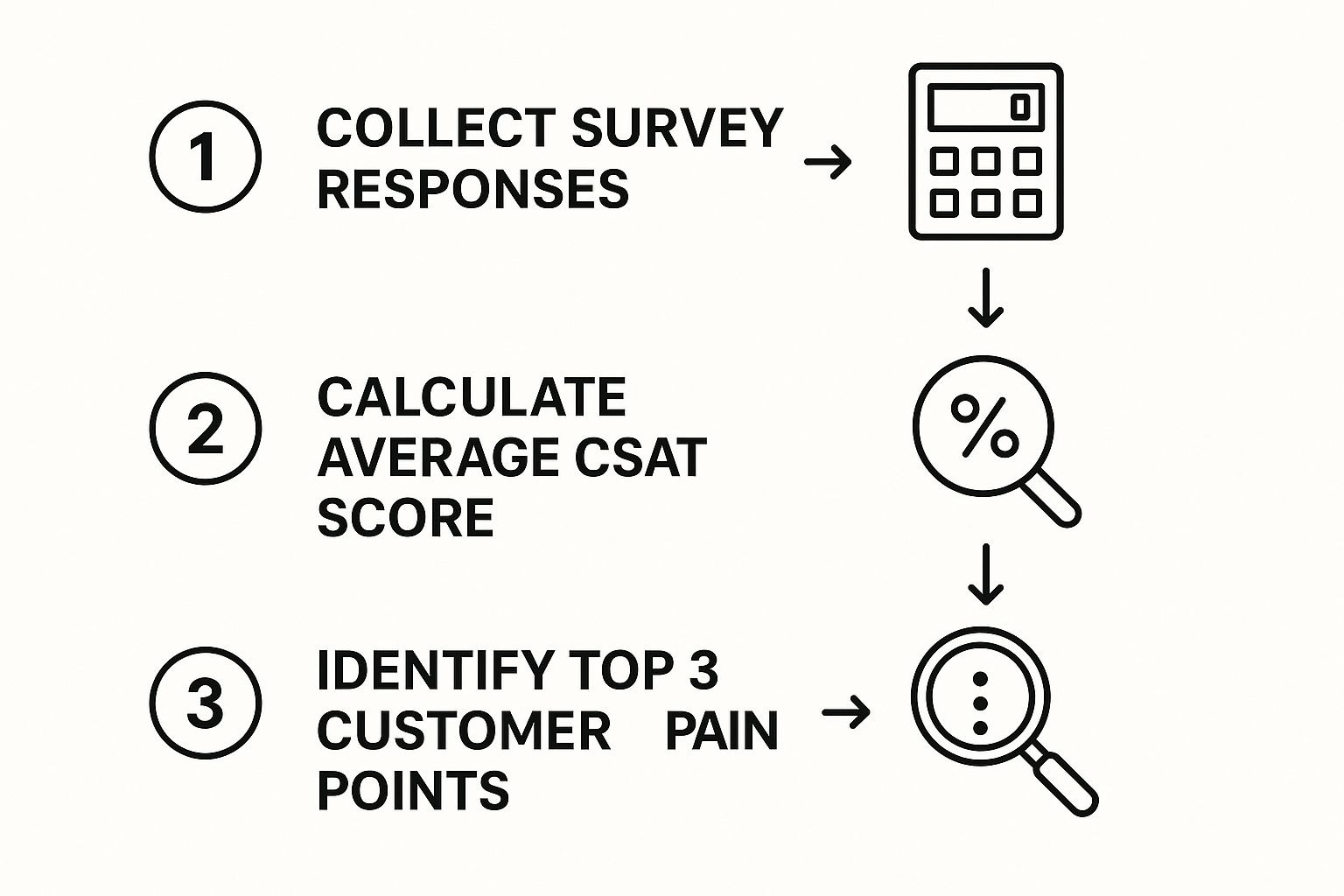
It breaks down how you can turn raw survey results into a concrete action plan, showing you exactly which issues you need to tackle first.
Set Up Smart Routing and Prioritization
One of the most common customer complaints? Getting bounced around to the wrong people. Intelligent routing is the key to getting a customer to the right expert on the very first try. Instead of dumping everyone into a single, general queue, you can automatically send tickets to specific agents or teams based on keywords, customer history, or the type of issue.
For instance, a ticket with the word "billing" can go straight to your finance team. A technical question about your API can be sent directly to a Tier 2 engineer. This completely gets rid of the dreaded "let me transfer you" conversation.
The goal is to make your internal complexity invisible to the customer. To them, it should feel like one seamless conversation with a person who can solve their problem right away.
Finally, remember that not all support tickets are created equal. You need clear Service Level Agreements (SLAs) and a solid ticket prioritization system to make sure the most critical issues get immediate attention.
Think about categorizing tickets by urgency and impact:
- Urgent: A system-wide outage affecting all users.
- High: A major feature is broken for a single high-value client.
- Normal: A simple "how-to" question or a minor bug report.
- Low: A feature request or a small cosmetic issue.
This kind of structure helps your team focus their energy where it truly matters. It also shows your customers you understand the severity of their problems and are on top of it, which is a powerful way to build trust and improve CSAT.
Use Technology and AI to Support Your Team

The right tech doesn’t replace your people; it supercharges them. I’ve seen firsthand how smart tools, especially AI, can completely change the game for a support team. It’s all about taking the tedious, soul-crushing work off their plates so they can focus on what humans do best: building relationships and solving the really tough problems.
Boosting CSAT isn't just about speed anymore. It’s about digging into the why behind customer issues. Modern tech gives you the power to analyze every single interaction, spotting patterns and pain points that you'd otherwise completely miss. This is how you shift your team from a purely reactive stance to one that proactively improves the entire customer experience.
Tools like an AI executive assistant are great for automating routine tasks and serving up data-driven insights. This frees up your team for the meaningful, high-empathy conversations that make customers feel truly valued.
Get Deeper Insights with AI-Powered Analysis
Imagine knowing the sentiment behind every customer conversation without having to read thousands of tickets. That’s not a dream; it’s what modern AI platforms do. They perform root cause analysis across all your channels—email, chat, phone calls—and give you real-time insights into what’s really going on.
This goes way beyond your standard surveys. I'm talking about AI that analyzes 100% of customer interactions, sifting through chat logs, emails, and call transcripts to generate precise CSAT scores as they happen. This kind of deep monitoring can detect subtle shifts in tone or frustration, giving you a picture that’s free from survey bias.
The real magic of AI in customer support is its knack for finding the "unknown unknowns." It can spot a recurring bug mentioned in just a few chats or flag confusing copy on your website that’s causing headaches. This lets you fix problems before they snowball.
When you can pinpoint the exact source of customer friction, you can fix the core problem instead of just patching up the symptoms. It’s a win-win: your CSAT scores go up, and your whole operation becomes more efficient.
Automate Repetitive Tasks to Empower Agents
Nothing burns out a good agent faster than answering the same simple questions over and over again. This is where automation is your best friend. By automating those high-volume, low-effort queries, you give your team the space to tackle the complex, high-value issues where their expertise really matters.
Here’s where you can start:
- AI-Powered Chatbots: Let them handle the easy stuff, like "What's my order status?" or "How do I reset my password?" This immediately frees up your agents for more complex conversations.
- Automated Ticket Routing: Good systems can instantly route tickets to the right agent or department based on keywords. Customers get to the right person faster, and no one wastes time playing traffic cop.
- Canned Responses and Templates: For those common questions that still need a human touch, templates are a lifesaver. They ensure faster responses while still allowing for personalization.
The goal is to find a balance where technology handles the predictable, and your team handles the exceptional. For more on this, check out our guide on how to https://blog.screendesk.io/automate-customer-support/ without losing that personal connection.
Turn Customer Feedback into Actionable Insights
https://www.youtube.com/embed/So8aseCO3hY
Getting CSAT scores is a great first step, but the numbers themselves don't tell the whole story. Knowing you have an 85% CSAT score is one thing, but it doesn’t explain why the other 15% of customers weren't happy. The real improvements come from digging into what people are actually saying.
This is where you need to get good at analyzing the open-ended comments. A single complaint might just be a one-off, but if you see five, ten, or twenty people mentioning the same confusing checkout step, you've just found a major issue that's probably costing you money. The goal is to move from guessing to knowing by systematically tracking this feedback.
Creating a Feedback Loop System
You can get started by creating a few simple categories to tag your feedback. This doesn't need to be some overly engineered system right out of the gate. Simple tags can tell you a lot.
For example, you could start with a few basic ones like:
- Product Bug: Something is clearly broken or not working as intended.
- Feature Request: The customer has a new idea or a suggestion for an improvement.
- Pricing Confusion: Something about the cost, billing, or subscription is unclear.
- Slow Response: The customer felt they had to wait too long for an answer.
Once you start tagging every piece of feedback that comes in, you can run simple reports to see where the problems are piling up. This immediately shows you where to focus your energy to make the biggest dent in customer frustration.
The best way to improve your CSAT score is to prove to customers that their feedback actually matters. It's not just about saying sorry—it's about showing them you listened and fixed the problem for good.
Following Up with Unhappy Customers
Honestly, one of the most powerful things you can do is personally reach out to customers who left a bad score. It’s amazing how often a timely, human follow-up can turn a really negative experience into a positive one. After all, research shows 1 in 3 customers will leave a brand they love after just one bad experience. Your response really counts.
Set up a simple process. When a poor score comes in, have someone reach out within 24 hours. The goal isn’t just to apologize, but to truly understand what went wrong and, if possible, offer a real solution. This simple act shows you're paying attention and makes people feel valued.
This whole approach is fundamental to managing the customer satisfaction metrics that shape how people see your brand. By consistently analyzing feedback and closing the loop, you create a system that naturally drives your scores up and builds real, lasting loyalty.
Common Questions About Improving CSAT
Even with a solid plan, you're bound to run into some practical questions when you start the real work of improving your CSAT score. Let's walk through a few of the most common hurdles I've seen teams face when putting these ideas into practice.
A question that comes up all the time is, "How often should we actually send out CSAT surveys?" It's a great question because blasting customers with a survey after every single interaction is a surefire way to cause survey fatigue.
My rule of thumb is to be strategic. Trigger surveys after key moments in the customer's journey—think moments of truth. Good examples are right after a support ticket is closed, once their initial onboarding is complete, or following a major purchase. This approach gets you timely, relevant feedback without burning out your customer base.
Another big one is getting the whole company to care. Your support team is on the front lines, so they're naturally invested. But to see real, lasting change, you need everyone from product to marketing to the C-suite on board.
The secret to getting buy-in? Frame your CSAT data in a language everyone understands: money. Don't just say, "Our CSAT score dipped by 2%." Instead, translate that into business impact. For example: "This drop in satisfaction is directly linked to a 5% increase in churn for this feature, which is costing us real revenue."
When you connect customer happiness to the bottom line, it suddenly becomes a priority for the entire organization.
How Can We Improve CSAT with Limited Resources?
This is a huge concern, especially for smaller teams or startups. It’s easy to feel like you can't make a dent without a big budget or a large team. But that’s not true at all. The key is to start small and focus on high-impact, low-cost changes. You don't need a fancy, expensive system to get started.
Here are a few practical things you can do right now, even on a shoestring budget:
- Build a Scrappy Knowledge Base: You don't need a sophisticated platform to begin. A simple shared document (like Google Docs) or a basic tool can serve as your first repository for common questions and answers. It costs next to nothing and will save your team a ton of time.
- Pick One Metric to Obsess Over: Don't boil the ocean. Dig into your data, find the single biggest pain point for your customers—maybe it's a slow first response time—and put all your energy into fixing just that one thing for the next quarter.
- Empower Your Agents with Trust: This one is completely free and incredibly powerful. Give your support agents the autonomy to solve problems without needing a manager's approval for every little thing. This simple cultural shift can speed up resolutions dramatically.
These focused efforts can deliver real, noticeable improvements without breaking the bank. For a deeper look at this, you can find more tips on how to increase customer satisfaction in our detailed guide.
Remember, improving CSAT is a marathon, not a sprint. Every small step forward is a win. The most important part is to simply start listening to your customers and taking consistent, deliberate action on what you hear.
Ready to see how video can transform your customer support and boost your CSAT scores? Screendesk provides the tools your team needs to resolve issues faster with personalized screen recordings and seamless live video calls. Start improving your customer satisfaction today.
