


When a customer has a bad experience, how you handle it is everything. It’s not just about fixing the problem; it’s about showing you care. A simple, human-centered approach—listening, showing empathy, taking ownership, and finding a fair solution—can turn a moment of frustration into a chance to build incredible loyalty.
A Modern Framework for Complaint Resolution
Let's be honest, mishandling a customer complaint is costly. It doesn't just lose you a sale; it slowly erodes the trust you've built in your brand. What's worse is that research shows a staggering 91% of unhappy customers won't even tell you they're unhappy. They just walk away.
This makes every single complaint you do receive pure gold. It's a direct signal from someone who cares enough to give you a second chance. They're telling you exactly where the cracks are, and that's an opportunity you can't afford to waste.
From Reactive Fixes to Proactive Insights
Putting out fires is exhausting. A truly effective approach to complaints isn't just about reacting; it's about getting ahead of the problems. You need a system to understand the why behind every issue. It starts with tracking where complaints are coming from, sorting them into categories, and looking for patterns that point to bigger, underlying issues.
This simple workflow shows how you can start turning raw feedback into real business intelligence.
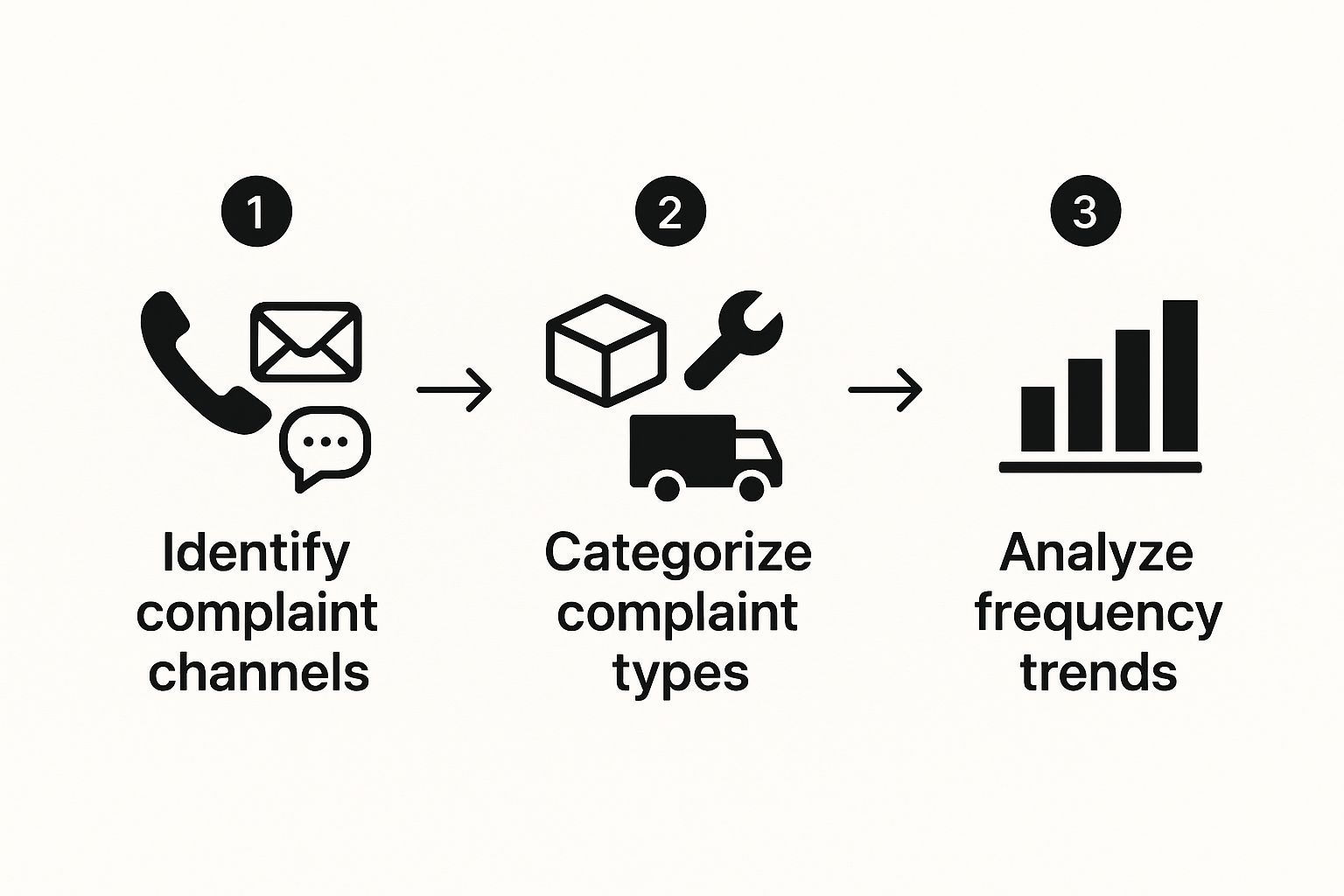
As the graphic illustrates, a structured process is key. When you track where feedback comes from and what it’s about, you can spot those nagging, recurring problems before they snowball.
For many growing businesses, having the right people in place is crucial. A smart strategy for scaling your support is establishing a remote customer service team to make sure every complaint gets the expert attention it deserves, and fast.
The real goal isn’t just to solve a problem. It’s to make the customer feel so heard and valued that they forget they were ever upset. That's how you create fans for life.
The Four A's: A Clear Path to Resolution
To give your team a reliable roadmap, we can break the process down into four core stages. Think of it as the "Four A's" of complaint resolution. This structure provides consistency and helps your team handle even the toughest situations with confidence.
Here’s a quick summary of the framework we’ll be exploring.
The Four A's of Complaint Resolution
| Stage | Objective | Key Action |
|---|---|---|
| Acknowledge | Validate the customer's frustration and de-escalate. | Listen without interrupting and offer a sincere apology for the trouble. |
| Assess | Get all the facts to find the root cause. | Dig into the issue by checking account history, logs, and other data. |
| Act | Propose and carry out a fair solution. | Clearly explain the fix and what the customer can expect next. |
| Affirm | Confirm the fix worked and the customer is happy. | Follow up after a day or two to make sure the problem is truly solved. |
This table lays out the core principles we'll dive into. Each stage is a chance to rebuild trust and show your company genuinely stands behind its promises. By mastering this framework, you can turn negative feedback from a threat into one of your greatest assets for improvement and growth.
Mastering the First Contact with Unhappy Customers
The first few moments after a customer complains are make-or-break. This is your chance to pivot from simply processing a ticket to genuinely understanding someone's frustration. How your team handles this initial touchpoint will determine whether you build loyalty or give them a reason to walk away.

You don’t need to have an immediate fix. The real goal is to make the customer feel seen, heard, and respected. It all starts with sincere empathy and a clear plan to de-escalate the situation, turning a negative moment into a productive conversation.
The Power of Empathy and Acknowledgment
Before you can even think about solving the problem, you have to defuse the tension. An angry customer isn't just mad about a bug or a shipping delay; they often feel ignored or powerless. Your first job is to hand that power back by validating their feelings.
This doesn't mean you have to agree with everything they say or accept blame right away. It simply means you recognize how they feel. A few simple phrases can work wonders:
"I can see how frustrating this must be."
"I understand why you're upset. I would be, too."
"Thank you for bringing this to my attention. I'm so sorry you're dealing with this."
These aren't admissions of guilt. They're acknowledgments of the customer's reality. A sincere apology for their bad experience can be incredibly disarming. In fact, research shows 45% of customers are willing to forgive a company after a genuine apology, proving a little empathy goes a long, long way.
The Human Connection in a Digital World
No matter how much tech we have, customers still want to talk to a real person, especially when things go wrong. We’ve all been there—stuck in an automated phone menu or arguing with a chatbot that doesn’t understand. A Microsoft study found that for 27% of U.S. consumers, not being able to reach a live agent was their biggest customer service headache.
This really drives home a critical point: making it easy for people to talk to people is non-negotiable. This isn't a niche preference, either. A whopping 75% of customers still choose to interact with a real person over an automated system. Building a simple path for a frustrated customer to reach a knowledgeable agent is the foundation of good complaint management. You can discover more insights about customer service trends and see how they impact satisfaction.
Empowering Customers to Show, Not Just Tell
One of the biggest hurdles in that first conversation is simply understanding the problem. A customer might struggle to explain a complex software glitch, which kicks off a long chain of back-and-forth emails that only makes things worse. This is where modern tools completely change the game.
Picture this: Instead of asking a customer to describe an error message, you invite them to record their screen. With a tool like Screendesk, they can send you a quick, asynchronous video that shows you exactly what's going on.
This simple shift accomplishes several things at once:
- It empowers the customer: They get to show you the problem on their own time, in their own way.
- It provides complete context: Your agent sees the issue firsthand—including the clicks that led to it—eliminating all the guesswork.
- It captures emotional tone: You can hear the frustration in their voice, which gives your team valuable cues on how to approach the situation with the right level of empathy.
When you let customers share their experience visually, you get to the heart of the issue faster. This doesn’t just speed up the investigation; it makes the customer feel like a partner in solving the problem, not just another ticket number. It shows you're ready to listen with your eyes and your ears from the very first second.
Digging In: How to Investigate Complaints with Empathy and Speed
Once a complaint is officially logged, the pressure is on. A fast, thorough investigation tells a customer you're taking them seriously. On the flip side, a slow or clumsy process just pours salt in the wound, confirming their initial frustration. The goal here is simple: get the full story quickly, without making the customer feel like they’re being interrogated.

Modern tools like Screendesk bring all this visual feedback into one place, as you can see above. It makes it so much easier for teams to literally see the problem and work together on a fix. This mix of smart tech and human understanding doesn't just solve problems faster—it shows you genuinely care about their specific issue.
First, Get Your Facts Straight
Before you even think about offering a solution, you need to become an expert on the problem. This means digging into the details that go way beyond the initial ticket. I've seen it time and time again: teams rush this step, leading to half-baked solutions and an even angrier customer.
Take a moment to review all the information you have. This isn't just about patching the immediate issue; it's about understanding why it happened in the first place.
Here’s what to look for:
- Customer's Account History: Is this their first time reporting an issue, or is this a recurring problem? Are they a brand-new user still learning the ropes or a long-time power user? This context is gold for tailoring your response.
- Previous Conversations: Skim through every past interaction you've had with them. Nothing makes a customer see red faster than having to repeat their entire story for the third time.
- Internal Data: Look at the raw data. Check your system logs, their order history, or any other backend information that might reveal a technical hiccup.
Doing this homework upfront means that when you follow up with the customer, you're coming from a place of knowledge, not just making educated guesses. If you're building out your process from scratch, our guide on handling customer complaints is a fantastic resource for creating a system that works every time.
See the Problem Through Their Eyes
Let's be honest, text support can only go so far. A customer might write, "The dashboard is broken," but what does that actually mean? A button isn't clicking? Data isn't loading? Maybe they're using an ancient browser you don't support. This ambiguity is what leads to those painful, endless email chains.
This is exactly where visual tools change the game. When a customer can just send a quick screen recording of the issue, the whole investigation is transformed.
A two-minute screen recording often provides more clarity than a dozen back-and-forth emails. It completely removes the guesswork. Your team can see the exact clicks, the unexpected behavior, and even pull critical details like browser version and console logs right from the video.
Think about it. A customer is wrestling with a tricky software bug. Instead of asking them to describe the indescribable, you get a video. You see them click a button, and you see the precise error message that follows. Instantly, your dev team has everything they need to replicate and squash that bug.
This approach delivers two massive wins:
- It’s faster for everyone. The customer doesn't have to play tech-translator, and your team gets straight to the root of the problem.
- It builds empathy. You’re not just reading words on a page; you're watching their frustrating experience unfold. It helps your team connect with them on a human level.
Work Together to Find the Root Cause
Many customer problems, especially the complex ones, can't be solved by one support agent alone. They often need expertise from other teams—product, engineering, billing, you name it. The secret to great collaboration is making it invisible to the customer.
Bouncing a customer from one department to another is a classic recipe for a terrible experience. A much better way is to use a central system where your teams can huddle up behind the scenes.
For instance, a support agent can share a customer's screen recording directly with an engineer in a shared Slack channel or ticketing system. The engineer sees the bug in action, checks the console logs attached to the video, and can either ship a fix or suggest a workaround. The best part? The engineer never has to speak directly to the customer. This internal teamwork presents a unified, competent front, and the customer simply gets a fast, accurate answer.
You've done the hard work of digging into the complaint and figuring out what went wrong. Now comes the moment of truth: communicating the solution and taking action.
Getting this part right is what separates an okay support experience from one that actually rebuilds trust. Simply finding a fix isn't the finish line. The way you deliver that solution is what can turn a frustrated customer into a loyal advocate. This is where you shift from investigator to problem-solver, providing clarity and proving you’re committed to making things right.

A well-explained solution delivered with a personal touch can completely transform a negative situation. It shows your company isn't just a faceless entity—it's made of people who genuinely care.
Come Clean and Explain What Happened
First things first, you need to tell the customer what went wrong, and you need to do it in plain English. Drop the corporate-speak and technical jargon. Nobody wants to hear about a "database synchronization error." It sounds like an excuse.
Customers appreciate honesty way more than they expect perfection.
Instead, try something more human: "We found a bug in our system that was causing your order information to display incorrectly for a short time. I am so sorry for the confusion and frustration that must have caused."
This direct approach works because it:
- Makes sense of the issue: The customer actually understands what happened.
- Shows you own it: You're taking full responsibility, not hiding behind tech talk.
- Validates their feelings: It confirms there was a real problem and they were right to be upset.
Never underestimate the power of a sincere apology. One study found that 45% of customers will forgive a bad experience if the company offers an authentic apology. It’s a simple act with a huge impact.
Show, Don't Just Tell, with a Personalized Video
Explaining a fix over email can get messy fast, especially if the customer needs to follow a few steps. A long, numbered list feels cold and is often a recipe for more confusion and follow-up questions. This is the perfect opportunity to deliver a surprisingly personal and effective solution.
Instead of typing out a wall of text, why not record a quick, personal video using Screendesk? You can greet the customer by name, show them exactly what happened on your screen, and then walk them through the fix.
Imagine a customer is wrestling with a tricky software setting. A video that starts with, “Hi, Sarah! Thanks again for your patience. I've figured this out and have a fix for you. Let me quickly show you what to do,” is a game-changer. Then, you simply share your screen and guide them through the process, click by click.
This method is so much more effective than text because it’s:
- Personal: Hearing their name and your voice makes the whole interaction feel human.
- Crystal Clear: They can see exactly what to do, which kills any chance of misunderstanding.
- Efficient: It solves the problem faster and drastically cuts down on back-and-forth emails.
This small gesture of creating a custom video turns a routine support ticket into a memorable experience. It shows a level of care that really makes your brand stand out.
Set Clear Expectations for What’s Next
Whether you have an instant fix or it's going to take a bit more time, you absolutely have to set clear expectations. Vague promises just lead to more anxiety and frustration for the customer.
Be completely upfront about timelines, what the customer might need to do, and when they’ll hear from you again. Leaving them in the dark is not an option.
Here’s a simple way to frame the next steps:
| Action Item | Example Communication |
|---|---|
| What We're Doing | "Our engineering team is pushing out a patch tonight to fix the bug you found." |
| What You Can Expect | "The update will be live by 9 AM tomorrow. You shouldn't have to do a thing." |
| When We'll Follow Up | "I'll shoot you a quick email tomorrow afternoon just to confirm everything is working smoothly for you." |
This approach leaves no room for doubt. The customer knows what’s happening, when it will be over, and that you’re going to be there to make sure it’s truly fixed. That final follow-up closes the loop and cements their confidence in your company.
Connecting Complaint Handling to Business Growth
How you handle customer complaints isn't just about good service—it’s a direct line to your bottom line. It's all too easy to see complaints as a cost center, a frustrating drain on time and resources. But if that's all you see, you're missing the bigger picture.
Each complaint is a bright, flashing signal. It highlights a genuine opportunity to improve and, more importantly, a chance to win a customer for life. Thinking of complaint management as a growth engine changes everything. The goal shifts from simply "closing the ticket" to actually rebuilding trust and strengthening a relationship.
This simple change in mindset turns a moment of friction into a powerful tool for retention and revenue.
The Real Cost of Getting It Wrong
The financial damage from poor service is staggering. When customers feel ignored or misunderstood, they don't just get upset—they walk away.
The numbers don't lie. Globally, a massive 71% of consumers have ditched a company because of a bad service experience. In the United States alone, that figure sits at a hefty 40%.
And it doesn't take much to push them out the door. A shocking 92% of customers will abandon a brand after just two or three negative interactions. This isn't just data; it's a warning. Effective, empathetic complaint handling isn't a "nice-to-have" luxury. It’s your front-line defense against churn, directly protecting your revenue.
The flip side? Good service can boost customer loyalty by up to 93% and increase sales by 2–7%. Suddenly, the investment seems obvious. You can discover more about these complaint management statistics and what they mean for your business.
So, the critical question is: are you set up to win back trust, or are you accidentally sending customers straight to your competitors?
Turning Complainers into Your Biggest Fans
It might sound strange, but a customer who takes the time to complain is often far more invested in you than the silent majority who just leave. They're giving you a second chance. What you do with it is everything.
When you resolve their issue with genuine care and efficiency, you don't just solve a problem—you create a story.
This is the service recovery paradox in action. It’s a fascinating phenomenon where a customer actually thinks more highly of your company after you fixed their problem than if they never had one in the first place. The initial negative experience gets completely overshadowed by the positive resolution.
A customer whose problem is fixed becomes a powerful advocate. They have a compelling, authentic story to tell about how your company stepped up when it mattered. This kind of word-of-mouth marketing is priceless.
Think about the last time a company truly wowed you with its support. You probably told someone. Now imagine empowering your team to create those moments consistently. For example, a customer struggling with a technical bug isn't just relieved when you send a personalized Screendesk video walkthrough—they’re genuinely impressed.
Complaint Handling as a Proactive Growth Strategy
Viewing complaints as raw, unfiltered feedback unlocks their true strategic value. Every issue that gets reported is a piece of free consulting, telling you exactly where your product, service, or process has a crack.
By tracking and analyzing complaints, you can spot patterns that point to deeper issues.
- Product Development: Are multiple users complaining about the same confusing feature? That's a clear signal for your product team to prioritize a redesign.
- Process Improvement: Do many complaints mention slow shipping? It’s time to review your logistics and fulfillment partners.
- Marketing Clarity: Are customers consistently misunderstanding a specific offer? Your marketing messaging may need a tune-up.
This proactive approach stops you from just putting out fires and lets you fix the faulty wiring that starts them. Using the right customer-facing technologies can even help you get ahead of issues before they become full-blown complaints.
When you systematically turn negative feedback into actionable insights, your complaint process becomes a direct contributor to innovation and sustainable growth.
Why the Human Touch Is Your Secret Weapon
Even with all the automation available today, nothing beats genuine human empathy. We've all been there—stuck in a chatbot loop when all we want is a real person. While tech is great for efficiency, it can't build the kind of trust that comes from a real conversation. This is especially true when handling customer complaints, where putting people first isn’t just a nice idea—it’s a solid business strategy that protects your bottom line and your team's sanity.
The financial hit from getting this wrong is massive. U.S. companies lose a jaw-dropping $75 billion a year just from poor customer service. That number reflects customers walking away, support tickets dragging on forever, and talented employees heading for the door. Investing in your people is the best way to stop the bleeding. If you're curious about the wider trends, recent research digs into the global impact of customer loyalty.
The Hidden Costs of a Stressed-Out Team
When we think about bad service, we usually picture angry customers. But the internal damage to your team can be just as devastating. Throwing support agents into high-pressure situations without the right tools or training is a recipe for burnout. This creates a revolving door of employee turnover.
Believe it or not, replacing a single customer service agent can cost a business around $10,000. That figure doesn't even touch on the lost productivity or the hit to team morale. This constant churn eats away at the quality of your support and, you guessed it, makes the customer experience even worse.
An engaged employee is your best brand ambassador. A burned-out employee is your biggest risk. When you invest in your team’s well-being and training, you are directly investing in customer satisfaction.
And the data backs this up. A full 76% of customer service employees feel more engaged when their leaders show empathy. That feeling of being supported and understood translates directly into more patient and effective resolutions for your customers.
Finding the Sweet Spot: Tech That Empowers People
The real goal isn't to pick between technology and people. It’s about finding that perfect balance where tech helps your team be more human, not less.
Think of it this way: smart tools should automate the tedious, repetitive stuff. This frees up your agents to focus on what they do best—listening, creative problem-solving, and actually connecting with customers. For example, using a tool like Screendesk to see a customer’s problem on video instantly gives an agent the context they need. Instead of asking a dozen questions, they can focus on the customer’s frustration and finding a solution.
This blend of tech-driven efficiency and human empathy is where the magic happens. You can learn more about getting ahead of issues in our guide to building a proactive customer service strategy. Ultimately, the best technology serves as a bridge to a better human connection, not a barrier that keeps people apart.
Common Questions About Managing Customer Complaints
Even with a great plan in place, a few tricky questions always pop up when you're dialing in your complaint resolution process. Getting straight, real-world answers helps your team handle tough situations with confidence and consistency, turning problems into moments of trust.
Here are a couple of the most common questions we hear from teams who are really digging in and trying to master the art of turning a complaint around.
What's the Single Most Important First Step?
It all starts with active listening. Simple as that. Before you jump into problem-solving mode, you have to show the customer you've genuinely heard their frustration.
A quick, sincere acknowledgment of how they're feeling can completely change the tone of the conversation. It defuses tension right away and proves you’re taking them seriously from the get-go.
Remember, acknowledging someone's feelings isn't the same as admitting fault. A simple, "I'm so sorry for the frustration this has caused you," builds an immediate connection and opens the door for a real conversation, no matter where the blame ultimately lies.
How Do You Deal with a Customer You Just Can't Seem to Please?
This is a tough one, and it happens. The key is to stay professional and empathetic, no matter what. Make sure you document every single interaction and clearly lay out the final, fair resolution your company is able to offer.
If the customer still isn't happy, you can calmly restate the solution and explain that you've exhausted all the available options. Knowing when to politely and respectfully end the conversation is so important for protecting your team’s time and energy.
Your goal is always a fair resolution, not necessarily making every single person happy. How you handle these difficult moments gracefully says a lot about your company. In the long run, it all contributes to your success, which you can learn more about in our guide on how to increase customer satisfaction.
At Screendesk, we built our entire platform on a simple idea: seeing is solving. Our video tools give your team the power to handle complaints with incredible clarity and empathy, helping you turn bad experiences into loyal customers. Discover how Screendesk can transform your customer support today.
