


When we talk about customer service digital transformation, we're not just talking about buying a new chatbot or launching a help center. We're talking about a complete, ground-up reinvention of how you communicate with your customers, using technology to build an experience that feels connected and effortless.
It’s less about bolting on a new tool and more about fundamentally changing your operations, your processes, and even your company culture to deliver the fast, personal, and effective support that people now expect.
Redefining Support in a Digital-First World
Think of it like renovating an old house. You could just buy a new couch—that’s like adding a single piece of software—but that won't fix the leaky pipes or outdated electrical wiring. A real transformation means rethinking the entire layout to make the space work better for the people living in it. That’s what this shift does for your customer journey.
The process involves weaving digital tools into every single touchpoint a customer has with your business. The idea is to break down the walls between your support channels. No more isolated phone lines, disconnected email inboxes, or separate social media teams. Instead, you create one intelligent, unified system that truly understands and even anticipates what your customers need.
The Core Idea Behind the Shift
So, what’s driving this massive change? It all boils down to one thing: sky-high customer expectations.
One study found that 40% of business leaders named customer experience as the main reason they were pursuing digital projects. People are used to the slick, on-demand experiences they get from companies like Amazon and Netflix, and they bring those same expectations to every other business they interact with.
A successful customer service digital transformation meets people where they are by focusing on a few key pillars:
- Proactive Engagement: Using data to spot potential problems and reach out to customers before they even know they have an issue.
- Seamless Omnichannel Support: Letting customers start a chat on your website, switch to email, and then jump on a call, all without having to repeat their story.
- Empowered Agents: Giving your support team the right tools, a complete view of the customer's history, and AI-powered assistance to solve problems faster and with more confidence.
- Self-Service Options: Building out great knowledge bases, smart FAQs, and community forums so customers can find their own answers, anytime they want.
This isn't just about making things more efficient. It's about building stronger, more meaningful relationships. Research shows that highly engaged customers buy 90% more often and spend 60% more with each purchase.
Ultimately, this kind of transformation isn't a project with a start and end date. It's a continuous commitment to evolving alongside your customers. It demands a culture where everyone—from marketing to product—is obsessed with delivering an amazing service experience. By making technology work for your customers, you don’t just solve problems better; you build real loyalty and unlock serious growth.
The Real Cost of Doing Nothing

Ignoring the shift to digital customer service isn’t just a missed opportunity—it’s a surefire way to lose money and ground to your competitors. Sticking with old, manual methods in a world that expects instant answers is like trying to bail water out of a sinking boat with a teacup. Eventually, the leaks from frustrated customers and clunky workflows will pull you under.
The fallout isn't just theoretical; it shows up in black and white on your balance sheet. When customers hit roadblocks, wait on hold forever, or have to repeat themselves, their patience runs out fast. One bad experience is often all it takes to send them looking for a competitor who makes things easy. Every customer who walks away chips away at your revenue.
The Financial Drain of Old-School Systems
Legacy systems aren't just dated; they're a quiet but significant financial burden. The costs pop up everywhere, from lost sales to bloated operational budgets. The numbers tell a pretty clear story about what’s really at stake.
U.S. companies lose an estimated $75 billion a year simply from poor customer service. There’s a huge gap where technology could be making a difference. Despite all the talk about AI, only about 25% of call centers have actually brought AI automation into their daily routines. This isn't just about plugging in new tech; it's about smart strategy that combines technology with a human touch to stop the financial bleeding. You can dig deeper into these customer service findings from Amplifai.com.
The expense doesn't end with lost customers, either. Think about the operational drag from inefficient, manual work. Your team is sinking hours into repetitive tasks that a simple automation could handle in seconds.
This inefficiency directly leads to:
- Longer Resolution Times: Agents burn precious minutes digging for information across different, disconnected systems.
- Higher Labor Costs: You have to hire more people to handle the same number of inquiries that a digitally-equipped team could manage easily.
- More Mistakes: Manual data entry is a recipe for typos and errors, which only leads to more rework and even more annoyed customers.
A recent study found that 55% of businesses worry they have less than a year to adapt before they start losing serious market share. The clock is ticking, and standing still is a gamble most can't afford.
The Hidden Toll on Your Team
The problems with outdated customer service aren't just customer-facing. They create a toxic environment that can cripple your support team from the inside. When your agents have to fight with clunky software and hunt for scattered information, their jobs become a daily struggle. They end up absorbing all the customer's frustration without having the tools to actually fix the problem.
This is a perfect storm for burnout. Agents get disengaged and demoralized, and before you know it, your turnover rates are through the roof. Constantly hiring and training new people is expensive, and it drains your team of experience and knowledge, causing service quality to dip even further. A digital overhaul isn't just for customers—it empowers your team. Without it, you're just building a revolving door for your best people.
Core Pillars of a Successful Transformation
A truly great customer service transformation doesn’t just happen. It's built on a few core pillars that work together to create something modern, resilient, and totally focused on the customer. Think of it like building a house—if any of the foundational supports are weak, the whole structure is at risk.
These pillars give you a clear roadmap. They guide you from big-picture strategy all the way down to the daily tasks, focusing on smart data use, intelligent automation, a unified customer journey, and—most importantly—empowering the people on your team.
Pillar 1: Data-Driven Decisions
The first pillar is all about truly understanding your customers. For years, customer service was a reactive game, waiting for a problem to pop up. A modern digital approach completely flips that idea on its head. It uses data to figure out what customers need, often before they even realize it themselves.
Every time a customer interacts with your business—a website click, a past purchase, a support ticket—they leave behind a breadcrumb of data. When you gather and analyze these breadcrumbs, you get a crystal-clear picture of their journey, revealing where they get stuck and where you can make things better. It’s the difference between guessing what customers want and knowing what they need.
- Predictive Analytics: By digging into past support tickets and user behavior, you can spot patterns that scream "potential problem." For example, if a ton of users visit a specific FAQ page and then submit a support ticket within 10 minutes, that page probably isn't doing its job.
- Personalization: Data helps you treat customers like individuals. Instead of one-size-fits-all answers, you can offer solutions and support that are directly relevant to their history with your brand.
- Proactive Outreach: Once you have these insights, you can get ahead of problems. This is where proactive customer service comes in. You can reach out with a helpful tip or a solution to an issue you predict they’ll face, turning a potential headache into a "wow" moment. For a deeper dive, check out our guide on implementing proactive customer service.
Pillar 2: Intelligent Automation and AI
Next up is bringing in automation and artificial intelligence (AI) to handle the routine stuff. This frees up your human agents to tackle the complex, high-value conversations where they truly shine. The goal here isn’t to replace your team; it’s to give them superpowers.
AI-powered tools like chatbots can answer simple, repetitive questions 24/7 without ever getting tired or making a typo. This is huge for customer satisfaction, especially since one study found that over half of consumers expect a response from customer service within an hour. Automation is built for that kind of demand.
Automation isn't about creating a faceless, robotic experience. It's about using technology to handle the predictable so that your talented human agents can handle the exceptional.
Below is a snapshot of the key technologies powering this shift.
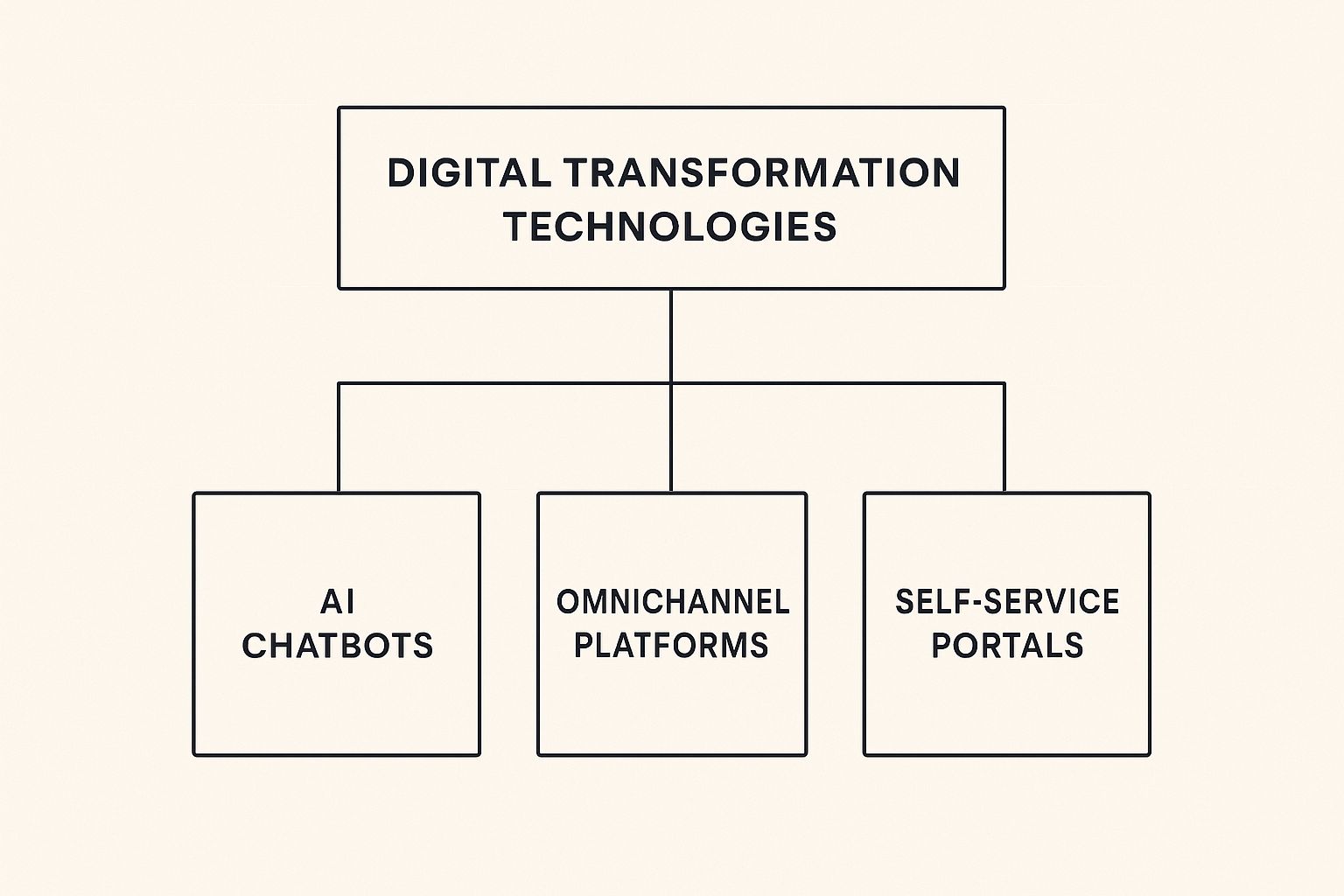
As you can see, tools like AI chatbots and self-service portals are fundamental for automating the customer experience and creating some serious efficiencies.
To get a clearer picture of the technology involved, it helps to break down the tools, their functions, and the tangible benefits they bring to the business.
Key Technologies Driving Customer Service Transformation
| Technology | Primary Function | Key Business Benefit |
|---|---|---|
| AI-Powered Chatbots | Provide instant, 24/7 responses to common customer queries and requests. | Reduces agent workload, cuts response times, and improves customer satisfaction for simple issues. |
| CRM Systems | Centralize all customer data, interaction history, and communication logs in one place. | Gives agents a complete 360-degree view of the customer for more personalized and informed support. |
| Self-Service Portals | Empower customers to find answers, track orders, and solve problems on their own. | Lowers support ticket volume, reduces operational costs, and meets customer demand for autonomy. |
| Predictive Analytics | Analyze historical data to anticipate customer needs and identify potential friction points. | Enables proactive outreach, reduces customer churn, and helps identify areas for service improvement. |
| Omnichannel Platforms | Integrate all communication channels (email, chat, phone, social) into a single, unified view. | Creates a seamless customer journey, eliminates repetition, and improves agent efficiency. |
Ultimately, these tools work together to create an ecosystem where both customers and agents are set up for success.
Pillar 3: A Seamless Omnichannel Experience
The third pillar is about creating one unified, consistent journey for your customers, no matter how they choose to contact you. In the old days, phone, email, and social media were like separate islands. This meant customers had to repeat their entire story every time they switched channels, which is incredibly frustrating.
An omnichannel strategy demolishes those islands. It ensures a conversation can start on a chatbot, move to email, and then escalate to a video call without losing a single bit of context. The customer's history travels with them, creating one continuous dialogue.
This requires tight integration between your different platforms and systems. But the payoff is huge: no matter where a customer finds you, they get the same high-quality service and consistent brand voice.
Pillar 4: Empowered Human Agents
The final pillar—and you could argue it's the most important—is empowering your human agents. Technology is a fantastic tool, but your people are the ones who build relationships and provide the empathy a machine can't. A true customer service digital transformation should make their jobs better, not obsolete.
This means giving them the right tools and the right training. An empowered agent has:
- A 360-Degree Customer View: A single dashboard showing every past interaction, purchase, and data point for the customer they're helping. No more hunting for information.
- AI-Powered Assistance: Real-time suggestions, instant access to a shared knowledge base, and automated summaries of long conversations.
- Advanced Communication Tools: The ability to instantly escalate a chat to a screen-sharing session or a live video call to solve tricky problems faster.
When your agents are truly empowered, they stop being reactive problem-solvers and become proactive relationship-builders. They have everything they need to not only fix an issue but also delight the customer, building the kind of loyalty that lasts.
How to Navigate Common Transformation Challenges

Starting a customer service digital transformation is a game-changer, but let's be real—it’s never a straight line from A to B. It’s a major strategic shift, and the path is almost always littered with obstacles that can stop you in your tracks if you’re not prepared.
These hurdles aren’t just about the tech, either. More often than not, they’re about people, outdated processes, and the creaky old infrastructure holding everything together. Getting this right means knowing what’s coming and planning for it. By anticipating the common pitfalls, you can build a smarter, more resilient strategy that accounts for both the shiny new tools and the people who will use them.
Overcoming Employee Resistance to Change
One of the biggest roadblocks you'll hit is internal resistance. Your support agents have their routines, and throwing new tools or processes into the mix can feel like a major disruption. It’s natural for them to worry if their jobs are on the line or to feel overwhelmed by having to learn a whole new system.
The key to getting everyone on board is communication. You have to frame this transformation as a way to empower them, not replace them. Show them how the new tools will take the boring, repetitive tasks off their plate so they can focus on the complex, human-to-human problem-solving where they really shine.
- Involve Your Team from Day One: Bring your agents into the conversation early. Ask for their feedback on new tools and workflow designs. When people feel like they have a say, they’re far more likely to get behind the change.
- Don't Skimp on Training: Set them up for success with hands-on training, easy-to-find help guides, and a solid support system for when they get stuck.
- Answer the "What's in It for Me?" Question: Make it crystal clear how these changes will make their day-to-day work less stressful, more efficient, and ultimately help them deliver better results for customers.
Integrating New Tech with Old Systems
Another classic headache is trying to make modern platforms play nice with your legacy systems. Lots of companies run on a patchwork of older software that simply wasn't built to talk to new, cloud-based tools. This can lead to data getting stuck in silos and clunky workarounds that defeat the whole purpose of the upgrade.
Think of it like trying to plug a new 4K streaming device into an old tube TV. It’s not impossible, but you’ll need the right adapters and a bit of patience to get it working. A phased rollout is usually your best bet here. Start small by connecting just one or two systems, show that it works, and learn from the process before going all-in.
The goal isn’t just to connect systems; it’s to create a single source of truth for all customer information. This unified view is the foundation of a truly modern customer service operation.
A significant hurdle in digital transformation is often a lack of necessary skills within the existing workforce. Discover strategies for businesses adapting to the tech skills gap.
Maintaining the Human Touch in an Automated World
As you roll out chatbots and automated replies, there's a real risk of losing the personal, empathetic connection that makes for great customer service. Nothing frustrates a customer faster than getting trapped in an automated loop with no way to reach a real person. The trick is to strike the right balance between machine efficiency and human empathy.
Use automation for the simple, repetitive questions, but always—always—provide a clear and easy "escape hatch" for customers to talk to a human. This isn't just a nice-to-have. According to recent survey data, 58% of consumers reported never receiving a response after contacting a company. And with 63% of customers ready to walk away after just one bad experience, failing to connect is a direct threat to your bottom line.
Real-World Examples of Transformation Success
Theory is great, but seeing a customer service digital transformation in action is what really makes the lightbulb go on. When you look at how real companies solved real problems, you get a practical blueprint for what actually works. These stories prove that transformation isn't just about bolting on new tech—it's about fundamentally changing the way you interact with your customers.
Let's break down two very different examples—one from retail and another from finance—that completely nailed their digital shift. Each had its own unique hurdles, but both ended up in the same place: with happier, more loyal customers and a much healthier bottom line.
How a Retailer Built a Seamless Shopping Journey
A major retailer with hundreds of brick-and-mortar stores and a booming e-commerce site had a classic, nagging problem: their customer experience was totally disconnected. A customer might browse online, pop into a store to check something out, and then ping support on social media later. The issue? None of these teams had a clue what the other was doing.
This created maddeningly repetitive conversations where customers had to re-explain their entire story at every turn. The company knew it was hemorrhaging sales and eroding trust with every one of these broken interactions. Their goal was simple: create a single, unified experience where customers felt seen and understood, no matter where they showed up.
To pull this off, they rolled out a powerful omnichannel platform to tie everything together:
- Centralized Customer Profiles: They connected their CRM, e-commerce site, and in-store sales systems. Suddenly, every support agent had a 360-degree view of every customer.
- Unified Communication Hub: All channels—email, chat, social media, and phone calls—fed into one single screen for agents. An agent could instantly see a customer's abandoned cart, their last in-store purchase, and their entire chat history in one place.
- Proactive In-App Support: They used their mobile app to push location-based help and personalized offers, finally bridging the gap between their digital and physical worlds.
The results were stunning. By mapping out and smoothing over every touchpoint, they created a genuinely seamless journey. Customer satisfaction scores shot up by 18%, and repeat purchases climbed by 12% within the first year. Getting a handle on the entire customer journey was the key to their win. If you're looking to do the same, our in-depth guide to customer experience journey mapping is the perfect place to start.
A Financial Firm’s Leap into AI-Powered Personalization
A mid-sized financial services firm was drowning in high call volumes and frustratingly long wait times. Their support team was bogged down with the same simple questions over and over—account balances, transaction histories, password resets. This bottleneck wasn't just annoying customers; it was also preventing agents from focusing on the complex financial advisory work where they could add real value.
The firm's game plan was to use AI and automation to deflect all the routine stuff, freeing up their human experts to deliver truly personalized guidance. They weren't trying to replace their people; they wanted to make them superhuman.
The core idea was to use technology to manage the predictable so that human agents could master the exceptional. This strategic balance is key to a successful digital transformation in customer service.
Here’s how they did it:
- An AI-Powered Chatbot: They launched a chatbot on their website and mobile app, training it to handle over 60% of common questions instantly, 24/7.
- Smart Escalation Paths: If the bot hit a wall or sensed a customer was getting frustrated, it seamlessly handed off the entire conversation and history to a live agent. No more starting over.
- Agent Assist Tools: Agents got new AI-powered tools that fed them real-time information and suggested next steps during calls, helping them solve tricky issues much faster.
The impact was immediate. The average time it took to handle an inquiry plummeted by 40%, and the number of issues solved on the first try went way up. This move proved that being obsessed with the customer experience pays off. Research shows that companies with this mindset achieve a 43% better customer retention rate, 33% higher profitability, and 28% more revenue growth on average. You can dig into the full customer-obsession findings from Telus Digital to see the data for yourself.
Your First Steps in Modernizing Customer Experience

Starting a customer service digital transformation isn't a single, massive project—it’s a journey of continuous improvement. With a solid strategy in place, the best way to get moving is to start small, build momentum, and learn as you go.
Here are three practical steps you can take today to start bringing your customer experience into the modern era.
1. Audit Your Current Customer Journey
Before you can build a better path, you need a clear map of the one you already have. You have to walk in your customer’s shoes, step-by-step, from the moment they first look for an answer on your FAQ page to when they finally submit a support ticket.
Look for every single point of friction. Where do people get stuck? What questions go unanswered? Where do they have to repeat themselves? Finding these pain points gives you a solid, data-backed foundation for your entire plan.
2. Gather Direct Customer Feedback
Your audit will show you the cracks in the process, but direct feedback tells you how your customers feel about those cracks. You simply can't build something customer-focused without actually talking to your customers.
- Deploy Simple Surveys: Use tools to send out quick Net Promoter Score (NPS) or Customer Satisfaction (CSAT) surveys right after key interactions, like when a support ticket is closed.
- Conduct Interviews: Have real conversations with a small but diverse group of customers. Ask them about their frustrations and what they truly expect from you, and let them answer in their own words.
This kind of feedback is gold. It adds a human story to your analytics and makes sure the changes you make will solve real problems for real people.
A business that truly listens doesn't just solve problems—it builds loyalty. Remember, research shows 72% of business leaders see digital shifts as a prime opportunity to create better relationships with customers.
3. Launch a Focused Pilot Project
It’s tempting to try and fix everything at once. Resist that urge. Instead, pick one significant pain point you discovered and launch a small, controlled pilot project to tackle it.
For example, you could set up a basic chatbot to handle the top five most common questions your team gets. This lets you test new tools and measure the impact with very little risk. More importantly, it helps you score a quick win that builds confidence and support for bigger changes down the road.
Frequently Asked Questions
When you start thinking about modernizing your customer service, a lot of questions pop up. Let's tackle some of the most common ones that business leaders ask.
How Do You Measure the ROI of This Transformation?
Figuring out the return on investment (ROI) here isn't just about subtracting software costs from your budget. A good measurement plan looks at the whole picture—how the changes affect your costs, your team, and most importantly, your customers.
First, look at the straightforward cost savings. Are you seeing fewer phone calls because customers are finding answers on their own? Are automated workflows handling simple, repetitive tasks that used to eat up your team's time? These are your quick, easy wins.
Next, zoom in on your team's productivity. Keep an eye on a few key metrics:
- First Contact Resolution (FCR): When this number goes up, it means your agents have the right tools to solve problems on the first try.
- Average Handling Time (AHT): Don't be surprised if this goes up for complex issues—that's a good sign! It means automation is handling the easy stuff, and your team is spending quality time on the problems that really need a human touch.
- Tickets Handled Per Agent: This shows your team is becoming more efficient, handling more customer conversations without letting quality slip.
Finally, and this is the big one, track the impact on your customers. Better Customer Satisfaction (CSAT) scores, a higher Net Promoter Score (NPS), and improved customer retention are the ultimate proof that your investment is working. Keeping customers happy and loyal has a massive effect on your revenue down the road.
Can Small Businesses Implement These Strategies?
Yes, absolutely. This kind of change isn't just for huge companies with deep pockets. In many ways, small businesses have an advantage—they can be more nimble and adopt new tools much faster than larger corporations.
The trick is to start small and focus on what will make the biggest difference right now. A small business probably doesn't need a massive, all-in-one CRM from day one. You can start with simpler, more focused tools.
The goal for a small business is not to implement everything at once, but to strategically choose tools that solve the biggest customer pain points first. This creates immediate value and builds momentum for future improvements.
For instance, setting up a shared inbox with a basic chatbot can make a huge difference in how organized you are and how quickly you can respond. You can explore how small adjustments lead to big wins by learning more about strategies to increase customer satisfaction.
What Is the Future Role of Human Agents with AI?
The rise of AI doesn't mean human agents are on their way out. Far from it. It means their role is changing—becoming more strategic and more valuable. As AI and automation take care of the routine, predictable questions, your human agents are freed up to become true problem-solvers.
Their future will be focused on:
- Handling Complex Issues: Agents will take on the tricky, emotional, or technically difficult problems that need empathy and real critical thinking.
- Building Customer Relationships: With more time for each important conversation, agents can build genuine rapport and create memorable experiences that turn customers into fans.
- Providing Proactive Support: Using insights from AI, your team can spot potential issues and reach out with solutions before a customer even has to ask.
Think of AI as a co-pilot for your support team. It gives them the data, context, and tools they need to provide exceptional, high-touch service exactly when it counts.
Ready to see how video can transform your customer support? Screendesk offers a powerful, download-free solution for screen recordings and live video calls, directly integrated into your helpdesk. Resolve issues faster and delight your customers with visual, personal support. Learn more at https://screendesk.io.
