


So, what exactly is customer service benchmarking?
Think of it like this: you wouldn't train for a marathon without knowing the times you need to beat. You’d look at professional runners' paces, your own past race times, and maybe even the average times for your age group. You need a standard to measure yourself against.
Customer service benchmarking is the exact same idea, but for your support team. It’s the process of measuring your team’s performance against a recognized standard—whether that's your top competitor, a company famous for its amazing service, or even your own results from last year.
It's not about just getting a score. It’s about understanding how the best in the business achieve their results and then figuring out how to bring those winning strategies back to your own team. Without that context, you’re flying blind. A two-hour response time might feel fast, but if your rivals are responding in under 30 minutes, you’re already losing the race.
Why Benchmarking Is a Blueprint for Success
Benchmarking pulls you out of your own bubble. It’s what turns vague goals like "improve customer service" into a concrete action plan based on real-world data. It helps you see your performance through your customers' eyes.
This process gives you clear answers to critical business questions:
- Are we answering customer questions as quickly as our competitors?
- How does our Customer Satisfaction (CSAT) score stack up against the industry average?
- Are we spending more per support ticket than other companies our size?
- What are the top-performing companies doing differently that we can learn from?
When you consider that a whopping 73% of consumers say they'll jump ship to a competitor after a few bad service experiences, you can see why this matters. Benchmarking helps you spot those potential "bad experiences" and fix them before they cost you customers. It gives you an honest, outside-in look at your operations.
By looking beyond your own company walls, customer service benchmarking provides a realistic snapshot of what "great" actually looks like. It’s not about blindy copying another company's playbook; it’s about learning from the best to build a stronger, more customer-focused support operation.
Ultimately, benchmarking is the engine of continuous improvement. You measure, analyze what you found, make smart changes, and then measure again. This cycle ensures your customer service is always evolving, helping you not just meet expectations, but to consistently blow them away. That's how you build true customer loyalty and drive real growth.
Choosing Your Benchmarking Approach
Alright, so you’re sold on the idea of setting a performance standard. The big question now is: who do you measure against? Not all benchmarking is created equal, and picking the right approach is the difference between getting fuzzy data and getting game-changing insights. Your goals, your budget, and even your industry will point you toward the best fit.
There are four main ways to tackle this, each giving you a different perspective on your performance. Think of them like different running partners for a marathon. You might run against your own past times, race against a friendly rival, or even study the form of an Olympic sprinter to improve your technique.
Let's break down these four types so you can find the right one for your team.
Internal Benchmarking: Look Inward First
The simplest place to start is often right in your own building. With internal benchmarking, you’re comparing performance between different teams, departments, or even individual agents within your company.
It’s like a friendly competition between your phone support and live chat teams to see who can nail the highest Customer Satisfaction (CSAT) score. The best part? You already have all the data. It's fast, cheap, and shines a light on your own hidden superstars. You can then take what they're doing right and share it with everyone else.
This method is perfect for:
- Getting all your teams on the same page and delivering a consistent experience.
- Pinpointing what your top performers do differently so you can train others.
- Setting a clear starting line before you start looking at the competition.
Competitive Benchmarking: Sizing Up the Competition
This is what most people picture when they hear "benchmarking." Competitive benchmarking means you're putting your performance metrics head-to-head with your direct competitors—the other companies fighting for your customers.
Getting your hands on their internal data is tough, of course. Companies aren't exactly eager to share it. But you can piece together a pretty clear picture by digging into public reviews, posing as a "mystery shopper," or using third-party industry reports. Since a whopping 56% of consumers will just leave for a competitor after one bad experience, knowing what that competitor does better is critical.
This approach gives you an unfiltered look at where you stand in the market. It tells you where you’re winning and, more importantly, where you’re losing ground in the eyes of the customers you both share.
Functional Benchmarking: Learning From the Best-in-Class
Why limit yourself to your own industry? Functional benchmarking is about looking beyond your direct rivals to learn from companies that are legendary at a specific task, no matter what they sell.
Maybe you’re a software company, but you could benchmark your customer onboarding process against a company like Duolingo, famous for its user-friendly start. Or you could study how a top retailer like Zappos handles customer returns. The idea is to find the absolute best and learn from them. It’s a fantastic way to spark real innovation and find ideas your competitors haven’t even thought of.
Strategic Benchmarking: Adopting Winning Models
Finally, there’s strategic benchmarking. This is the highest-level view, focusing less on individual metrics and more on the big-picture business models that lead to incredible service. It’s about asking why a company is so successful.
You might study how another company structures its entire customer support department, invests in new technology, or empowers its frontline agents. This goes beyond the numbers to help you make fundamental shifts in your own strategy, building a customer service advantage that’s truly built to last.
To help you decide, here’s a quick overview of how these four approaches stack up.
A Snapshot of Benchmarking Types
This table quickly compares the four main types of benchmarking to help you decide which is best suited for your business objectives.
| Benchmarking Type | What It Measures | Primary Goal | Example Use Case |
|---|---|---|---|
| Internal | Performance across your own teams or departments. | Standardize quality and identify internal best practices. | Comparing CSAT scores between your email and phone support teams. |
| Competitive | Your key metrics directly against your direct rivals. | Understand your market position and gain a competitive edge. | Analyzing your average response time versus your top three competitors. |
| Functional | Your processes against leaders in a specific function, regardless of industry. | Innovate and adopt world-class processes. | A bank studying a top e-commerce company's checkout process to improve its loan application flow. |
| Strategic | High-level business strategies and operating models. | Drive fundamental, long-term improvements to your overall service model. | Analyzing how an industry leader structures its employee training and empowerment programs. |
Ultimately, you aren't locked into just one. Many companies use a mix of these approaches to get a complete, 360-degree view of their performance. You might start internally to get your house in order, then look outward to see how you stack up against the competition.
The Metrics That Matter Most
If you want customer service benchmarking to actually work, you need to measure the right things. Think of it like a pilot flying a plane—they don't just stare at the speedometer. They have a whole dashboard of instruments giving them a complete picture. Focusing only on one metric, like how fast your team responds, is just as dangerous. A quick reply that doesn't actually solve the problem is worse than useless.
To get a true read on your performance, you have to look at a blend of metrics from three different angles: how efficiently your team operates, how your customers actually feel, and what impact all of this has on the business. This gives you a balanced scorecard that doesn't just show what’s happening, but helps you understand why and how it's hitting your bottom line.
Operational Efficiency Metrics
These metrics are all about the "how" and "how fast" of your support team. They're the nuts and bolts, showing you where your customer service machine is running smoothly and where there are hiccups.
- First Response Time (FRT): This is simply the average time it takes an agent to get back to a customer. A low FRT makes a great first impression. It tells your customers you're paying attention and you're on the case.
- Average Handle Time (AHT): This tracks the full lifecycle of a support ticket, from the moment an agent picks it up to when it’s fully resolved. While a lower AHT can signal efficiency, you have to watch it carefully. If it's dropping but your satisfaction scores are too, your agents are likely rushing people off the phone or chat.
The real goal here is to get AHT down without letting customer satisfaction dip. That’s the sweet spot you're aiming for.
Customer-Focused Quality Scores
This is where you get to hear directly from your customers. These metrics tell you how people feel about the service they’re getting, which is arguably the most important piece of the puzzle.
Net Promoter Score (NPS): This is a classic for a reason. It asks a simple but powerful question: "On a scale of 0-10, how likely are you to recommend us?" It’s a fantastic big-picture look at brand loyalty.
- Customer Satisfaction (CSAT): Usually a quick survey sent right after an interaction, CSAT asks how happy a customer was with that specific experience. It’s an immediate pulse check on how well an agent handled a particular issue.
- Customer Effort Score (CES): This one asks, "How easy was it for you to get your problem solved?" When you make things effortless for customers, they stick around. A low-effort experience is a massive driver of loyalty.
These scores are your direct line to what customers are thinking and feeling. They give you the context behind your operational numbers and are essential for any real benchmarking.
Business Impact Metrics
Finally, these are the KPIs that connect all your support efforts back to business results like revenue and customer retention. They answer the big question from the C-suite: "Is our customer service actually helping us grow?"
One of the most critical metrics here is Churn Rate. It measures the percentage of customers who leave you over a set period. A high churn rate is a huge red flag, and more often than not, poor customer service is a big reason why.
Another key metric is Resolution Rate, which shows what percentage of issues your team actually solves. A high resolution rate proves your team isn't just fast; they're effective. You can dive deeper into these and other crucial KPIs by checking out our complete guide to strategic tracking for support teams.
Getting this balanced view is more important than ever. A recent analysis found that how a company communicates with its customers is a massive driver of satisfaction. For example, a 2025 study on smartcommunications.com revealed that 62% of consumers worldwide rated communications from tricky sectors like finance, insurance, and healthcare as good or excellent. Satisfaction rates have shot up, with banking climbing by 67% and healthcare by an incredible 75%. This just goes to show that even in complex industries, better customer engagement pays off.
This kind of progress proves that when companies benchmark and genuinely improve how they talk to customers, people notice. By tracking a balanced scorecard of metrics, you can make sure your customer service isn't just seen as a cost center, but as what it truly is: a powerful engine for building loyalty and driving real growth for your business.
Your Step-by-Step Benchmarking Framework
Jumping into a customer service benchmarking project can seem overwhelming, but it doesn't have to be. The key is to break it down into a clear, manageable process. If you follow the steps, you can move from vague goals to concrete actions that get you real results.
Think of it like building a piece of furniture with a good set of instructions. Follow them step-by-step, and you'll end up with something sturdy and effective. This framework is your instruction manual—a practical, five-step guide to turn raw data into a sharper competitive edge.
The infographic below shows how customer feedback flows directly into team performance analysis, which is at the heart of this entire process.
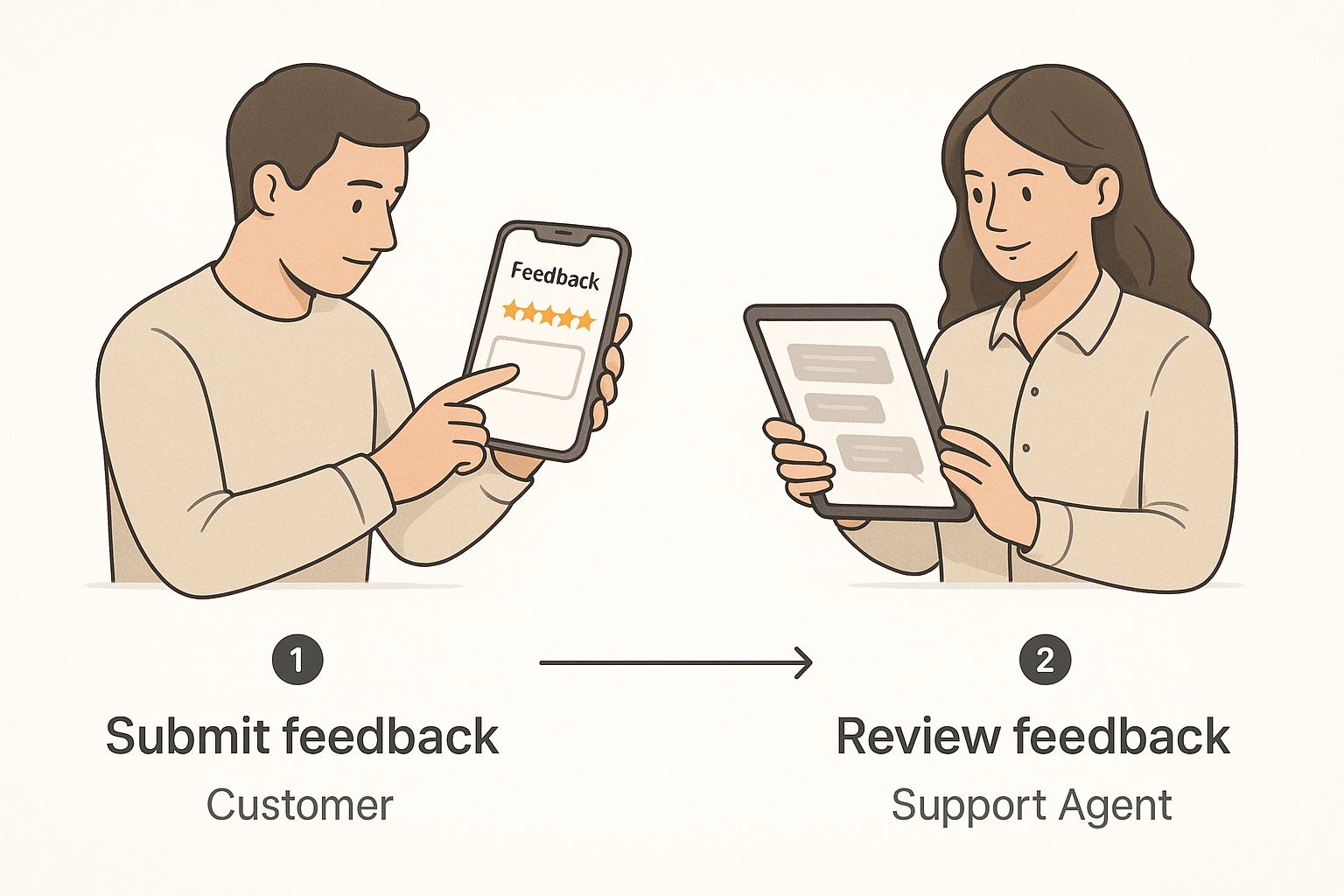
As you can see, modern tools connect the dots between what customers are experiencing and how agents are performing, making it easier than ever to turn insights into action.
Step 1: Decide What to Measure
Before you start pulling numbers, you have to decide what actually matters to your business and your customers. If you try to measure everything, you'll drown in data. But if you're too narrow, you might miss the big picture.
Start by zeroing in on the interactions that have the biggest impact on the customer experience. Common areas to focus on include:
- Speed and Efficiency: How quickly are tickets resolved? What’s your First Response Time?
- Quality and Accuracy: Are your agents giving correct and complete answers?
- Channel Performance: How does your chat support stack up against your email or phone support?
Your goal here is to pick a few key areas that tie back to your main business objectives, whether that's reducing customer churn or boosting loyalty.
Step 2: Select Your Benchmark Group
Once you know what you’re measuring, you need to decide who you’re measuring against. This choice gives your results all-important context. As we've covered, you have a few options, and each offers a different perspective.
You could conduct competitive benchmarking and pick your top three direct rivals. Or, you might try functional benchmarking by looking at a company outside your industry that’s a rockstar in a specific area—like a top e-commerce brand’s returns process. Many companies start with internal benchmarking just to get a baseline before they start looking outside.
The trick is to choose a group that sets a standard that's both relevant and aspirational. Don't just pick a big-name company; pick one that excels at the specific thing you want to improve.
Step 3: Gather Your Data
With your metrics and benchmark group locked in, it’s time to roll up your sleeves and collect the data. This part requires a bit of resourcefulness. You'll likely need to use a mix of methods to get a complete picture.
Here are a few effective ways to gather information:
- Internal Analytics: Start with what you already have. Use your helpdesk software and CRM to pull reports on your own team’s performance for metrics like AHT and Resolution Rate.
- Customer Surveys: Send out CSAT, NPS, and CES surveys to get feedback straight from the source. You can even ask customers how your service compares to others they’ve used.
- Third-Party Research: Look for industry reports and studies that publish average performance benchmarks. For example, some SaaS industry research shows B2B companies typically spend around 8% of their annual revenue on customer support and success.
- Mystery Shopping: Put on your detective hat. Engage with your competitors' support channels as a potential customer to get a firsthand feel for their response times and service quality.
The aim here is to gather objective, reliable information you can trust when it's time to draw conclusions.
Step 4: Analyze the Gaps and Opportunities
This is the moment of truth. With all your data collected, you can finally compare your performance to your benchmark group. This is where the numbers start telling a story.
Lay your metrics side-by-side with your benchmark's. Where are the biggest gaps? Maybe your First Response Time is 30% slower than the industry average, or your CSAT score is five points lower than your main competitor's.
Don't just stop at what the gap is—dig deeper and ask why. A performance gap isn't a failure; it’s an opportunity knocking. Each one highlights a specific area where you can focus your efforts for the biggest payoff.
Step 5: Implement Changes and Track Progress
This is the final and most crucial step: taking action on what you've learned. Benchmarking is a waste of time if it doesn't lead to real change.
Using your analysis, create a targeted action plan. If your Average Handle Time is too high, maybe your agents need better training or more efficient tools. If your resolution rate is low, you might need to beef up your internal knowledge base.
Once you implement these changes, you’re not done. The most important part is to start the cycle all over again. Continuously monitor your metrics to see if your changes are working. This is how you turn benchmarking from a one-off project into a powerful, ongoing cycle of improvement.
How Technology and AI Are Changing the Game
Not long ago, customer service benchmarking meant wrestling with spreadsheets and trying to make sense of data by hand. Those days are fading fast. Today, technology and AI are completely transforming how we measure and improve customer support, making the process faster, smarter, and far more insightful.
Think about it: how could you possibly gauge customer emotions by reading thousands of individual support tickets? It’s a Herculean task. Now, AI-powered sentiment analysis can do it in seconds. These tools scan every interaction and tell you whether your customers are happy, frustrated, or just neutral, giving you a real-time pulse on your customer base.
Automating Insights and Predicting Problems
But this shift isn't just about looking at what’s already happened. It’s about predicting what comes next. Predictive analytics can spot subtle patterns in customer behavior that scream "trouble ahead!" long before a customer decides to leave. For example, the system might flag someone who has contacted support multiple times for the same bug, allowing your team to step in with a solution before they churn.
Automation is another game-changer. By handling simple, repetitive questions, AI frees up your human agents to tackle the tricky problems that require a personal touch. This naturally improves key metrics like Average Handle Time (AHT) while letting your team focus on high-impact work. These advancements are part of a much bigger picture of how technology reshapes the industry on a grand scale.
The real magic of technology in customer service benchmarking is its ability to turn a mountain of raw data into a clear, actionable story. It doesn’t just tell you what happened, but why it happened and what you can do about it.
Striking the Right Balance
The proof is in the numbers. The global customer service software market was valued at around $14.9 billion in early 2025 and is expected to skyrocket to $68.19 billion by 2031. This explosive growth shows just how essential these tools have become for any business serious about support. You can explore more about these customer service statistics and benchmarks.
But here’s the key: technology is a tool, not a replacement for people. A dashboard can flash red and tell you CSAT scores are dropping, but it takes a skilled manager to figure out why and work with the team to fix it. This human element is especially vital in product-led companies where support is woven directly into the customer’s journey. For a deeper dive, check out our article on the future of customer support in product-led growth SaaS companies.
Ultimately, embracing technology gives you an incredible advantage. It allows you to move from simply reacting to problems to proactively crafting great experiences, ensuring your benchmarking efforts drive real growth and keep you one step ahead.
Common Benchmarking Mistakes to Avoid

Starting a customer service benchmarking project is exciting. It holds a ton of promise, but it's also riddled with potential traps. If you're not careful, a valuable exercise can quickly turn into a waste of time and money, leading you to draw the wrong conclusions and make misguided decisions. Knowing what these common mistakes are ahead of time is the best way to sidestep them.
One of the most common blunders is focusing on the wrong metrics. It’s so easy to get tunnel vision. You might see a competitor with a killer Average Handle Time (AHT) and immediately push your team to match it. But what happens next? Your own Customer Satisfaction (CSAT) scores could plummet because agents are now rushing people off the phone just to hit a number.
A truly successful benchmarking effort looks at the whole picture. Instead of chasing a single metric, you need to see how different KPIs influence each other. To get a handle on which numbers matter most, check out our guide on the 8 key customer support performance metrics for 2025.
Blindly Copying Instead of Adapting
Here's another big one: trying to copy-paste a competitor's strategy without understanding the "why" behind it.
Just because your biggest rival offers 24/7 chat support doesn't mean you should, too. They might serve a completely different customer base, operate at a higher price point, or have a slick AI system that makes round-the-clock support profitable. Your reality might be totally different.
Instead of copying, the real goal is to adapt their best ideas to your unique situation. Dig deeper. Figure out the systems and processes that allow them to perform so well. The point isn't to become a clone of your competitor; it's to learn from their playbook to build a stronger version of your own team.
Using Unreliable or Incomplete Data
Benchmarking is a data-driven process, which means it’s only as reliable as the data you feed it. If you base your decisions on outdated industry reports, a few anecdotal customer comments, or incomplete analytics, you're setting yourself up for failure.
To avoid this, you need to pull information from several different places:
- Internal analytics from your helpdesk software.
- Direct customer feedback from your CSAT and NPS surveys.
- Third-party industry research to understand broad performance averages.
- Mystery shopping to experience your competitors' service firsthand.
When you combine these sources, you build a solid, well-rounded foundation for your decisions.
The single biggest mistake in customer service benchmarking is a failure to act. Gathering data and identifying gaps is only half the battle. Without a clear action plan to implement changes and track their impact, the entire exercise is just an academic one.
This failure to act comes with a hefty price tag. Poor customer service costs U.S. companies an estimated $75 billion every year. Even with all the new technology available, only 25% of call centers have properly integrated AI, leaving a massive amount of potential on the table.
Ultimately, insight without implementation is just trivia. A successful benchmarking process connects the dots between data, technology, and human leadership to drive real, measurable improvements.
Frequently Asked Questions
Even with the best game plan, you're bound to have a few questions when you start benchmarking. Let's tackle some of the most common ones so you can move forward with confidence.
How Often Should We Perform Benchmarking?
There’s no single right answer here—it really depends on what you're trying to measure. For a deep-dive competitive benchmarking analysis, looking at how you stack up against your rivals, an annual review is usually plenty. It’s enough to catch major shifts in the market without getting bogged down.
But for your own team's performance? That needs a much closer eye. Internal benchmarking of key metrics like CSAT or First Response Time should be a continuous effort, happening weekly or monthly. If your industry moves at lightning speed or you’ve just rolled out a new product, a quarterly check-in is a great way to stay on your toes.
What Is the Biggest Challenge in Competitive Benchmarking?
The toughest part, without a doubt, is getting reliable data on your competitors. Most of this information is kept under lock and key—companies aren't exactly publishing their Average Handle Time or resolution rates for everyone to see.
The trick is to get creative and piece together a picture using publicly available clues. You can combine data from industry reports, sift through online customer reviews, run surveys that ask about experiences with other brands, and even do some "mystery shopping" to test their service yourself. Focus on what you can gather realistically and ethically.
Can a Small Business Do Benchmarking Effectively?
Absolutely. Benchmarking isn’t just for the big players. In fact, it can be incredibly valuable for smaller teams, even if you don't have a huge budget. The key is to start small and be consistent.
A small business can kick things off with internal benchmarking, which costs nothing more than your time. Just start tracking your own performance to see how you're trending and where you can improve. You can also:
- Use free survey tools to collect CSAT and NPS scores from your customers.
- Keep an eye on your competitors' social media and online reviews to get a feel for their public reputation.
You don’t need a dedicated research department. The most important step is simply to start, stick with it, and use what you learn to make small, steady improvements over time.
Ready to stop guessing and start seeing what your customers see? With Screendesk, you can resolve issues faster using video recordings and live calls, turning frustrating support tickets into clear, simple solutions. See how Screendesk can improve your key support metrics by visiting our website.
