


Customer engagement solutions are the tools and strategies you use to build real, ongoing relationships with your customers. Think of them as the modern-day equivalent of the small-town shopkeeper who knows everyone by name—but scaled for thousands of digital interactions. It’s all about turning one-time buyers into loyal fans through proactive, personal communication on every channel.
Understanding Customer Engagement Solutions
Imagine that local shopkeeper who remembers your preferences and your last conversation. Now, how do you replicate that personal touch for thousands of customers online? That’s the entire point of modern customer engagement solutions.
These solutions aren't just one piece of software. They're a complete strategy for tying together every single interaction a customer has with your brand. Whether it’s via email, social media, live chat, or a phone call, the goal is to create one seamless, continuous conversation. This approach moves you away from impersonal transactions and toward building genuine, long-term relationships that create real loyalty.
Moving Beyond Basic Customer Service
Traditional customer service is usually reactive. A customer has a problem, they reach out, and you fix it. Customer engagement, on the other hand, is proactive. It’s about anticipating what customers might need, offering helpful recommendations, and creating valuable experiences that make them want to stick around. You're looking at the entire customer journey, not just a single support ticket.
This shift is more than just a nice idea—it's what customers now expect. In fact, a staggering 84% of consumers say the experience a company provides is just as important as its products or services. People aren't just buying a thing; they're buying an experience.
The visual below breaks down the core pillars that make this possible.
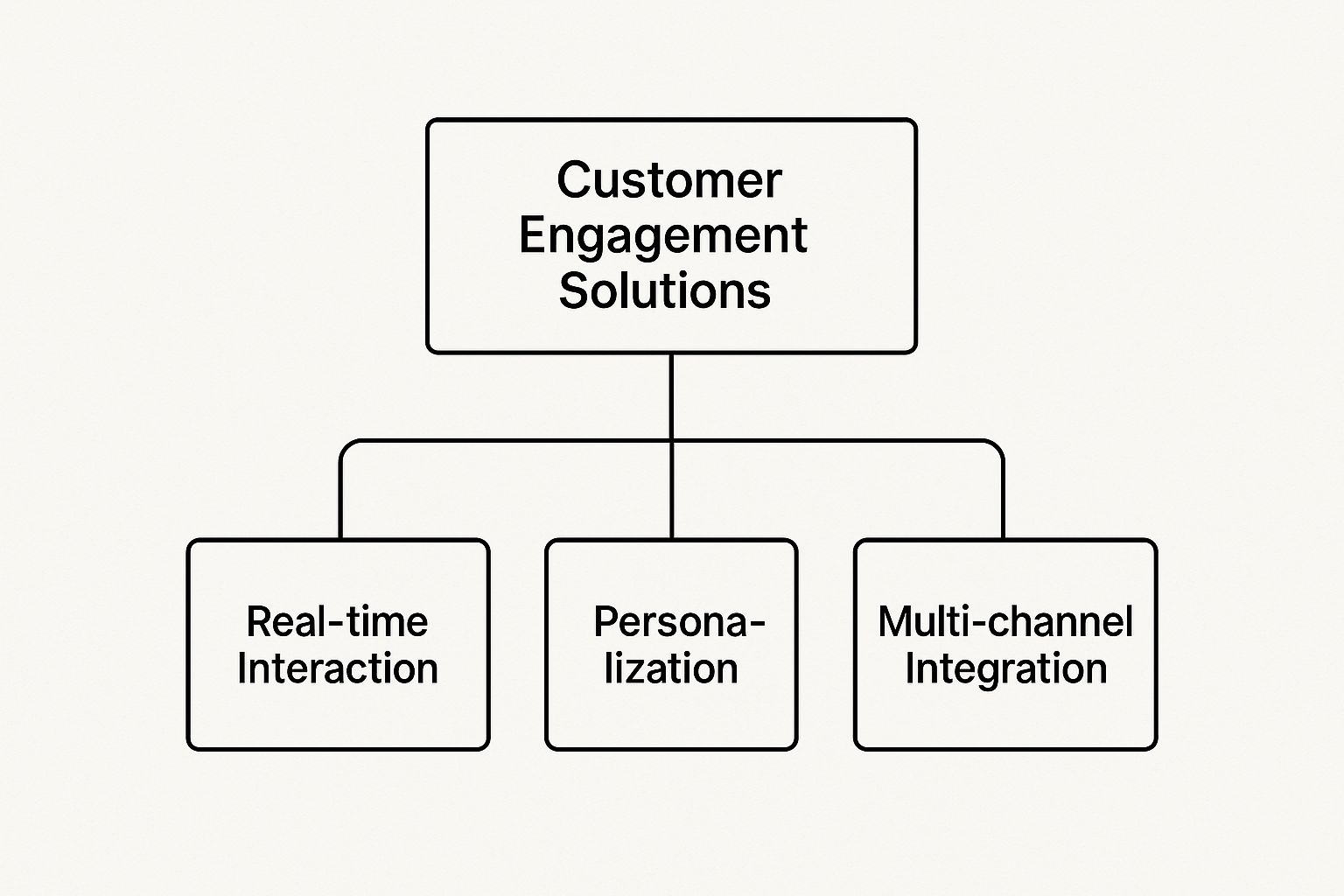
As you can see, things like real-time interaction, deep personalization, and being present on multiple channels all have to work together. If any one piece is missing, the whole experience can feel clunky and impersonal.
The Growing Importance of Engagement
There’s a reason the market for these tools is exploding: they work. The global customer engagement solutions market was valued at over USD 22 billion in 2024 and is expected to keep climbing. This growth is fueled by a simple truth—customers crave personalized experiences that make them feel understood and valued. You can explore more about the market growth and what it means for businesses.
To really nail this, it helps to think about the core components that make up a strong customer engagement solution. The table below breaks down these fundamental pillars and what they achieve for your business.
Key Pillars of a Customer Engagement Strategy
| Pillar | Description | Primary Business Goal |
|---|---|---|
| Personalization | Using customer data to tailor communications, offers, and experiences to individual preferences and behaviors. | Increase relevance and conversion rates. |
| Omnichannel Communication | Providing a seamless and consistent experience across all channels (e.g., email, chat, social, phone). | Meet customers where they are and reduce friction. |
| Proactive Outreach | Anticipating customer needs and initiating contact with helpful information, tips, or support. | Prevent issues before they happen and build trust. |
| Feedback and Analytics | Systematically collecting, analyzing, and acting on customer feedback to improve the overall experience. | Drive continuous improvement and customer-centric decisions. |
By focusing on these four areas, you create a system that doesn't just react to customers but actively builds a stronger relationship with them over time.
A strong engagement strategy directly impacts the bottom line. It's about more than just making customers happy; it's about increasing customer lifetime value, reducing churn, and building a resilient brand that can thrive in a competitive market.
Ultimately, these solutions give you the power to listen, understand, and act on what your customers are telling you—at scale. This is how you create those positive, memorable interactions that turn casual buyers into passionate supporters. In today's market, proactive and personalized communication isn't a luxury; it’s a core driver of loyalty and sustainable growth.
Key Features Of Effective Engagement Platforms

Knowing why you need to engage customers is one thing, but understanding what the right tools actually do is what makes a strategy come alive. The best customer engagement solutions aren't just a jumble of features. They're thoughtfully designed platforms where every part works together to create a seamless experience.
Think of it like a world-class orchestra. You need strings, brass, and percussion, but more importantly, you need them all playing in perfect harmony. In the same way, an engagement platform's features must be perfectly in sync to deliver a smooth, intuitive experience for both your customers and your team.
A Unified Omnichannel Hub
Nothing frustrates a customer more than having to repeat themselves. If someone starts a conversation in your website's live chat and then has to call in, they expect the agent on the phone to know what’s going on. This is where a true omnichannel hub makes all the difference.
An omnichannel platform consolidates every single communication channel—email, social media, chat, phone calls—into one clean, unified timeline. This means any agent can instantly see a customer’s full history, turning a series of separate, frustrating interactions into one continuous conversation.
This single source of truth is the backbone of a consistent, low-effort customer experience. It gives your team the context they need to provide smarter, faster, and more personal support, no matter where the conversation starts.
Deep CRM and Data Integration
If the omnichannel hub is the platform's nervous system, then your Customer Relationship Management (CRM) system is its brain. A top-tier engagement solution has to plug directly into your CRM and other data sources, pulling everything together.
This tight integration is what gives you that coveted 360-degree view of the customer. It connects the dots between their purchase history, past support tickets, recent website activity, and even personal preferences.
With this complete picture, your team can finally move beyond generic, scripted responses and start having truly personalized conversations.
- Tailored Recommendations: Suggest products a customer will actually love based on what they've bought before.
- Proactive Support: Spot potential trouble from a customer's recent activity and reach out before they have to complain.
- Contextual Conversations: Understand a customer's history and value to provide a support experience that makes them feel appreciated.
When your data flows freely, your team has the power to make every single customer feel seen and understood.
A truly connected platform doesn't just display data; it makes it actionable. The goal is to equip your team with the insights needed to solve problems on the first try and build stronger relationships with every interaction.
AI-Driven Automation and Assistance
Today's best engagement solutions use artificial intelligence (AI) not to replace humans, but to supercharge them. It’s all about automating the repetitive stuff so your team can focus on what they do best.
For example, smart chatbots can handle common questions 24/7, like "Where's my order?" or "How do I reset my password?" This can deflect up to 40% of routine inquiries, freeing up your expert agents to tackle the complex, high-stakes issues that really matter.
But AI also works in the background to help live agents. It can suggest the right help articles, provide real-time tips during a tricky conversation, and automatically summarize calls. This cuts down on manual work and helps ensure your team delivers consistently great service. And, of course, applying the best practices for user interface design is crucial to making all this technology feel effortless for your team.
Robust Analytics and Reporting
You can't fix what you can't see. That’s why powerful analytics and reporting tools are non-negotiable. We're talking about more than just basic numbers like ticket volume or average response time.
A modern platform gives you deep insights into things like customer sentiment, agent performance, and the most common pain points in your customer journey. You can see why customers are contacting you, not just that they are.
This is the data that drives real improvement. You can pinpoint where your team needs more training, identify recurring product bugs that need fixing, and make smart, evidence-based decisions to elevate the entire customer experience. If you're ready to dig deeper, our guide on key metrics for your customer support team is a great place to start.
The Business Case for Investing in Engagement
Bringing a great customer engagement solution into your business isn't just a tech upgrade—it's a direct investment in your company's future. The fancy features are nice, but the real magic is in the measurable impact it has on your bottom line. It's about drawing a straight line from how you interact with customers to real business results.
Think back to the last time a company really wowed you with their service. It wasn't just about getting a fast reply, was it? You felt heard, understood, and like you actually mattered. When you make customers feel that way every time, you’re not just fixing problems. You’re building a loyal following that your competitors can't easily steal.
From Cost Center to Revenue Driver
For years, many companies treated customer service like a necessary evil—a cost center. The main goal was to handle issues as quickly and cheaply as possible. That old-school thinking just doesn't work anymore. Today, genuine engagement is what drives revenue and keeps customers coming back.
Investing in the right platform lets you flip the script from reactive to proactive. Instead of just waiting for complaints to roll in, you can start anticipating what customers need, offering help at the right moment, and creating great experiences all along their journey. This isn't just a small tweak; it has a huge financial upside.
A smart engagement strategy turns your support team from a group of firefighters into a proactive force that actually generates revenue. It stops customers from leaving and uncovers new ways to grow their lifetime value.
For instance, companies that really nail customer engagement see a 23% premium in wallet share, profitability, and overall growth from those customers. That's proof that engagement isn't just about creating warm fuzzies; it's a rock-solid business strategy.
Measuring the Return on Engagement
The payoffs from a strong engagement plan aren't just vague ideas. They are real, measurable results that directly impact your company's health. Here are a few of the biggest returns you can count on:
- Drastically Reduced Customer Churn: When customers feel connected and supported, they stick around. By offering personalized, proactive help, you solve their frustrations before they become a reason to cancel, directly protecting your revenue.
- Increased Customer Lifetime Value (LTV): Happy customers simply buy more. A great experience encourages them to make repeat purchases and makes them more open to hearing about other products or upgrades, boosting their total value over time.
- Stronger Brand Reputation and Advocacy: When you solve a problem and make a customer feel great, they don't just forget about it—they tell their friends. These positive interactions create powerful brand advocates, giving you word-of-mouth marketing that you couldn't possibly buy.
These outcomes show a clear connection between investing in customer engagement solutions and achieving real, sustainable growth.
A Global Shift Toward Deeper Connections
This push for better engagement is happening everywhere. North America is currently leading the pack, especially in industries like retail and finance where deep customer relationships are everything. As business moves online, companies all over the world are realizing they need smarter ways to interact with their customers. You can dig deeper by reading the full research about customer engagement trends.
Ultimately, the business case is crystal clear. By creating more meaningful and proactive interactions, you build a loyal customer base that is more forgiving of the occasional slip-up, more likely to spend more, and more willing to recommend you to others. It’s time to shift your mindset and invest in the right tools. Learn more about how to get started in our detailed guide on implementing proactive customer service. This isn’t an expense; it’s the foundation of a modern, customer-first business.
How Screendesk Changes the Game in Customer Engagement
It's one thing to talk about customer engagement in theory, but seeing it work in practice is where things get interesting. Plenty of platforms let you talk to your customers, but Screendesk offers a completely different way to work with them. It moves beyond basic text and turns every support ticket into a chance for clear, visual communication.
This isn't just about adding a fancy new feature. It's about fixing the fundamental problem that plagues old-school support: miscommunication. Screendesk tackles the headache of trying to explain a tricky technical issue through a wall of text, cutting through the confusion and getting straight to a solution.
Moving Past the Limits of Text-Based Support
Let's be honest—traditional support via email or chat can feel like trying to describe a painting over the phone. You can be as descriptive as you want, but something always gets lost in translation. This inevitably leads to longer wait times, the same questions being asked over and over, and frustration building on both sides.
Screendesk breaks that frustrating cycle by making visual collaboration the norm. Instead of asking a customer to describe what’s on their screen, an agent can just see it for themselves. It’s a simple change, but it’s the key to delivering faster, more helpful, and far more human support.
Think about it. The conversation shifts from, "Can you tell me what the error message says?" to "Okay, I see the problem. Let me show you how to fix it." That's a massive leap forward for both your team's efficiency and your customer's experience.
By putting visual problem-solving first, Screendesk gets to the heart of what modern customer engagement solutions are all about. It makes every conversation more personal, efficient, and effective, giving customers the better service they expect.
Solving Problems Together, in Real-Time
Screendesk’s magic lies in its "show, don't tell" toolkit. These features are specifically designed to get rid of guesswork and get the agent and customer on the same page—literally.
Here’s a look at how the platform makes this happen without adding complexity.
As you can see, the interface lets agents start a live call or ask for a screen recording right from their helpdesk. This is a big deal. It keeps the entire conversation in one place, so you don't have to juggle different apps just to solve one problem.
Here are the core tools that make it work:
- Co-browsing and Screen Sharing: Agents can securely see a customer's screen or even click and type for them to guide them through a tricky process. It’s perfect for software demos, filling out complicated forms, or fixing settings.
- Live Video Calls: Sometimes, nothing beats a face-to-face conversation. Integrated video calls help build trust and resolve issues quickly with a personal touch that text just can't match.
- Customer Screen Recordings: Instead of trying to explain a bug, a customer can just record their screen to show you exactly what's happening. These recordings come packed with technical data like browser info and console logs, giving your developers everything they need to fix the issue.
These tools turn a simple support ticket into a collaborative problem-solving session. The result? Quicker resolutions and happier customers.
Screendesk Features vs Traditional Support
To really see the difference Screendesk makes, it helps to put its features side-by-side with the struggles of traditional support. This table highlights how a visual approach solves common pain points.
| Traditional Challenge | Screendesk Solution | Customer Benefit |
|---|---|---|
| Vague Problem Descriptions | Customer screen recordings capture the exact issue with technical data. | No more struggling to explain complex bugs; problems are shown clearly. |
| Back-and-Forth Emails | Live co-browsing and screen sharing allow for real-time guidance. | Issues are often resolved in a single, collaborative session. |
| Impersonal, Scripted Chat | Face-to-face video calls build rapport and human connection. | Customers feel heard and understood by a real person. |
| Slow Resolution Times | Visual context eliminates guesswork and lengthy diagnostic questions. | Faster solutions with less effort, leading to higher satisfaction. |
This comparison shows how Screendesk isn't just another tool—it's a better way of working.
In the end, Screendesk does exactly what great customer engagement solutions are supposed to do. It doesn't just manage conversations; it makes them better. By making every interaction clearer, more human, and more efficient, it helps you exceed customer expectations and build the kind of loyalty that truly drives growth.
Your Guide to Implementing an Engagement Solution
Bringing a new customer engagement solution on board is a journey, not a sprint. It’s about much more than just flipping a switch on some new software. To really get it right, you need a smart strategy that connects the technology directly to your business goals and the way your team actually works.
Think of it like building a house. You wouldn't just start hammering away without a solid blueprint, right? The same logic applies here. This guide will walk you through a step-by-step framework to make sure your implementation is a success right out of the gate.
Start with a Customer Journey Audit
Before you can improve your customer's experience, you first have to understand what it’s actually like today. That’s where a customer journey audit comes in. This means mapping out every single interaction a customer has with your brand, from the moment they first land on your website to their latest support ticket.
The goal here is to find the friction. Where do people get stuck? What questions are they forced to ask over and over? Pinpointing these pain points gives you a crystal-clear map of what needs fixing. You might discover, for instance, that customers are constantly abandoning their carts because they can’t find shipping information—a perfect opportunity for proactive engagement.
Set Clear and Measurable Goals
Once you know where the problems are, you can set real, measurable goals for your new customer engagement solution. Vague targets like "improve customer satisfaction" just won't cut it. You need concrete objectives you can actually track.
Here are a few examples of goals that have some teeth:
- Reduce first response time by 30% within the first three months.
- Boost first-contact resolution by 15% by giving agents better tools and information.
- Decrease cart abandonment by 10% by launching a proactive chat on the checkout page.
Goals like these give you a clear benchmark for success and make it easy to justify the investment. Tracking these numbers is everything, and knowing your way around customer support analytics is a key step to proving the real value of your new system.
Setting precise goals transforms your implementation from a hopeful experiment into a calculated business strategy. It ensures everyone on the team knows exactly what you're trying to achieve and how you'll measure success along the way.
Choose the Right Platform for Your Needs
Let's be honest—not all customer engagement platforms are created equal. The market is packed with options, so it’s crucial to pick one that truly fits your business needs, budget, and tech stack. A small startup has entirely different needs than a massive enterprise.
As you weigh your options, keep these key factors in mind:
- Scalability: Can this platform grow with you? You need a tool that works for you today and can keep up with your ambitions for tomorrow.
- Integration Capabilities: How well does it play with your other tools, especially your CRM? A seamless connection is an absolute must-have for getting a complete view of your customer.
- Ease of Use: Is the interface actually intuitive for your agents? A clunky, complicated system will just lead to frustration and slow adoption, completely undermining your efforts.
- Core Functionality: Does it solve your biggest problems? If you’re constantly struggling to explain complex technical issues, a visual-first platform like Screendesk makes a lot more sense than a simple text-chat tool.
Part of this process involves understanding how to choose and implement the right CRM. This decision often goes hand-in-hand with picking an engagement platform, since the two systems need to work together flawlessly.
Train Your Team for a Proactive Mindset
Your shiny new technology is only as effective as the people using it. A great implementation isn't just about technical training; it's about shifting the team’s culture from a reactive to a proactive mindset. You need to coach your team to anticipate customer needs, not just wait for problems to pop up.
Focus your training on these key areas:
- Mastering the Tools: Make sure every team member is comfortable with all the new features, whether it's starting a co-browsing session or digging into sentiment data.
- Empathy and Soft Skills: Run through role-playing scenarios that show agents how to use the platform's features to build rapport and handle tough conversations.
- Identifying Proactive Opportunities: Train your team to spot those moments where they can jump in and offer help before the customer even thinks to ask.
Avoid Common Implementation Pitfalls
A successful rollout is as much about knowing what not to do. Too many companies stumble over the same common mistakes. If you know what they are, you can steer clear.
- Overcomplicating Your Tech Stack: Don't add a tool just because it looks cool. Every piece of software should have a clear purpose and add genuine value.
- Forgetting Team Buy-In: Get your support team involved from the very beginning. They’re the ones on the front lines, and their feedback is gold.
- Failing to Iterate: Your first setup won't be your last. Always be gathering feedback from your team and your customers, and be ready to tweak things to make your workflows even better.
By following this roadmap, you can make sure your new customer engagement solution truly delivers on its promise, helping you build stronger relationships and drive real, sustainable growth.
The Future of Customer Engagement

The world of customer engagement doesn't stand still. It's constantly being reshaped by new tech and, more importantly, by what customers have come to expect. What impresses someone today will be the bare minimum tomorrow. The next wave of customer engagement solutions is all about making interactions smarter, faster, and surprisingly more human.
Leading the charge is AI-powered hyper-personalization. This isn't just about plugging a customer's first name into an email template. We're talking about using artificial intelligence to sift through mountains of data, predict what an individual customer needs right now, and shape their experience on the fly. It's about making every single touchpoint feel like it was designed just for them.
A Shift to Predictive and Proactive Models
Another massive shift is the move away from reactive support. Instead of waiting for a customer to hit a snag and reach out for help, forward-thinking platforms will spot potential problems and fix them before the customer even notices.
This proactive approach completely changes the game. Support goes from being a cost center that puts out fires to a strategic part of the business that builds loyalty. By getting ahead of issues, companies can sidestep customer frustration entirely, earn some serious trust, and show they’re genuinely looking out for people.
A few other key trends are coming into focus:
- Integrated Departmental Engagement: Engagement is breaking out of the support silo. It's becoming everyone's job, with sales, marketing, and product teams all chipping in to create one seamless conversation with the customer.
- Ethical Data Handling: The more personal we get, the more important transparency becomes. Earning and keeping customer trust will hinge on clear, ethical data policies that give people control and peace of mind.
The big takeaway is pretty simple: the tools will keep changing, but the goal won't. Building real, human-centric relationships will always be the secret to success. Technology just helps us get there.
In the end, the companies that will win are the ones that can masterfully blend powerful technology with a genuine desire to understand and value each customer.
Frequently Asked Questions
Jumping into the world of customer engagement can feel a bit overwhelming, and a few questions always seem to pop up. Let's break down some of the most common ones to give you a clear starting point.
Customer Service Versus Customer Engagement
So, what's the real difference between customer service and customer engagement? It’s a great question, and the answer is all about timing and mindset.
Think of customer service as being reactive. It’s what happens when something goes wrong. A customer’s package is late, and your team jumps in to track it down and fix the problem. It's essential, but it’s about solving an existing issue.
Customer engagement, on the other hand, is proactive. It's about building a relationship before a problem even has a chance to surface. This could be sending a helpful follow-up email with tips on using a new purchase or offering a personalized discount just because. Engagement is the long game—it’s about building loyalty and connection.
How Small Businesses Can Implement These Solutions
Is this kind of tech just for the big guys? Not at all. Small businesses can absolutely get in on the action, and you don’t need a massive, complex system to do it.
The trick is to start small with customer engagement solutions that are scalable and won't break the bank. First, pinpoint your single biggest communication headache. Are you drowning in social media DMs, or is your website support just too slow? Find a tool that does one thing really, really well.
To make sure it's worth it, focus on the return on investment (ROI). Track simple metrics like how much faster your team responds or if you see more repeat purchases after you start.
The goal for a small business isn’t to do everything at once. It’s about making smart, targeted investments that solve real customer frustrations and deliver results you can actually measure.
First Steps To Improving Engagement
Ready to dive in? Improving customer engagement doesn’t have to be a huge, complicated project. Here’s a simple checklist to get you started:
- Map the Journey: Take a step back and identify every single point where a customer interacts with your brand.
- Gather Feedback: Don't be afraid to ask for opinions. A simple survey or a quick follow-up email can give you a goldmine of information.
- Personalize Communication: Start with the basics. Using a customer's name and referencing what they bought shows you're paying attention.
- Be Proactive: Instead of waiting for them to call you with a problem, reach out first with helpful content or a friendly check-in.
Ready to transform your support from simple text to collaborative visual experiences? Screendesk provides the tools to solve issues faster and build stronger customer relationships. Discover how Screendesk can elevate your customer engagement today.
