


In a competitive market, standing still is the same as moving backward. Efficient operations are no longer just a "nice-to-have" but a core driver of growth, customer satisfaction, and profitability. The challenge isn't recognizing the need for change; it's knowing where to start. The answer lies in adopting a structured approach to refining how work gets done, moving from guesswork to a deliberate strategy. This is where mastering business process improvement techniques becomes a critical advantage.
This guide is designed to be your practical playbook. We cut through the theoretical clutter to present 10 powerful and proven methodologies that can fundamentally transform your organization. We won’t just define these concepts; we will equip you with actionable frameworks to implement them effectively. You'll learn how to identify bottlenecks, eliminate waste, and optimize workflows from end to end.
We will explore each of these powerful techniques in detail:
- Lean Manufacturing/Lean Six Sigma
- Business Process Reengineering (BPR)
- Six Sigma
- Kaizen (Continuous Improvement)
- Value Stream Mapping (VSM)
- 5S Workplace Organization
- Process Mining
- Theory of Constraints (TOC)
- Root Cause Analysis (RCA)
- Agile Process Improvement
Whether you need the radical redesign offered by BPR or the consistent, incremental gains championed by Kaizen, you'll find a methodology that fits your unique operational challenges. Each section provides practical steps, real-world examples, and clear insights to help you reduce costs, boost team morale, and deliver exceptional value to your customers. Let's dive in and find the right strategy to unlock your company's full potential.
1. Lean Manufacturing/Lean Six Sigma
Lean Manufacturing, often combined with Six Sigma, is a powerful methodology for business process improvement. At its core, Lean focuses on maximizing customer value by relentlessly eliminating waste from processes. Originating from the Toyota Production System, this approach identifies eight key types of waste, often remembered by the acronym DOWNTIME: Defects, Overproduction, Waiting, Non-utilized talent, Transportation, Inventory, Motion, and Extra-processing.
Six Sigma complements Lean by using statistical analysis to reduce defects and process variation. Together, they create a comprehensive framework for making processes more efficient, predictable, and customer-centric. Companies like Toyota revolutionized automotive manufacturing with these principles, while Amazon uses them to streamline its warehouse operations for lightning-fast order fulfillment.
When to Use This Technique
This is one of the most effective business process improvement techniques when your goal is to:
- Reduce operational costs by systematically removing non-value-added activities.
- Improve product or service quality by minimizing defects and errors.
- Increase efficiency and speed by optimizing workflow and reducing lead times.
How to Implement Lean Six Sigma
Getting started requires a structured approach. Focus on these actionable steps to build momentum and see tangible results.
- Map Your Value Stream: The first step is to visualize your entire process from start to finish with a value stream map. This helps you clearly identify every step, pinpoint bottlenecks, and see where waste occurs.
- Start with Pilot Projects: Don't try to overhaul everything at once. Select one or two well-defined, high-impact processes for a pilot project. Success here will build confidence and provide a blueprint for wider implementation.
- Train and Empower Your Team: Your employees are your greatest asset in identifying waste. Invest in training them on Lean principles and empower them to suggest and implement improvements.
The following infographic highlights the typical impact of applying Lean Six Sigma methodologies.
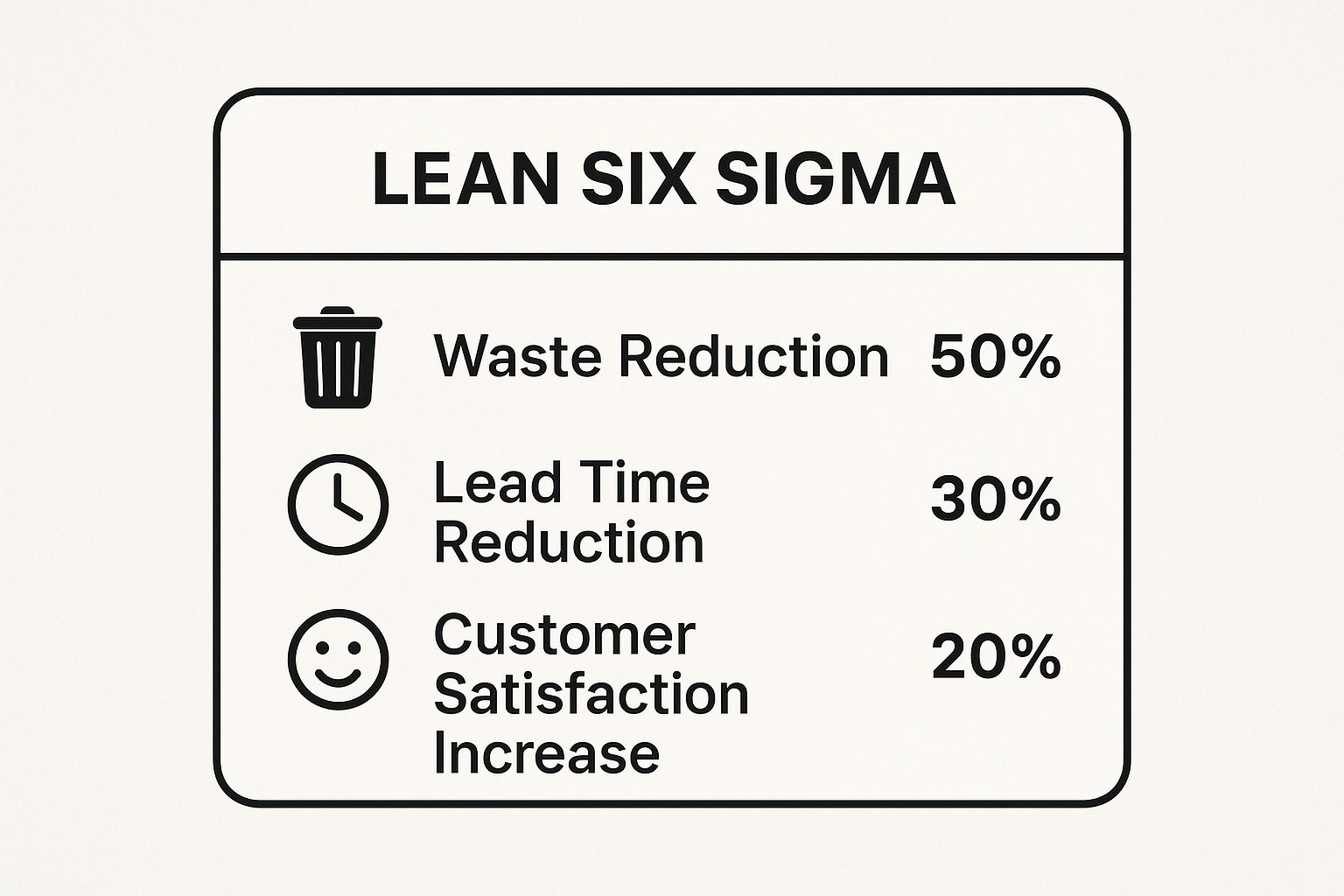
These metrics show how a focused effort on eliminating waste and reducing defects directly translates into significant operational gains and happier customers. Such improvements are why Lean Six Sigma remains a foundational business process improvement technique for organizations aiming for operational excellence.
2. Business Process Reengineering (BPR)
Business Process Reengineering (BPR) is not about making small, incremental changes; it’s a radical redesign methodology that involves fundamentally rethinking core business processes from the ground up. The goal of BPR is to achieve dramatic, game-changing improvements in critical performance metrics such as cost, quality, service, and speed. Popularized by pioneers like Michael Hammer and James Champy, BPR challenges the old ways of working and asks, "If we were starting this company today, how would we run this process?"

This approach focuses on reinventing processes, not just improving them. A classic example is Ford, which reengineered its accounts payable process by challenging the assumption that they needed to match purchase orders, receiving documents, and invoices. By changing the process to pay upon receipt of goods, they reduced their accounts payable staff by 75%. Similarly, IBM Credit dramatically cut its loan approval time from seven days to just four hours by redesigning the workflow around a single case manager empowered with technology.
When to Use This Technique
BPR is one of the most powerful business process improvement techniques to consider when your organization needs to:
- Achieve breakthrough performance and requires more than just minor efficiency gains.
- Respond to major market disruption or a fundamental shift in customer expectations.
- Overcome outdated, inefficient, or overly complex legacy processes that are holding the business back.
How to Implement BPR
Implementing BPR is a significant undertaking that requires careful planning and a top-down commitment. These steps are crucial for a successful transformation.
- Secure Strong Leadership Commitment: BPR is a strategic initiative that requires unwavering support from the highest levels of management. Leaders must champion the change, allocate resources, and communicate the vision.
- Focus on High-Impact Processes: Identify the core processes that have the most significant impact on your customers or operational costs. Start with these to ensure your efforts deliver maximum value.
- Challenge Every Assumption: The core of BPR is to question everything about how work is currently done. Encourage your team to think creatively and design processes as if they were starting from a blank slate, leveraging technology as a key enabler.
3. Six Sigma
Six Sigma is a highly disciplined, data-driven methodology designed to eliminate defects and improve quality in any process. Its core principle is to reduce process variation so that processes become consistent and predictable. The name "Six Sigma" refers to a statistical goal of achieving a quality level with no more than 3.4 defects per million opportunities, representing near-perfection.
This approach uses a structured problem-solving framework, most commonly DMAIC (Define, Measure, Analyze, Improve, and Control), to systematically identify the root cause of issues and implement sustainable solutions. Its success stories are legendary; General Electric famously saved over $12 billion in its first five years of implementation, and Motorola, where the methodology originated, has recorded savings in the billions.
When to Use This Technique
This is one of the most powerful business process improvement techniques when your primary objective is to:
- Drastically reduce defects in a product or service to improve customer satisfaction.
- Solve complex problems where the root cause is unknown and requires deep statistical analysis.
- Enhance process capability to meet stringent quality standards and client specifications.
How to Implement Six Sigma
A successful Six Sigma implementation relies on a systematic, data-centric approach. Focus on these actionable steps to ensure your projects deliver measurable results.
- Start with High-Impact Projects: Select projects that address critical business issues and have clear, measurable outcomes. Early wins in areas like reducing manufacturing defects or mortgage processing errors, as seen at 3M and Bank of America, build momentum.
- Invest in Proper Training: Six Sigma requires specialized knowledge. Provide your teams with formal training and certification (e.g., Green Belt, Black Belt) to equip them with the necessary statistical tools and problem-solving skills.
- Use the DMAIC Framework: Apply the Define, Measure, Analyze, Improve, and Control sequence rigorously. This structure ensures that you move from identifying a problem to implementing a lasting solution based on hard data, not assumptions.
4. Kaizen (Continuous Improvement)
Kaizen is a Japanese philosophy centered on continuous, incremental improvement that involves every employee, from the C-suite to the front line. The core idea is that making small, ongoing positive changes can lead to significant improvements over time. Rather than pursuing large, disruptive overhauls, Kaizen promotes a culture where everyone is empowered to identify and solve problems in their daily work.

This approach focuses on enhancing processes, eliminating waste, and improving overall quality and efficiency. For example, Toyota built its legendary production system on this principle, generating millions of employee ideas annually. Similarly, Lockheed Martin used Kaizen events to reduce aircraft assembly time by 40%, demonstrating its power in complex manufacturing environments. Kaizen is a cornerstone technique for any organization looking to cultivate a proactive and improvement-focused culture.
When to Use This Technique
Kaizen is one of the most versatile business process improvement techniques and is especially powerful when your aim is to:
- Foster a culture of continuous improvement where all team members are engaged.
- Make gradual, low-risk changes that don't disrupt core operations.
- Empower employees to take ownership of their processes and contribute to service quality improvement.
- Address small, everyday inefficiencies that collectively create significant drag on productivity.
How to Implement Kaizen
Implementing Kaizen is about building habits and systems that encourage small, consistent enhancements. Focus on these practical steps to embed this philosophy into your organization.
- Encourage All Employees to Submit Ideas: Make it clear that every idea is valuable, no matter how small. Focus on problems that employees face daily, as they are closest to the work and have the best insights.
- Implement a Formal Suggestion System: Create a simple, accessible system for employees to submit, track, and see the results of their suggestions. Recognition and rewards, even non-monetary ones, can significantly boost participation.
- Hold Regular Kaizen Events: Dedicate focused time (often called a "Kaizen blitz") for a team to analyze a specific process and implement improvements rapidly.
- Celebrate Small Wins: Acknowledging and celebrating even minor improvements helps build and maintain momentum, reinforcing the value of continuous effort.
5. Value Stream Mapping (VSM)
Value Stream Mapping (VSM) is a fundamental Lean tool that helps you visualize, analyze, and improve all the steps in your product delivery process. It goes beyond a simple flowchart by documenting the flow of both materials and information required to bring a product or service from its beginning to the end customer. The primary goal of VSM is to create a clear, high-level view of your entire system, making it easier to identify waste and prioritize improvements.
This technique is powerful because it shifts the focus from optimizing individual tasks to improving the overall flow. By mapping the "current state," you can pinpoint bottlenecks, delays, and non-value-added activities. For instance, aerospace giant Boeing used VSM to analyze its 737 wing assembly process, ultimately cutting the total time required from 22 days down to just 11.
When to Use This Technique
Value Stream Mapping is one of the most effective business process improvement techniques to deploy when you need to:
- Gain a holistic view of your end-to-end process instead of just isolated segments.
- Identify sources of waste and inefficiency that are not obvious at the task level.
- Align cross-functional teams on a shared understanding of how value is currently delivered and how it can be improved.
How to Implement Value Stream Mapping
A successful VSM initiative requires a hands-on, collaborative approach. Focus on these practical steps to ensure you create an accurate and actionable map.
- Walk the Actual Process: Don't create your map from a conference room. Physically walk the path of the value stream, observing each step and talking to the people who perform the work. This practice, known as a "gemba walk," provides invaluable firsthand insights.
- Involve a Cross-Functional Team: Assemble a team with representatives from every department involved in the process, from sales and purchasing to production and shipping. Diverse perspectives are crucial for creating a comprehensive and accurate map.
- Create a "Future State" Map: After analyzing the current state and identifying waste, your team should collaborate to design an ideal "future state" map. This becomes your clear, visual roadmap for implementation and one of the most powerful business process improvement techniques for guiding change.
6. 5S Workplace Organization
The 5S methodology is a systematic approach to workplace organization that creates an efficient, safe, and clean work environment. Originating from the Toyota Production System, this technique focuses on establishing and maintaining order to reduce waste and boost productivity. The name "5S" refers to five Japanese terms: Seiri (Sort), Seiton (Set in Order), Seiso (Shine), Seiketsu (Standardize), and Shitsuke (Sustain).
By implementing 5S, teams create a space where tools, supplies, and information are easy to find, use, and return. This seemingly simple practice has a profound impact on process efficiency. For example, Harley-Davidson used 5S to reduce motorcycle assembly errors by 70%, while Virginia Mason Medical Center applied it to enhance patient safety by organizing medical supplies and equipment.
When to Use This Technique
This is one of the most effective business process improvement techniques when your goal is to:
- Reduce wasted time spent searching for tools, documents, or information.
- Improve safety and morale by creating a cleaner, more organized, and less hazardous workspace.
- Enhance product or service quality by minimizing errors caused by disorganization or incorrect equipment.
How to Implement 5S Workplace Organization
Getting started with 5S requires a team-based, systematic effort. Focus on these actionable steps to create a culture of continuous improvement and organization.
- Start with a Pilot Area: Choose one specific workstation, department, or digital folder to apply the 5S principles. This allows you to demonstrate clear benefits and work out any challenges on a smaller scale before a full rollout. Take "before and after" photos to visually communicate the progress.
- Involve Employees in Creating Standards: The people who use the workspace every day are the best-suited to define how it should be organized. Engage your team in the Sort, Set in Order, and Shine phases, and empower them to create the standards that will be followed.
- Conduct Regular Audits: The final step, Sustain, is often the most difficult. Implement a schedule for regular 5S audits or checklists to ensure the new standards are being followed. This reinforces the habits and prevents the workspace from reverting to its previous state.
A well-organized environment is fundamental to improving workplace efficiency and serves as a strong foundation for more advanced improvement initiatives. By making 5S a daily practice, you build discipline and a shared commitment to operational excellence.
7. Process Mining
Process Mining is an analytical discipline that acts like an X-ray for your business operations. It uses event data readily available in your company's IT systems (like your CRM, ERP, or custom databases) to automatically discover, monitor, and improve how your processes actually run, not just how you think they run. Pioneered by academics like Wil van der Aalst and popularized by software firms like Celonis, it bridges the gap between data science and process management.
This technique provides fact-based insights by creating a visual map of your real process flows, including all the variations, bottlenecks, and deviations. For example, Siemens used process mining to optimize its invoice processing, reducing cycle times by 20%. Similarly, ABN AMRO Bank improved its mortgage application process by identifying and eliminating inefficiencies revealed through data analysis.
When to Use This Technique
This is one of the most powerful business process improvement techniques when you need to:
- Gain an objective view of complex processes that are difficult to map manually.
- Identify hidden inefficiencies and compliance issues that aren't obvious on the surface.
- Monitor process performance in real-time and measure the impact of changes accurately.
How to Implement Process Mining
Getting started involves leveraging data to uncover objective truths. Focus on these steps to ensure a successful implementation.
- Start with a High-Impact Process: Choose a process that is high-volume and well-documented in your IT systems, such as order-to-cash or procure-to-pay. This ensures you have enough quality data to generate meaningful insights.
- Ensure Data Quality: The famous saying "garbage in, garbage out" is especially true here. Before analysis, work with your IT team to ensure the event data is clean, complete, and accurate. Each event log should ideally contain a case ID, an activity name, and a timestamp.
- Involve Process Owners: The data tells you what is happening, but process owners can explain why. Involve them in interpreting the process maps and results to develop effective, context-aware improvements.
8. Theory of Constraints (TOC)
The Theory of Constraints (TOC) is a management philosophy that views any complex system as being limited in achieving more of its goals by a very small number of constraints. Popularized by Eliyahu M. Goldratt in his book "The Goal," TOC asserts that every process has a single bottleneck, and focusing improvement efforts on that constraint is the fastest path to significant gains in throughput. Rather than making scattered improvements, TOC provides a laser-focused approach to elevating the performance of the entire system.
This methodology works by identifying the "weakest link" in the chain and ensuring it operates at maximum capacity. Once the constraint is managed and improved, the overall system's performance increases. Great examples include Ford, which increased truck production by 20% by managing its paint shop constraint, and 3M, which cut order fulfillment time from 120 days down to just 20 by addressing its key bottleneck.
When to Use This Technique
This is one of the most effective business process improvement techniques when your goal is to:
- Rapidly increase throughput with limited resources by focusing on a single critical point.
- Improve on-time delivery and reduce lead times by ensuring the bottleneck is never starved for work.
- Enhance profitability by maximizing the output of your most constrained resource.
How to Implement the Theory of Constraints
Implementing TOC involves a five-step cyclical process. Following these steps helps you systematically find and eliminate bottlenecks.
- Identify the Constraint: First, map your entire process to find the single step that limits the system's output. This could be a machine, a department, or even a policy. The constraint is the part of the process with the longest cycle time or the most work piled up in front of it.
- Exploit the Constraint: Ensure the identified constraint is working at its maximum capacity. This means eliminating any downtime, optimizing its schedule, and ensuring it only works on value-added tasks. This step focuses on getting the most out of what you already have without major investment.
- Subordinate Everything Else: Align all other non-constraint processes to support the bottleneck. This means other parts of the system should operate at the pace of the constraint, not at their own maximum speed. This prevents overproduction and excess inventory buildup.
9. Root Cause Analysis (RCA)
Root Cause Analysis (RCA) is a systematic problem-solving method designed to identify the fundamental, or "root," causes of problems instead of just addressing the immediate symptoms. The core principle is that it's more effective to systematically prevent and solve for underlying issues rather than simply treating surface-level effects. By drilling down past the initial problem, RCA helps organizations create lasting solutions and prevent recurrence.
This technique uses various tools, such as the 5 Whys or Fishbone (Ishikawa) Diagrams, to trace a problem back to its origin. For instance, NASA famously uses RCA to investigate mission failures, ensuring the same error never happens twice. Similarly, healthcare organizations apply it to analyze patient safety incidents, improving protocols and saving lives. This focus on deep, systemic fixes makes it an indispensable business process improvement technique.
When to Use This Technique
This is one of the most effective business process improvement techniques when your goal is to:
- Prevent problem recurrence by addressing the foundational cause, not just the symptoms.
- Improve safety and quality in high-stakes environments like healthcare or manufacturing.
- Enhance system reliability by identifying and correcting hidden flaws in your processes.
How to Implement Root Cause Analysis
Getting started requires a structured, inquisitive approach. Focus on these actionable steps to uncover the real source of your process issues.
- Define the Problem Clearly: Before you begin, create a precise and unambiguous problem statement. A well-defined problem provides a clear focus for your investigation and prevents the team from getting sidetracked.
- Use the 5 Whys Technique: Start with the problem and repeatedly ask "Why?" until you uncover the root cause. This simple but powerful method forces you to look beyond obvious answers and dig deeper into the process chain.
- Focus on Systems, Not People: The goal of RCA is to improve processes, not to assign blame. Frame the analysis around systemic failures, such as inadequate training, flawed workflows, or poor communication channels. This fosters a culture of continuous improvement rather than fear.
10. Agile Process Improvement
Agile Process Improvement adapts the principles of Agile software development for broader business process enhancement. This methodology champions an iterative approach, focusing on delivering incremental value through short, rapid improvement cycles known as sprints. Instead of lengthy, large-scale overhauls, Agile breaks down process changes into small, manageable experiments that can be quickly tested and refined based on real-world feedback.
This technique is about embracing flexibility and continuous learning. Teams work collaboratively to identify opportunities, implement changes, and measure the impact, allowing them to pivot quickly if an idea doesn't work. Companies like ING Bank have famously restructured their entire organizations around Agile principles to improve customer responsiveness, while Spotify uses its "squad" model for continuous organizational and process improvement.
When to Use This Technique
This is one of the most effective business process improvement techniques when your goal is to:
- Adapt to a rapidly changing market or customer expectations.
- Encourage innovation and a culture of continuous experimentation.
- Deliver process improvements quickly and see tangible results faster.
How to Implement Agile Process Improvement
Getting started with Agile requires a shift in mindset toward iterative progress over perfection. Focus on these actionable steps to build momentum and foster a culture of agility.
- Start with Small Experiments: Identify a high-priority but low-risk process pain point. Define a small, testable change and implement it within a short timeframe, such as a two-week sprint. This minimizes disruption and allows for quick learning.
- Focus on Customer Value: Frame every process improvement initiative around a single question: "How does this add more value for the customer?" This ensures your efforts remain aligned with what truly matters and prevents changes for the sake of change.
- Hold Regular Retrospectives: At the end of each improvement cycle, bring the team together to discuss what worked, what didn’t, and what can be done better next time. This feedback loop is the engine of continuous improvement in an Agile framework.
Top 10 Business Process Improvement Techniques Comparison
| Methodology | Implementation Complexity 🔄 | Resource Requirements ⚡ | Expected Outcomes 📊 | Ideal Use Cases 💡 | Key Advantages ⭐ |
|---|---|---|---|---|---|
| Lean Manufacturing/Lean Six Sigma | Medium to High (cultural change required) | Moderate to High (training, leadership) | Waste reduction, faster delivery, customer satisfaction | Manufacturing, logistics, service delivery | Significant waste reduction, long-term gains |
| Business Process Reengineering (BPR) | High (radical redesign, disruption risk) | High (investment, technology, change mgmt) | Breakthrough performance improvements, innovation | Large-scale process overhaul | Dramatic improvements, competitive advantage |
| Six Sigma | Medium to High (statistical rigor needed) | High (training, statistical tools) | Defect reduction, quality improvement, financial ROI | Quality-critical, measurable processes | Data-driven decisions, measurable quality |
| Kaizen (Continuous Improvement) | Low to Medium (incremental, ongoing) | Low to Moderate (employee involvement) | Steady improvements, employee engagement | Continuous improvement culture | Low risk, high employee ownership |
| Value Stream Mapping (VSM) | Medium (cross-functional mapping) | Moderate (team involvement, data collection) | Waste identification, process visualization | Process analysis and prioritization | Holistic process view, focused improvements |
| 5S Workplace Organization | Low (discipline and standards needed) | Low to Moderate (training, audits) | Workplace safety, cleanliness, efficiency | Workplace organization | Improves safety and morale, foundation for improvement |
| Process Mining | Medium to High (software & data quality) | High (data, tools, expertise) | Real-time insights, process compliance, analysis speed | Data-rich environments | Objective data insights, continuous monitoring |
| Theory of Constraints (TOC) | Medium (constraint identification needed) | Moderate (measurement tools, training) | Throughput improvement, bottleneck focus | Systems with clear bottlenecks | Fast throughput improvement, simple focus |
| Root Cause Analysis (RCA) | Medium (systematic investigation) | Moderate (facilitators, data collection) | Problem prevention, improved reliability | Complex problem solving | Addresses fundamental causes, prevents recurrence |
| Agile Process Improvement | Low to Medium (iterative, adaptive) | Moderate (team facilitation, collaboration) | Rapid, flexible improvements with customer feedback | Dynamic, fast-changing environments | Fast results, high adaptability |
Putting Theory Into Practice: Your Next Steps
We've journeyed through a powerful collection of ten distinct business process improvement techniques, from the radical transformation of Business Process Reengineering (BPR) to the incremental, daily progress of Kaizen. You've seen how methodologies like Lean Six Sigma ruthlessly eliminate waste and how Process Mining uses data to uncover hidden inefficiencies you never knew existed.
The sheer number of options can feel overwhelming, but the goal isn't to become an expert in all ten overnight. The real power lies in understanding the core philosophy behind each one and selecting the right tool for the right job. Think of this article not as a mandatory checklist, but as a strategic toolkit for operational excellence.
From Knowledge to Action: Choosing Your Starting Point
The most common mistake organizations make is "analysis paralysis," spending months debating which technique to use instead of simply starting. The best way to begin is to choose one specific, high-impact area and treat it as a pilot project. This focused approach minimizes risk, builds momentum, and provides valuable lessons you can apply to future initiatives.
To identify your starting point, ask these critical questions:
- Where is the most significant friction? Pinpoint the process that causes the most complaints from customers or frustration for your internal teams. Is it a slow customer onboarding process? A clunky IT support ticket system?
- Is the goal incremental or transformational? If you need to make small, consistent gains and build a culture of improvement, Kaizen or 5S is an excellent choice. If a process is fundamentally broken and needs a complete overhaul, a more dramatic approach like BPR might be necessary.
- Do you have data, or do you need it? If you have access to robust performance metrics, the data-driven precision of Six Sigma or Process Mining will serve you well. If you're starting with anecdotal evidence, a qualitative method like Root Cause Analysis (RCA) can help you dig deeper.
For instance, a customer support team struggling with long resolution times might use Value Stream Mapping (VSM) to visualize every step of a support ticket's journey. This exercise would quickly reveal bottlenecks, such as excessive handoffs between agents or time wasted trying to understand a customer's issue through text alone. This is a classic example of "waste" that Lean principles are designed to eliminate.
The Synergy of Methodology and Technology
Remember that these business process improvement techniques are not just abstract theories; they are practical frameworks that thrive when supported by the right technology. Modern tools can act as a powerful accelerator, turning good intentions into measurable results. You cannot effectively implement Agile Process Improvement without collaboration software, nor can you perform Process Mining without specialized analytics platforms.
Consider the common challenge in IT and customer support: the inefficiency of back-and-forth email and chat exchanges. A team applying Lean principles would immediately identify this as a form of "waste" in communication. The process is slow, often results in misunderstandings (defects), and requires significant effort (over-processing) from both the agent and the customer.
By integrating smart technology directly into your improvement framework, you're not just changing a process; you're fundamentally upgrading your operational capabilities. Technology makes the principles of efficiency and clarity tangible.
By adopting a tool that enables instant, asynchronous video communication, that same support team can slash resolution times. Instead of typing out complex instructions, an agent can record a quick screen share that visually walks the customer through the solution. This single change aligns perfectly with multiple improvement methodologies: it reduces waste (Lean), eliminates defects caused by miscommunication (Six Sigma), and delivers value to the customer faster (Agile).
Ultimately, mastering business process improvement techniques is about building a more resilient, adaptive, and customer-centric organization. It’s a continuous journey, not a final destination. By starting small, choosing the right framework for your unique challenge, and leveraging technology to accelerate your efforts, you are laying the foundation for sustainable growth and a competitive edge that will serve you well for years to come.
Ready to eliminate communication bottlenecks and supercharge your support team's efficiency? Screendesk replaces slow, text-based conversations with clear, actionable screen recordings, helping you resolve customer issues faster and more effectively. See how our asynchronous video platform aligns with Lean principles by visiting Screendesk to start streamlining your support processes today.
