


Let's cut through the noise. When we talk about digital transformation for small business, we’re not talking about some massive, bank-breaking tech overhaul. It’s much simpler than that. It’s about using today’s tools to solve age-old business problems in a smarter, more efficient way.
Think about swapping out your dusty paper ledger for simple accounting software. That’s it. That’s the core idea—making strategic, practical changes that streamline how you work, help you understand your customers better, and ultimately, find new ways to grow.
What Digital Transformation Really Means for You
Forget the jargon. At its heart, digital transformation is a shift in thinking. It’s about seeing technology as a fundamental part of your business strategy, not just another expense on the books.
It’s the difference between having a website that just sits there and one that actively pulls in new customers. It’s the difference between collecting a list of customer emails and actually using that list to build real relationships.
This isn't a single, giant leap. It’s a series of small, smart steps. You start by asking simple, practical questions:
- How can I get paid faster and easier?
- What’s the one repetitive task that’s bogging my team down every single week?
- Can I get a clear snapshot of my sales without drowning in spreadsheets for hours?
The answers usually lead to simple, affordable digital tools designed to solve exactly these kinds of problems. The best way to think about it is as a journey of ongoing improvements, not a one-and-done project.
From Paper to Pixels
Most businesses start their journey by simply digitizing what they already do. Imagine a local bakery that finally ditches its paper order book for a basic online ordering system. That's a great first step. Right away, they save time and cut down on mistakes.
But the real magic happens next.
Suddenly, that bakery has data. They can see which pastries sell out on Tuesdays. They know who their most loyal customers are. They can even start predicting how much flour they'll need for the weekend rush, which cuts down on waste. This is the transformation—moving from just reacting day-to-day to proactively building a smarter, more profitable business.
It's a Growing Movement
This isn't just a fleeting trend. It’s quickly becoming the new standard for how small businesses compete and win. In fact, projections show that by 2025, a whopping 70% of small and medium-sized businesses around the world will have made major changes to how they operate by going digital. They're adopting everything from cloud-based tools to stronger cybersecurity to get ahead.
The goal isn’t just to “go digital.” It’s to become more efficient, more tuned in to your customers, and more resilient, no matter what the market throws at you.
Ultimately, digital transformation is about giving you more control. It equips you with the tools to automate the grunt work, the insights to make decisions with confidence, and the channels to connect with your customers on a deeper level. It levels the playing field, allowing you to unlock your business's true potential.
Why Going Digital Is a Game-Changer for Small Business

It’s one thing to understand the idea of digital transformation, but what really gets people moving is seeing the results. For a small business, adopting digital tools isn’t about chasing the latest tech trend. It’s about solving everyday problems and getting a real competitive edge. These changes directly impact your bottom line, reshaping how you connect with customers, run your operations, and plan for what's next.
This shift isn't just a nice-to-have anymore; it's becoming essential for survival and growth. In fact, a whopping 55% of small businesses say growth is the top reason they're adopting new tech. And it's no surprise—by the end of 2023, 68% of small businesses globally had a website. The proof is in the pudding: 85% of small business owners report seeing positive results from the digital tools they’ve brought on board. You can read more about how technology is shaping small business success to see the bigger picture.
Create Happier, More Loyal Customers
The customer experience is the lifeblood of your business. Digital tools give you a direct line to making it stronger, faster, and far more personal. This isn't just about having a website; it's about making every interaction with your brand feel effortless.
Take a local mechanic, for example. Instead of playing endless phone tag, they could use online scheduling software. This small change lets customers book an oil change at 10 PM on a Tuesday if they want, eliminating frustration and preventing double-bookings. It’s a smooth, professional touchpoint right from the start.
This creates a powerful ripple effect:
- Faster Service: Tools like live chat mean customers get answers in minutes, not hours.
- Personalized Communication: A simple CRM helps you remember a customer's purchase history or preferences, making them feel seen and valued.
- Greater Convenience: Things like online payments or order tracking give customers the control they’ve come to expect.
When you nail the experience, you turn one-time buyers into repeat customers who rave about your business. That’s an asset no amount of advertising can buy.
Boost Your Day-to-Day Operational Efficiency
If you run a small business, you know time is your most valuable commodity. Those repetitive, manual tasks are silent profit killers, eating up hours you could be using to grow the company. This is where digital tools become your secret weapon against inefficiency.
Picture a small boutique struggling with inventory. Before, the owner might have spent half a day each week counting stock by hand, only to run out of a bestseller or get stuck with items nobody wants. By switching to a simple inventory management system, they get a live look at what’s on the shelves.
The system can be set to automatically reorder popular items when stock runs low, preventing lost sales and keeping shoppers happy. This isn't just about saving time—it’s about making the entire business run smoother with less stress and fewer mistakes.
Automating these tasks frees you and your team to focus on what actually moves the needle: talking to customers and thinking about your next big move.
Unlock New Opportunities for Growth
Finally, going digital opens doors that were completely shut for small businesses in the past. It smashes geographical barriers and arms you with the data you need to stop guessing and start making strategic, confident decisions.
Think about a local artist who starts selling prints on an e-commerce platform like Etsy or Shopify. Suddenly, their customer base isn't just their neighborhood—it's the entire country, or even the world. They can look at analytics to see which designs are selling best and which social media ads are actually driving traffic. That information is a roadmap, showing them exactly where to invest their time and money for the biggest impact.
Adopting technology really does level the playing field, giving you the power to compete, adapt, and truly thrive.
This table breaks down some of the core benefits you can expect when you start integrating digital tools into your business.
Core Benefits of Digital Tools for SMBs
| Benefit Area | What It Means for Your Business | Example Tool |
|---|---|---|
| Customer Experience | Create seamless, convenient, and personalized interactions that build loyalty. | HubSpot CRM |
| Operational Efficiency | Automate repetitive tasks to save time, reduce errors, and free up your team for high-value work. | QuickBooks |
| Marketing & Sales | Reach a wider audience, track campaign performance, and generate more leads online. | Mailchimp |
| Financial Management | Simplify bookkeeping, invoicing, and payroll, giving you a clearer view of your financial health. | Xero |
| Team Collaboration | Improve communication and project management, whether your team is in-office or remote. | Slack |
Ultimately, each of these benefits works together to create a stronger, more resilient, and more profitable business.
Where to Focus Your Digital Strategy First
The idea of "digital transformation" can feel huge and intimidating. It’s like being told to climb a mountain when you don't even have a map. But you don't have to conquer the whole thing at once. The smartest way to start is by picking a single, high-impact area where a small change can deliver the biggest (and fastest) results for your business.
Think of it as choosing your first base camp. By focusing your energy on one key area, you can build momentum, see real benefits, and get the confidence you need to keep going. For most small businesses, this means looking at your operations through four main lenses and deciding which one needs the most attention right now.
This diagram shows how three common technologies—cloud computing, e-commerce, and digital marketing—are often the building blocks for a small business's digital journey.
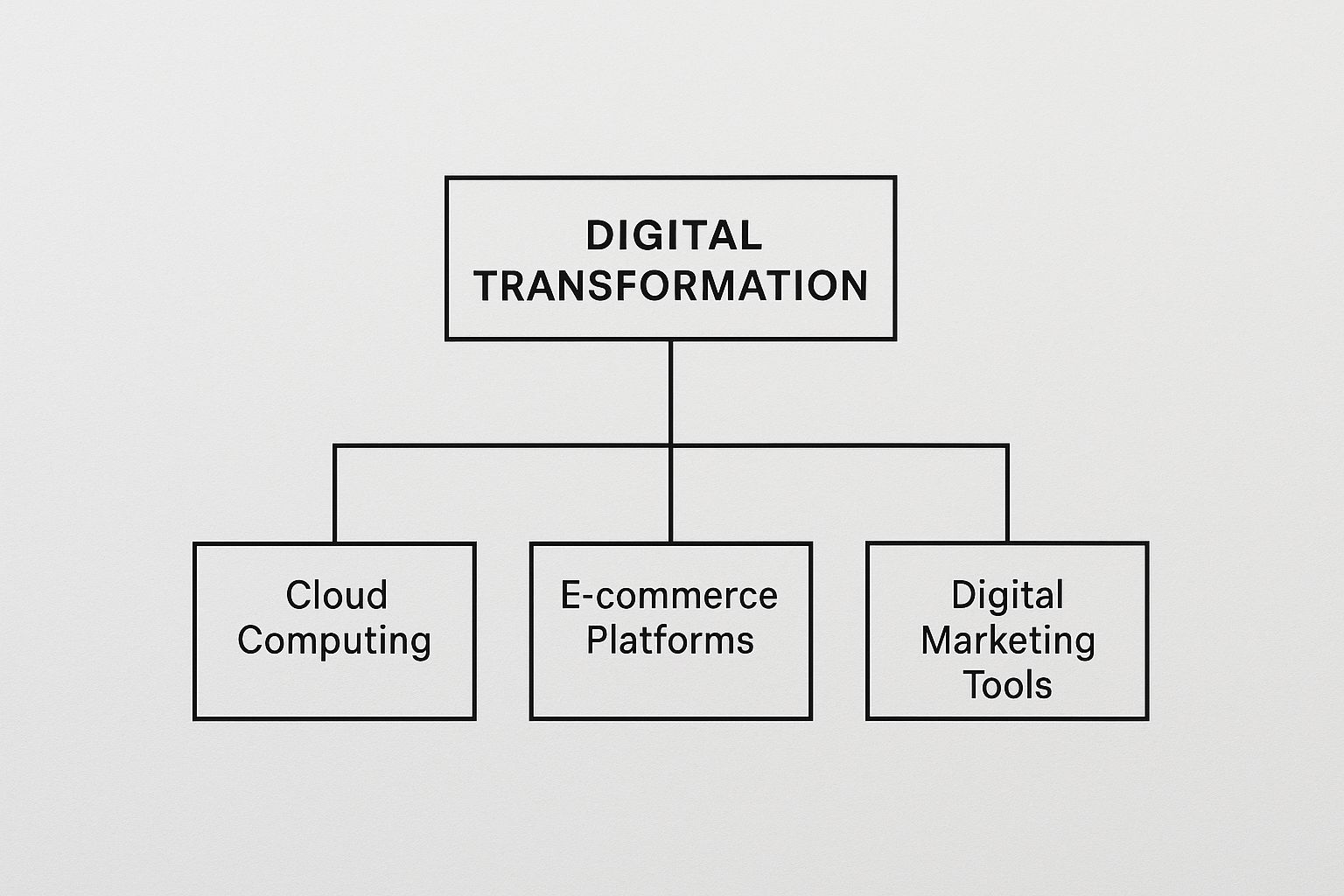
As you can see, real success comes from mixing and matching these elements to improve different parts of your business, from how you work internally to how you make sales.
Elevate Your Customer Experience
How customers feel when they interact with your business is everything. A great experience builds loyalty and gets people talking. A clunky one sends them straight to your competition. Making this area better often gives you the most visible return on your investment.
Start by walking through a typical customer’s journey with your business. Where do things get frustrating? Is it a pain to book an appointment? Do they have to repeat their story every time they call?
Actionable First Steps:
- Adopt a Simple CRM: A Customer Relationship Management (CRM) tool doesn't have to be complicated. It can start as a shared spreadsheet or a dedicated platform. The point is to track customer interactions so anyone on your team can offer personalized, helpful service.
- Use Social Media Schedulers: Tools like Buffer or Hootsuite let you plan out your social media content ahead of time. This helps you stay connected with your audience without having it eat up your entire day.
Streamline Your Daily Operations
Every business has them—those repetitive, time-sucking tasks that drain energy and create bottlenecks. This is often the easiest place to find a quick win. Automating just one or two of these processes can free up hours every single week.
The goal here isn't to work harder; it's to work smarter. Look for the tasks that cause the most headaches or errors. Is it creating invoices by hand? Chasing down payments? Juggling team projects with a messy web of sticky notes and emails?
A recent study found that 57% of small business owners feel they need to upgrade their IT infrastructure to get their operations running better. This tells you there's a huge opportunity to get ahead just by making your internal processes smoother.
Actionable First Steps:
- Move to Cloud-Based Accounting: Software like QuickBooks or Xero automates invoicing, tracks expenses, and gives you a real-time snapshot of your finances from anywhere.
- Implement a Project Management Tool: Platforms like Trello, Asana, or Monday.com help you organize tasks, assign deadlines, and keep your team in sync. Nothing falls through the cracks.
Rethink Your Business Model
Digital tools can do more than just make your current processes better—they can unlock entirely new ways to make money. This is all about thinking creatively. How can technology help you reach more people or even create brand-new products and services?
For example, a local shop can suddenly sell to a global audience with an e-commerce site. A consultant who used to only meet clients in person can now offer virtual sessions to people all over the country. A big part of this is understanding effective e-commerce growth strategies that can turn a simple website into a real sales engine.
Actionable First Steps:
- Launch an E-commerce Store: Platforms like Shopify or Squarespace make it surprisingly simple to start selling your products online, no coding experience required.
- Offer Online Booking: If you run a service business, adding a booking tool to your website lets customers schedule appointments 24/7. You'll capture business you might have otherwise missed.
Nurture Your Team Culture
Finally, always remember that technology is only as good as the people using it. Your digital efforts will only succeed if you get your team on board and comfortable with the new tools. A company culture that embraces change is your single greatest asset.
This all starts with clear communication. Explain why you're bringing in new software—how it will make their jobs easier, not just add another task to their to-do list. When your team sees technology as a helpful partner, they’ll actually want to use it.
Actionable First Steps:
- Involve Your Team in Decisions: Before picking a new tool, ask your employees for their input. They're on the front lines and often have the best insights into what will actually work.
- Provide Simple Training: Don't just hand over new software and walk away. Host a short training session and create a simple one-page "cheat sheet" to help everyone get started.
Overcoming the Common Hurdles of Digital Adoption

Embarking on a digital journey is exciting, but let’s be real—it’s not always a straight line. Like any big upgrade to your business, adopting new technology means navigating a few common speed bumps. For many small business owners, these obstacles can feel more like roadblocks.
The good news? These hurdles are well-known and completely manageable if you see them coming. By anticipating them, you can build a strategy that turns potential problems into simple steps on your path forward. The three biggest challenges are almost always the same: a tight budget, a perceived lack of technical skill, and a team that’s hesitant to change.
Let's break down each one with some practical, no-nonsense solutions.
Navigating Budget Constraints
The first question is usually about money. When you hear stories of huge corporations spending millions on tech, it’s easy to assume that digital tools are out of reach. That’s just not true anymore. Today's market is flooded with powerful, budget-friendly options designed specifically for businesses like yours.
The trick is to stop thinking of it as an expense and start seeing it as an investment. The real question isn't "How much does it cost?" but "What will I get back for my money?"
- Start with Free and Freemium Tools: So many great platforms have free versions that are perfect for getting your feet wet. Think of tools like Mailchimp for email marketing or Trello for managing projects—you can get a ton of value without spending a dime.
- Do the ROI Math: How much time will this new tool actually save you? If a $50/month accounting software frees up five hours of your bookkeeper’s time—and you pay them $40/hour—you're already ahead by $150 every single month.
- Tackle One High-Impact Area: Don't try to digitize everything at once. Pick a single, glaring pain point, like messy invoicing or chaotic scheduling, and find one affordable tool to fix it. A clear win here makes it much easier to justify the next investment.
By starting small and proving the value, you can scale your digital transformation for small business at a pace your cash flow can comfortably handle.
Bridging the Technical Skills Gap
"I'm just not a tech person." We hear this all the time, and it's a perfectly valid concern. The idea of setting up and learning new software can feel overwhelming. But here’s the thing: modern business tools are built for everyday users, not code-writing wizards. You don't need to be an expert to get incredible value from them.
Your focus should be on usability and the support you'll get.
Choosing the right tool isn’t about finding the one with the most features; it’s about finding the one your team will actually use. Simplicity is your secret weapon.
Here’s how to handle the skills gap:
- Prioritize User-Friendly Software: As you research options, look for phrases like "intuitive interface," "no-code," or "easy setup." Check reviews from other small business owners to see what they say about the learning curve.
- Use Free Online Resources: Almost every software company worth its salt has a library of free video tutorials, webinars, and how-to guides. A quick YouTube search can often teach you the basics in less than an hour.
- Lean on Customer Support: Don't hesitate to use the live chat or email support that comes with your subscription. It’s literally their job to help you get the most out of their product.
Adopting new tech is a skill you learn, not a talent you're born with. If you choose simple tools and use the free training available, you can empower your whole team.
Managing Resistance to Change
This might be the most underrated challenge of all: human nature. People are creatures of habit. Even a change for the better can be met with skepticism if your team is used to doing things a certain way.
It’s a huge deal. Global spending on digital transformation hit $2.5 trillion in 2024, but a shocking number of these projects fail—not because the tech was bad, but because the "people" side of the equation was ignored.
To get your team excited instead of anxious:
- Explain the "Why" for Them: Don't just announce the new tool. Clearly explain how it makes their specific job easier. Frame it around their personal benefits, like, "This will cut out three hours of manual data entry for you each week."
- Involve Them in the Decision: Get input from the people who will actually be using the software every day. When your team feels like they had a say in the choice, they take ownership of its success.
- Provide Real Training and Support: Set aside dedicated time to train everyone. It also helps to pick a "champion" for the new tool—someone who’s enthusiastic and can act as the go-to person for their colleagues' questions.
By facing these common hurdles head-on, you strip away the fear and uncertainty. Each challenge is just an opportunity to build a smarter, more resilient business. If you want to better understand the impact of these changes, check out our guide on how to measure operational efficiency for some practical tips.
Your Essential Digital Toolkit for Growth
Jumping into business software can feel like walking into a massive hardware store without a shopping list. The sheer number of options is overwhelming, and every shiny new tool promises to solve all your problems. But smart digital transformation for small business isn't about collecting the most apps; it’s about choosing the right ones that solve your biggest headaches.
We've cut through the noise to build your essential starter kit. Think of this less as a list of brand names and more as a guide to the core categories of tools that deliver an immediate, measurable impact. These are the workhorses that help you save time, understand your customers, and actually grow your bottom line.
Customer Relationship Management (CRM)
At its heart, a CRM is your business's digital memory. It’s a central hub for every piece of information about your customers—their contact details, purchase history, and every single interaction they've had with your team. It’s the final resting place for scattered sticky notes, messy spreadsheets, and forgotten email threads.
The problem it solves is simple but absolutely crucial: it keeps you from treating loyal customers like strangers. A good CRM ensures that when a customer calls, anyone on your team can see their entire history and provide informed, personal service. This builds the kind of trust and loyalty that successful small businesses are built on.
- Popular Options: HubSpot CRM (has a fantastic free version), Zoho CRM, and Insightly are all great starting points.
Cloud Accounting Software
Managing your finances is non-negotiable, but manually creating invoices and tracking expenses is a massive drain on your most valuable resource—time. Cloud accounting software automates these tedious but vital tasks, giving you a crystal-clear, real-time view of your financial health.
These tools help you get paid faster, make tax season a whole lot less painful, and give you instant access to key reports like profit and loss statements. You can see your cash flow from anywhere, on any device, which means you can make smarter financial decisions on the fly instead of waiting for a monthly report.
- Popular Options: QuickBooks Online, Xero, and FreshBooks are industry leaders known for being easy to use.
Project and Task Management Tools
As your business grows, keeping track of who is doing what—and when it's due—gets exponentially harder. Project management tools are the answer. They provide a shared digital workspace where you can organize tasks, set deadlines, and collaborate with your team.
These platforms are designed to bring clarity to chaos. They ensure projects keep moving forward, deadlines are met, and nothing important falls through the cracks, whether your team is in the same room or spread across the country.
By centralizing communication and tracking progress in one place, you can finally kill those endless email chains and "just checking in" meetings. Everyone gets more time to focus on their actual work.
- Popular Options: Trello, Asana, and Monday.com offer visual and flexible ways to manage projects of any size.
Social Media Management Platforms
Maintaining a consistent presence on social media is vital for marketing, but it can easily become a full-time job in itself. Social media management platforms let you schedule all of your content in advance, across multiple channels, from a single dashboard.
This isn't just a time-saver; it helps you create a more cohesive and strategic marketing presence. Most of these tools also offer analytics, showing you which posts are resonating with your audience so you can stop guessing and start creating content that actually works.
- Popular Options: Buffer, Hootsuite, and Later are excellent for scheduling content and analyzing performance.
E-commerce Solutions
If you sell products, an e-commerce platform is your digital storefront. These all-in-one solutions provide everything you need to sell online, including a website builder, secure payment processing, and inventory management.
They open your business to a global audience, letting you make sales 24/7, not just during store hours. Modern platforms make it incredibly easy to set up a professional-looking online shop, even if you have zero technical experience. Understanding your customer interactions on these platforms is also key; knowing the right customer service metrics your essential guide to success can make a huge difference.
- Popular Options: Shopify, Squarespace, and BigCommerce are powerful platforms designed for businesses of all sizes.
To make this even simpler, here’s a quick-glance table of the essential tool categories to get you started.
A Starter Toolkit for Your Digital Journey
| Tool Category | Primary Function | Popular Examples for SMBs |
|---|---|---|
| CRM | Manages all customer data and interactions in one place. | HubSpot CRM, Zoho CRM, Insightly |
| Accounting Software | Automates invoicing, expense tracking, and financial reporting. | QuickBooks Online, Xero, FreshBooks |
| Project Management | Organizes tasks, deadlines, and team collaboration. | Trello, Asana, Monday.com |
| Social Media Manager | Schedules posts and analyzes performance across channels. | Buffer, Hootsuite, Later |
| E-commerce Platform | Builds and operates an online store. | Shopify, Squarespace, BigCommerce |
Choosing your first few digital tools is a foundational step. By focusing on these five key areas, you're not just buying software—you're investing in a more efficient, organized, and customer-focused future for your business.
Creating Your Simple Digital Transformation Roadmap

Theory is one thing, but making real progress is another. This is where we get practical and build a plan you can actually start using today. A successful digital transformation for small business doesn't need to be some massive, five-year project. It often starts with just one smart, confident step.
We're going to use a simple, three-step approach to get you moving. The whole idea is to score a quick, tangible win. That initial success builds the momentum you need to keep improving, proving that progress is always better than waiting for perfection.
Step 1: Assess Your Biggest Pain Point
First things first: you need a starting line. Forget trying to fix everything at once. Your only job right now is to find the single biggest bottleneck that slows you down or the most frequent complaint you hear from your customers.
Think about it. Where does work grind to a halt? What mind-numbing, repetitive task is eating up everyone's time? It could be manually creating invoices one by one, playing endless phone tag to book appointments, or answering the same three customer questions over and over again.
The goal here is clarity. Pinpoint the one issue that, if solved, would make the biggest positive impact on your business, your team, or your customers. Write it down in a single sentence.
For example, your pain point might be: "We spend way too much time manually chasing unpaid invoices." Or maybe it's: "Customers get frustrated because it’s hard to get a quick answer about their order status." Getting this crystal clear is the foundation for everything that comes next.
Step 2: Prioritize and Pick One Simple Tool
With your target in sight, it's time to pick your tool. The goal is to choose one high-impact area and find a simple, affordable piece of software that solves that specific problem. Don't get distracted by shiny objects or platforms with a million features you’ll never touch.
If your biggest headache is tracking customer conversations, a free CRM could be your answer. If project management feels like a total mess, a straightforward tool like Trello is a fantastic starting point. The trick is to match a specific solution to your specific problem. Many of the best tools offer free trials, so you can test-drive them without any commitment.
Step 3: Implement With a 90-Day Goal
You’ve identified the problem and picked your tool. Now it’s time to act. Set a clear, measurable goal you want to hit within the next 90 days. A short-term deadline like this creates a healthy sense of urgency and makes it easy to see if your new solution is actually making a difference.
Here are a few examples of what a 90-day goal could look like:
- Goal: Cut the time we spend chasing late payments by 50%.
- Action: Set up accounting software that sends automated invoice reminders.
- Goal: Reduce routine customer support emails by 25%.
- Action: Build a simple FAQ page on our website to handle common questions.
- Goal: Get better feedback from our customers.
- Action: Use a CRM to track interactions and better understand our clients, which is a key step in learning how to increase customer retention.
When the 90 days are up, check your results. Did you hit the goal? What did you learn along the way? This small win gives you both the proof and the confidence to move on to your next digital project, kicking off a powerful cycle of improvement.
Your Top Questions About Going Digital, Answered
Jumping into the digital world can feel a little overwhelming, and it's natural to have questions. Let's tackle some of the most common ones we hear from small business owners just like you.
How Much Should a Small Business Budget for This?
There’s no one-size-fits-all price tag here, and you should be skeptical of anyone who tells you otherwise. The smartest way to start is small, focusing on getting a clear return on your investment. Forget about massive, scary upfront costs.
Instead, pinpoint one major headache in your business and look for tools that offer free trials or affordable monthly plans. A great approach is to dedicate a small slice of your revenue to a high-impact tool, like a simple CRM or accounting software. See what it does for you, measure the results, and then decide where to go next.
Do I Need to Be a Tech Whiz?
Absolutely not. You're an expert in your business, whether that's baking, consulting, or construction. You don't need to suddenly become a coding genius.
Today's best software is designed for regular people, not IT gurus. Think intuitive dashboards, easy-to-follow tutorials, and real human support. Your job is to know what you need to fix in your business; the right tool will handle the technical how for you.
How Do I Get My Team on Board With New Tools?
Bringing your team along for the ride is all about open communication. The key is to show them how a new tool makes their jobs easier, not just how it helps the bottom line.
Frame it in their language. For example, "This new software is going to cut out hours of that manual data entry you do every week." Even better, let them have a say in choosing the tool. Start with a small pilot group, let them become the experts, and then they can help their coworkers get up to speed. Patience and teamwork will get you there.
Ready to improve your customer support with clear, efficient video communication? Screendesk offers screen recordings, live video calls, and seamless helpdesk integrations to solve issues faster. See how over 500 companies are delighting their customers by visiting Screendesk's official website today.
