


What if you could hear everything your customers were saying about you—not just when you ask, but in their everyday conversations? That's the essence of Voice of Customer (VoC) analysis. It’s the process of tuning into what your customers are really saying across every channel and turning that raw feedback into a roadmap for improvement.
Think of it as moving from just collecting feedback to truly understanding it. You’re not just gathering clues; you’re connecting the dots to see the whole picture of their experience with your business.
Turning Customer Feedback Into Business Intelligence
At its heart, VoC analysis is about getting answers to the tough questions. It's a continuous, active process that helps you figure out things like:
- Why are we losing customers?
- What specific features make our loyal users stick around?
- Where are the biggest frustrations in our support process?
- Is our marketing actually connecting with the people we want to reach?
Instead of guessing, you get direct insight from the source. It’s the difference between navigating with a compass and navigating with a detailed, real-time GPS.
The Three Pillars of VoC Analysis
A successful VoC program isn't just a jumble of activities. It’s a structured process that can be broken down into three core stages: Collection, Analysis, and Action. Viewing it this way helps avoid the all-too-common trap of gathering mountains of data that never leads to meaningful change.
Each pillar supports the next, creating a powerful cycle of improvement.
| Pillar | Description | Example Activities |
|---|---|---|
| Collection | Gathering feedback from all the places your customers talk. | Surveys, social media monitoring, support ticket analysis, interviews. |
| Analysis | Making sense of the raw data to find patterns and insights. | Sentiment analysis, root cause analysis, theme identification. |
| Action | Turning insights into tangible business improvements. | Updating product features, improving support workflows, refining marketing. |
By following this structure, you ensure that every piece of customer feedback has a purpose and a path to making a real difference.
The ultimate goal of voice of customer analysis is not just to listen, but to understand so deeply that you can anticipate customer needs and act proactively. It transforms your company from being reactive to being predictive.
This chart shows which data collection methods are most popular in VoC analysis. Unsurprisingly, surveys lead the pack.
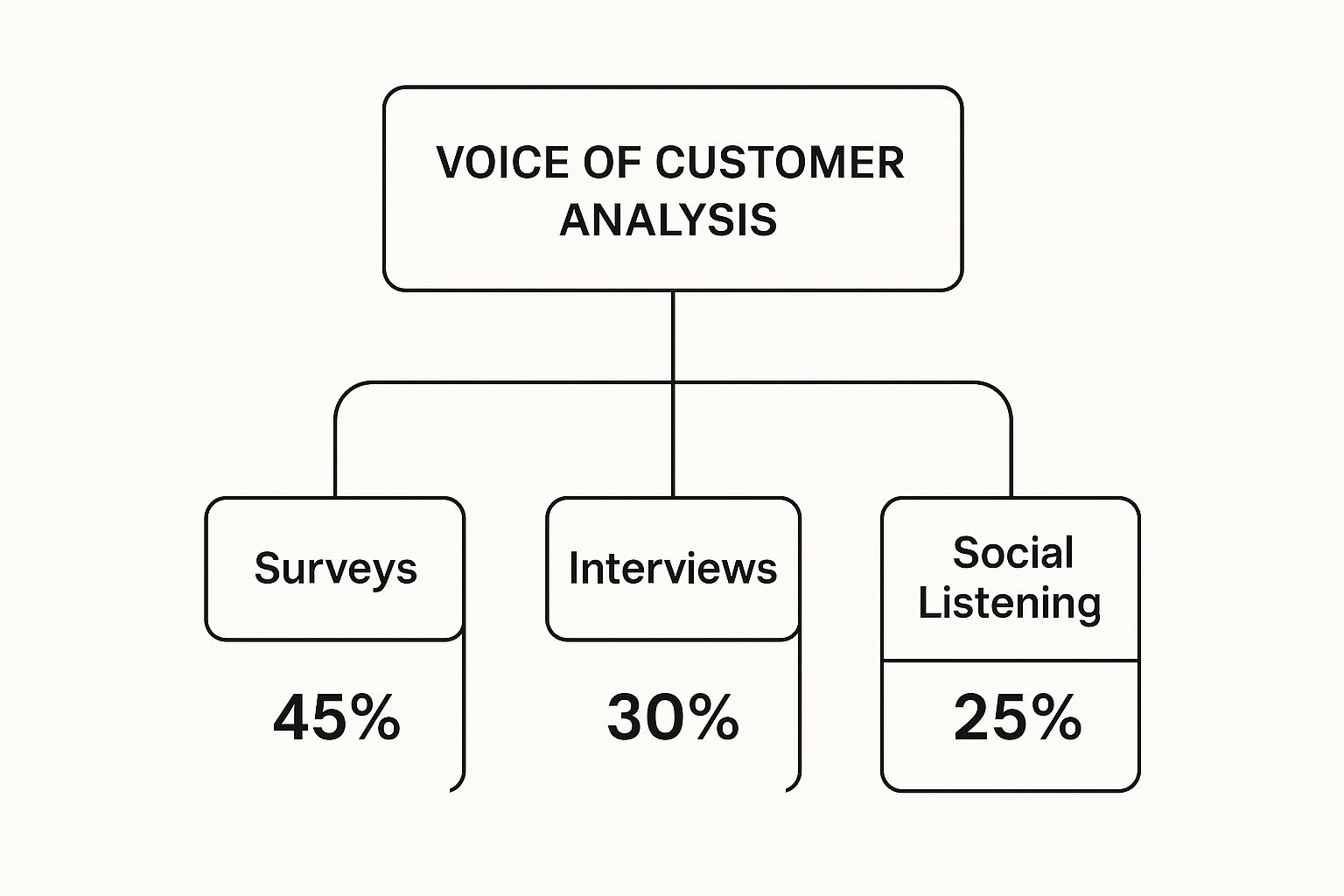
While surveys are valuable, their popularity points to a huge opportunity. Businesses that go beyond surveys to tap into authentic, unstructured feedback from interviews and social media can gain a serious competitive advantage.
A Rapidly Growing Field
The focus on understanding customers is more than just a trend; it's a massive market shift. The global customer analytics market, which encompasses VoC, was valued at $16.97 billion in 2024. It’s projected to skyrocket to $48.63 billion by 2030.
What’s driving this incredible growth? Simply put, businesses are flooded with feedback from countless digital touchpoints and need a way to make sense of it all. You can learn more about this growth and the role of AI in this detailed VoC analytics overview. The message is clear: companies that master listening to their customers are the ones that will win.
Why VoC Is a Game Changer for Your Business

It’s one thing to know what your customers are saying. The real magic happens when you understand why they're saying it. A voice of customer analysis program does more than just collect feedback; it ties what your customers are feeling directly to your business's health and profitability. This isn't just about making people happy—it’s a powerful strategy for real, sustainable growth.
Let’s say your support team keeps getting bogged down with tickets about your checkout process. On the surface, that’s just a daily headache and a cost center. But what if you dug into that feedback? You might find a single, confusing button is the culprit behind 90% of those tickets.
Fixing that one button does more than just quiet down your support queue. It boosts your conversion rate, improves customer satisfaction, and frees up your team to tackle more pressing problems. That’s VoC in action: turning a common complaint into a profitable fix.
Drive Meaningful Product Innovation
Your customers are a goldmine of brilliant ideas, but you need a filter to separate the great ideas from the noise. VoC analysis helps you zero in on the feature requests and improvements that will actually move the needle.
Instead of your product team making educated guesses about what to build next, they can work from hard evidence. Imagine sifting through online reviews and discovering a recurring demand for a "dark mode" in your app. That's not just a suggestion; it's a clear signal for your next development sprint. You end up building features people genuinely want and will use.
This approach takes the guesswork out of product development. It aligns your roadmap with real user needs, which leads to better adoption rates for new features and a product that people truly value.
Build Unbreakable Customer Loyalty
Loyalty is more than just getting customers to buy from you again. It’s about creating a bond where they feel genuinely seen and heard. In fact, research shows 83% of customers are more loyal to brands that actually listen and resolve their complaints. A structured voice of customer program is how you make that happen consistently.
When you actively listen and respond to feedback, you're no longer just a vendor; you become a partner. That emotional connection is what turns satisfied customers into your biggest fans—the ones who will recommend you to friends and stick with you.
This kind of loyalty is a huge asset. These customers are more likely to forgive a minor slip-up, be the first to try your new offerings, and are less likely to jump ship over a small price difference. They are the foundation of a resilient business.
Create a Strong Competitive Advantage
In a packed marketplace, the experience you provide is often your sharpest edge. While your competitors might be battling over features or price wars, you can win by delivering an experience that’s perfectly in sync with what customers want.
Here’s how VoC gives you that advantage:
- Spot Trends Early: By tracking customer conversations, you can pick up on emerging needs before anyone else, giving you a head start on innovation.
- Dodge PR Nightmares: Monitoring social media and reviews in real-time lets you catch negative feedback before it snowballs into a public crisis.
- Smooth Out the Entire Journey: VoC shines a light on friction points everywhere, from your first ad to your post-purchase support, helping you create an experience that’s smooth from start to finish.
At the end of the day, truly understanding your customers is the most powerful and defensible moat you can build around your business. It makes you smarter, more innovative, and ultimately, more profitable.
How to Collect Meaningful Customer Feedback

Getting real, useful feedback from your customers feels a lot like detective work. You can't just rely on one clue to solve the case of what they really want. If you do, you're trying to build a puzzle with half the pieces missing.
A truly effective voice of customer analysis program is all about gathering clues from different places. By combining various feedback methods, you can piece together a complete and accurate picture of the customer experience.
The Two Sides of Customer Feedback
The best way to think about collecting feedback is to split it into two main categories: what customers tell you when you ask (direct feedback) and what they say when you're not in the room (indirect feedback). Each one gives you a different, yet equally important, piece of the puzzle.
Direct Feedback: When You Ask, They Answer
Direct feedback is pretty straightforward—it's what you get when you proactively ask customers for their opinions. This approach is perfect when you have specific questions and need targeted answers. Think of it as a formal interview with a key witness.
Common ways to get direct feedback include:
- Surveys: These are the go-to for a reason. You can use quick Net Promoter Score (NPS) surveys to check on loyalty, send a Customer Satisfaction (CSAT) survey after a support chat, or deploy longer questionnaires to get detailed thoughts on a new feature.
- Interviews: Nothing beats a one-on-one conversation for digging deep. Interviews let you explore a customer’s real motivations and uncover frustrations that a multiple-choice question could never capture.
- Focus Groups: Getting a small group of customers together can spark incredible discussions. You'll often uncover shared pain points or brilliant ideas that you never would have thought to ask about.
The biggest plus of direct feedback is control. You set the agenda, ask the questions, and choose who to talk to. This makes it much easier to analyze specific parts of your business.
But there's a catch. People are busy, and "survey fatigue" is very real, often leading to low response rates. Plus, customers might tell you what they think you want to hear, or they might not even be fully aware of their own subconscious biases. This is exactly why you need the other side of the coin: indirect feedback.
Indirect Feedback: The Unfiltered Truth
Indirect feedback is the raw, unprompted voice of your customer. It’s what they say to their friends, colleagues, or the internet when they think you aren't listening. This is often where the most honest and valuable insights for your voice of customer analysis are hiding.
You can find this unfiltered truth in places like:
- Social Media: People are incredibly open on platforms like X (formerly Twitter), Facebook, and Reddit. Monitoring what they're saying about your brand gives you a live look at public perception.
- Online Reviews: Websites like G2, Capterra, or Trustpilot are gold mines. Customers leave detailed reviews about your product, your competitors, and their entire experience from start to finish.
- Support Tickets: Your own helpdesk is a treasure trove of feedback. Every email, chat log, and call transcript is a clue that points to common problems, confusing features, and recurring customer questions.
Comparison of VoC Data Collection Methods
To build a complete picture of the customer experience, it's essential to understand the unique role each feedback channel plays. The table below breaks down the primary uses, benefits, and drawbacks of both direct and indirect methods.
| Method | Type | Best For | Pros | Cons |
|---|---|---|---|---|
| Surveys | Direct | Gauging satisfaction and loyalty at scale. | Structured data, easy to quantify, and repeatable. | Low response rates, survey fatigue, and potential for biased answers. |
| Interviews | Direct | Deeply understanding user motivations and context. | Rich qualitative insights and the ability to ask follow-ups. | Time-consuming, not scalable, and can be expensive to conduct. |
| Focus Groups | Direct | Exploring group dynamics and shared opinions. | Generates new ideas and uncovers consensus on issues. | Can be influenced by dominant personalities; difficult to schedule. |
| Social Media | Indirect | Tracking brand sentiment and real-time reactions. | Unfiltered, spontaneous, and provides a broad public pulse. | Noisy data, lacks context, and can be difficult to quantify. |
| Online Reviews | Indirect | Understanding product strengths and weaknesses. | Detailed, comparative feedback against competitors. | Can be skewed by very positive or very negative experiences. |
| Support Chats | Indirect | Identifying common user problems and friction points. | Raw, honest data directly tied to product usage and issues. | Unstructured data requires analysis tools; reflects problems, not praise. |
By strategically combining these methods, you can cross-reference what customers say directly with what they express organically. This balanced approach ensures you're not just hearing what you want to hear, but what you need to hear.
Putting It All Together
Making sense of all this information, especially the unstructured chatter from social media and support tickets, can feel overwhelming. That's where specialized software comes in handy. There are many powerful customer feedback analysis tools available that can automate the heavy lifting of gathering and sorting all this data for you.
Ultimately, the goal is to create a powerful feedback loop. Use the raw, honest insights from indirect feedback to figure out what you should be asking in your direct surveys and interviews. This hybrid approach ensures you capture the full spectrum of the customer voice, leading to a much more insightful and actionable voice of customer analysis.
Turning Customer Feedback Into Actionable Insights
https://www.youtube.com/embed/mccsmoh2_3c
Collecting customer feedback is just the starting line. The real magic happens when you turn that raw, messy data into clear, strategic actions. Think of it like a treasure hunt: you've gathered all the maps, but now you need to decipher the clues to find the gold. That's the heart of voice of customer analysis.
You might have thousands of survey responses, hundreds of support chats, and a constant stream of social media mentions. By itself, this is just noise. The analysis process is what helps you find the signal in that noise, turning a jumble of customer comments into a clear to-do list for your team.
From Raw Data to Clear Direction
The real goal is to get past what customers are saying and truly understand why they're saying it. It’s a journey that takes you from a mountain of feedback to the specific root causes of things like customer churn or dissatisfaction.
It all starts with organizing and cleaning up the data. This means getting all your feedback into a structured format, whether that’s tagging support tickets by topic or categorizing open-ended survey answers. Once everything is tidy, the patterns start to emerge.
For instance, maybe you notice a spike in negative comments every time you release a software update. That’s a clear pattern. The next step is to dig in and find the root cause. Is it a specific bug? A confusing new feature? Or maybe just poor communication about the changes? Answering these questions is how you uncover genuine, actionable insights.
The Power of Sentiment Analysis
One of the most powerful tools in your VoC toolkit is sentiment analysis. Think of it as an "emotion detector" for all your customer feedback. It automatically scans text—from reviews, emails, and social media—and figures out the emotional tone behind the words.
Sentiment analysis goes way beyond just tracking keywords. It doesn’t just tell you customers are talking about your "checkout process"; it tells you they are overwhelmingly frustrated with it. This context is what turns data into a compelling reason to act.
This technique is incredibly helpful for getting a quick pulse on customer reactions at a large scale. Instead of having someone manually read every single comment, you get an instant overview of how people are feeling. Digging into customer sentiment analysis can further refine these insights, helping you grasp the emotional reality of customer interactions and prioritize the most urgent fires.
Using AI to Automate the Heavy Lifting
Let's be honest, manually sifting through thousands of data points is a massive time sink, not to mention it’s easy for human bias to creep in. This is where AI and machine learning tools have become game-changers. They can automate the entire analysis process, putting deep insights within reach for any business.
These tools can perform complex tasks in seconds, like:
- Topic Modeling: Automatically grouping feedback to see what major themes and topics customers are discussing.
- Trend Identification: Spotting emerging issues or positive trends in real-time before they blow up.
- Root Cause Analysis: Connecting the dots between different data points to find the real source of a problem.
By letting AI handle the grunt work, your team is freed up to focus on what humans do best: strategizing and taking meaningful action based on the findings. For a closer look at the different methods, our guide on analyzing customer feedback breaks down some practical steps. Ultimately, this transforms your VoC program from a simple listening exercise into a powerful engine for growth.
Putting VoC Insights Into Action With Screendesk

Finding a game-changing insight in your customer feedback is a great feeling, but it's just the first step. The real magic of any voice of customer analysis program happens when you turn those discoveries into actual improvements. This is where so many companies stumble, leaving valuable feedback to gather dust in a report instead of sparking real change.
Let's be honest: insights without action are just expensive trivia. For your VoC program to have any real impact, you need a way to connect what customers are saying directly to what your teams are doing. This is where a tool like Screendesk comes in, creating a bridge between the analysis and the action. It helps you build a system where responding to feedback is just a normal part of everyone's day, not some big, separate project.
From Feedback to Fix: A Real-World Scenario
Let's walk through a common situation to see how this plays out. Imagine your customer support team notices a worrying pattern over a few days: several customers are getting the same error message right at the final step of checkout.
In a disconnected system, this feedback could easily get lost. A support agent might drop a message in a team chat, but there’s no guarantee it will ever reach the right people or get fixed. It's a classic case of good feedback falling through the cracks.
With Screendesk integrated into the helpdesk, the whole story changes.
Here’s how it works:
- Spot the Pattern: As support chats arrive, Screendesk’s AI can automatically tag conversations with labels like “checkout issue” or “payment error.” This makes a recurring problem instantly visible.
- Get Visual Proof: Instead of trying to describe the bug, agents can use Screendesk to ask the customer for a quick screen recording. This gives developers the exact visual proof they need to see the problem for themselves and fix it fast.
- Create a Task: Right from the support ticket, the agent can create a task for the engineering team. All the crucial context—the customer's complaint, the screen recording, the ticket details—is attached automatically.
Suddenly, you have a direct, traceable line from the customer's frustration to the development team's to-do list. No more lost messages or games of telephone.
Closing the Loop With Customers
But it doesn't end when the bug is assigned. A truly connected system lets you see the issue through to resolution and—most importantly—follow up with the customers who helped you find it.
Closing the loop is the ultimate sign of respect for your customers' feedback. It shows them you're not just listening, but that their voice genuinely led to a positive change. This simple act can turn a frustrated user into a loyal advocate.
When the dev team fixes the checkout bug, your support team gets an automatic notification. They can then send a quick, personal message to every customer who reported it: "Hey, just wanted to let you know we fixed that checkout issue you told us about. Thanks so much for helping us improve!"
This one simple step validates the customer’s effort and makes them feel valued. After all, research shows that 83% of customers feel more loyal to brands that respond to and resolve their complaints. It’s a powerful way to build trust.
When you connect your voice of customer analysis directly to your day-to-day work with a tool like Screendesk, you create a culture of constant improvement that actually delivers results. You stop just collecting feedback and start putting it to work.
How to Measure the Success of Your VoC Program
So, you’ve launched a voice of customer program. That’s a great first step, but how do you know if it's actually making a difference? To get real buy-in from your team and leadership, you need to connect your VoC efforts to results your business can feel. This means going beyond just collecting feedback and starting to track metrics that prove you're moving the needle.
Measuring success is really about telling a story with your data. It’s about showing everyone that listening to customers isn't just a feel-good activity—it's a smart strategy that boosts efficiency, builds loyalty, and drives revenue.
Key Metrics to Track VoC Success
To see the full picture, you need to track a blend of metrics that cover operations, customer experience, and the bottom line. These key performance indicators (KPIs) help you put a number on the impact of your voice of customer analysis and make a solid case for keeping the program going.
Here are the most important metrics to keep an eye on:
- Reduction in Support Tickets: This one is simple and powerful. When you use VoC insights to fix a confusing feature or a recurring bug, people naturally have fewer reasons to contact support. Seeing a drop in tickets related to a specific issue is concrete proof that your analysis is leading to real-world fixes.
- Increase in Customer Satisfaction (CSAT): CSAT is your go-to for measuring in-the-moment happiness after a specific interaction. As you start implementing changes based on what customers are telling you, these scores should climb. For more on this, check out our guide on how to increase customer satisfaction.
- Improvement in Customer Effort Score (CES): CES answers a crucial question: "How easy was it to get your problem solved?" We all know that difficult, high-effort experiences are a fast track to losing customers. If your CES score is going up, it’s a clear sign you’re successfully getting rid of the friction that drives people away.
A successful VoC program doesn't just listen—it makes life easier for the customer. Tracking Customer Effort Score is crucial because it directly measures how effectively you're removing obstacles that lead to frustration and churn.
Connecting VoC to Financial Outcomes
Operational wins are great, but tying your VoC program to the company’s finances is what really gets everyone's attention. These financial KPIs show that listening to customers isn’t just good practice—it’s profitable.
- Increase in Customer Lifetime Value (CLV): CLV is a forecast of how much total revenue a customer will bring in over their entire time with you. When you use VoC insights to build loyalty and stop customers from leaving, you directly increase the long-term value of your customer base. A rising CLV is one of the strongest signs of VoC success.
- Decrease in Customer Churn Rate: Your churn rate—the percentage of customers you lose over a certain period—is a critical health metric. A high churn rate is like a leaky bucket. By using voice of customer analysis to find and fix the root causes of why people leave, you can patch those leaks and keep more customers. Since it costs far less to keep a customer than to find a new one, even a small drop in churn can have a huge financial impact.
By tracking these metrics consistently, you’re not just collecting data; you’re building a strong business case. You can clearly show how understanding what customers want leads to smoother operations, happier people, and a much healthier bottom line.
Got Questions About VoC Analysis? We’ve Got Answers.
Even the best-laid plans hit a few bumps. When you're just getting started with a voice of customer program, questions are going to pop up. Here are some of the most common ones we hear, along with some practical advice from the trenches.
How Can I Start a VoC Program if My Budget Is Tiny?
Don't let a small budget stop you. You absolutely do not need a pricey, all-in-one platform to start understanding your customers. The secret is to start small and work with the data you already have.
- Dig into your support tickets. Your helpdesk is a treasure trove of unfiltered customer feedback. Start reading through support chats and emails to find patterns and recurring complaints.
- Use free survey tools. You can get a surprising amount of mileage out of tools like Google Forms. Use them to send out simple customer satisfaction (CSAT) surveys without spending a dime.
- Keep an eye on social media. Manually set up some alerts for your brand name on places like X (formerly Twitter) and Reddit. You'll see what people are saying about you in the wild.
The trick is to have a specific goal. For example, aim to uncover the top three reasons customers reach out to support. You can do that with the free resources you already have.
How Often Should We Be Looking at Customer Feedback?
The right answer really depends on what kind of feedback you're talking about. Some things need your attention right now, while other insights only emerge when you look at the data over a longer period.
The biggest mistake you can make with VoC analysis isn't how often you do it, but whether you act on it. It’s far better to analyze one feedback channel every week and actually do something about it, than to analyze five channels once a month and do nothing.
A great way to get started is to create a simple schedule:
- Daily: Check on real-time channels like social media mentions and support tickets for any fires that need putting out.
- Weekly or Bi-Weekly: Take a look at your survey results to spot any short-term trends that are developing.
- Quarterly: This is when you do the big-picture analysis. Pull together all your data sources to identify major strategic opportunities and see how you’re tracking against your goals.
What's the Single Biggest Mistake to Avoid?
By far, the most common pitfall is collecting mountains of data without any plan to act on it. When that happens, your VoC program just becomes an interesting report that sits on a shelf, not a tool for making the business better.
You have to connect the feedback to a real-world outcome. Make sure every insight you uncover has a clear owner and a path to getting resolved.
Ready to turn all that customer feedback into something you can actually use? Screendesk works directly with your helpdesk to capture screen recordings and video feedback from your users. It makes it incredibly easy to see problems exactly as your customers do, so you can fix them faster. Start your free trial today.
