


Let's be honest, "workplace efficiency" sounds like corporate jargon for "work harder." But that's not what it's about anymore. It’s about working smarter by getting rid of the annoying, time-wasting tasks that stand between you and your actual job.
Think of it as fine-tuning an engine. You’re not just pushing the gas pedal harder; you’re making sure every part works together smoothly to get more power with less effort.
What Workplace Efficiency Really Means Today
The old-school approach of just piling on more work and expecting better results is thankfully on its way out. Today, creating an efficient workplace is about building a system where your team can actually focus on what they were hired to do, instead of getting buried in administrative busywork or clunky software.
This means we need to look at efficiency in a new light, focusing on clear processes, smart technology, and a company culture that protects everyone's time.
Believe it or not, the shift to remote and hybrid work hasn't killed productivity. In fact, the numbers tell a different story. In 2023, the U.S. witnessed its highest labor productivity growth in 20 years, jumping by 2.7%. Even now, productivity is still 2.1% higher than it was before the pandemic. If you're curious about the data behind these trends, ProofHub has a great breakdown of modern work statistics.
This tells us that flexible work arrangements, when paired with the right tools and practices, can actually make a team more effective.
The real problem isn't where people are working—it's how. Employees are still spending roughly 60% of their time on "work about work." This is all the time spent switching between apps, digging for information, and sitting in meetings that could have been an email.
This is the productivity killer we need to tackle. To build a genuinely efficient workplace, you have to find and eliminate these hidden time drains.
So, how do we build a framework for a more efficient workplace? It all comes down to a few core ideas that, when put together, create a powerful system for getting things done.
Here’s a quick look at what those foundational elements are:
Core Pillars of Modern Workplace Efficiency
| Pillar | Key Actions | Expected Outcome |
|---|---|---|
| Streamlined Workflows | Map and simplify key processes. Remove unnecessary steps and communication bottlenecks. | Faster project completion, fewer errors, and less time wasted on coordination. |
| Intelligent Technology | Choose tools that solve specific problems, not just add to the noise. Consolidate tasks into a single platform. | Reduced app-switching, clearer communication, and a single source of truth for information. |
| A Culture of Focus | Set clear communication rules. Run shorter, more effective meetings. Protect time for deep, uninterrupted work. | Higher quality work, less employee burnout, and a more engaged team. |
By focusing on these three pillars, you move away from temporary "productivity hacks" and toward building a sustainable system that helps everyone work more effectively. It’s not about adding more rules, but about designing a smarter way to operate.
Let's Break It Down
-
Streamlined Workflows: This is all about looking at how work gets done and asking, "Can we make this simpler?" From the way a customer support ticket is handled to how a blog post gets approved, there are always steps that can be cut or automated. The goal is to create a clear, simple path from start to finish.
-
Intelligent Technology: More apps don't equal more productivity. The key is to pick tools that actually fix a problem. For example, instead of juggling emails, chat messages, and tickets for support, a tool like Screendesk brings all that communication into one place. It’s about consolidation, not accumulation.
-
A Culture of Focus: This is the human element. It means creating an environment where people can actually concentrate. This might look like setting "no meeting" blocks, encouraging asynchronous communication, and making it okay to turn off notifications to get deep work done. It’s about respecting everyone’s time and attention.
Streamline Workflows to Eliminate Hidden Bottlenecks
Every team has them—those processes that started out simple but somehow spiraled into tangled, inefficient messes. These hidden bottlenecks are the silent killers of productivity, quietly causing delays and brewing frustration. If you're serious about figuring out how to increase efficiency in the workplace, your first job is to untangle these knots.
Think about a marketing team's content approval process. A single draft can get lost bouncing between four different people across email, Slack, and Asana. Nobody knows who has the latest version or what its actual status is. Sound familiar?
This is where you need to roll up your sleeves and do some workflow mapping. Pick a common process, like an IT support ticket, and literally draw out every single step it takes to get from submission to resolution. Who touches it? Where does it sit waiting for someone? You'll quickly see the glaring issues, like two people doing the same check or long delays where communication just dies.
Standardize and Simplify Your Processes
Once you've found the weak spots, the next step is to create a simple, standardized path that everyone can actually follow. This doesn't mean writing a fifty-page manual nobody will read. A simple one-page checklist or a clear flow diagram often does the trick.
For example, that chaotic content approval mess? You could fix it by setting up a single, dedicated channel where all drafts are submitted and all feedback is consolidated. It's a small change, but one that can easily save dozens of hours a month.
Automating repetitive tasks is another game-changer for freeing up your team's time and boosting efficiency. For a deeper look at this, check out this excellent a guide to task automation for small businesses.
A centralized tool can completely change the game. By bringing communication, approvals, and task management into one place, you directly attack the "work about work" problem, eliminating the constant app-switching that drains focus and kills momentum.
This diagram shows a straightforward way to get a handle on your daily tasks.
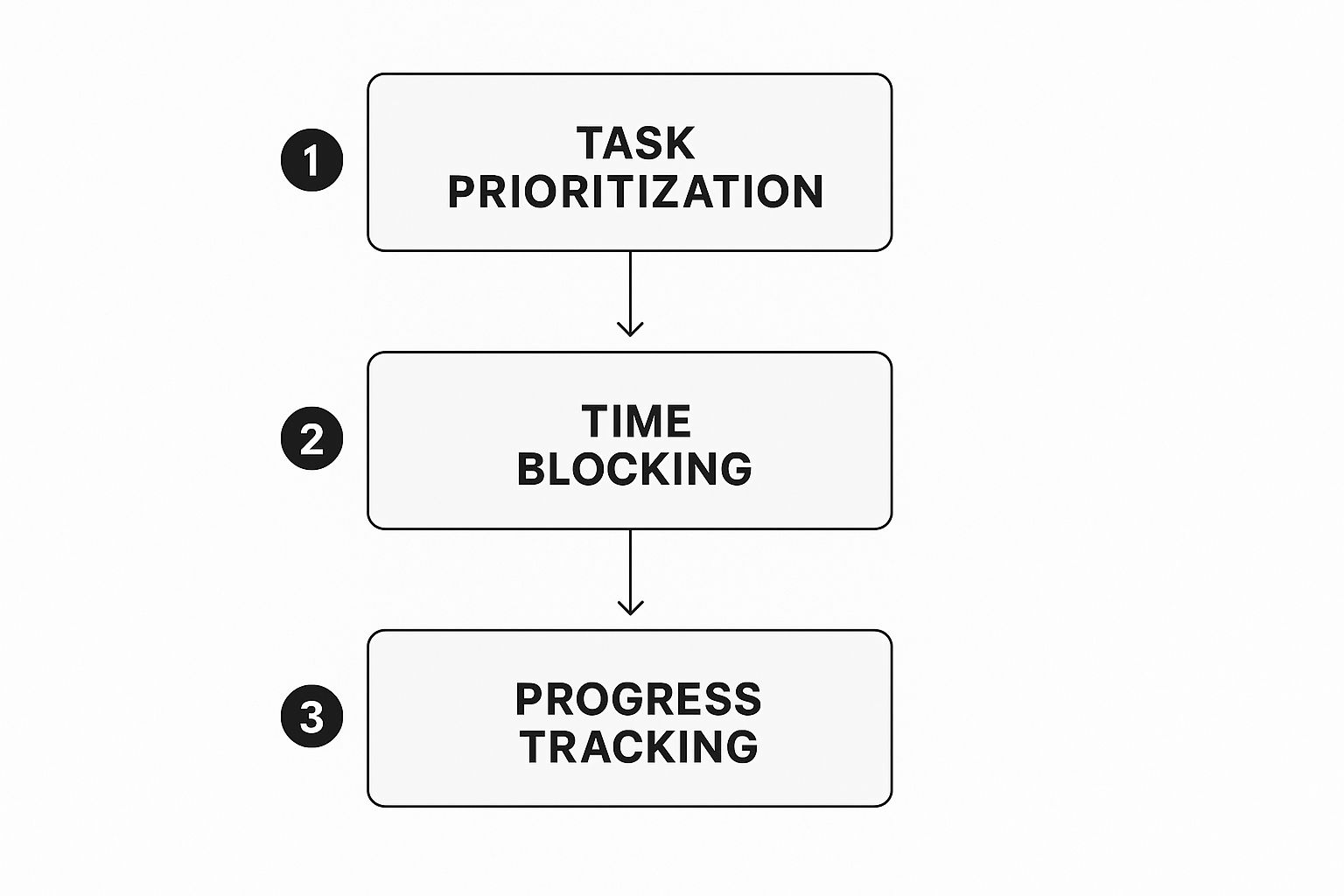
The visual breaks it down perfectly: first, you prioritize what's important. Then, you block out dedicated time to focus on that work. Finally, you track your progress. It creates a simple, repeatable cycle that helps you actually get things done.
Use Technology and Automation Wisely
Let’s be honest, throwing more software at a problem rarely solves it. The goal isn't to collect a bunch of new tech; it's to find tools that actually fix what's broken. The real secret to boosting workplace efficiency is picking solutions that get rid of friction, not add to it.
Before you invest in anything, ask yourself a simple question: "Does this tool automate something mind-numbingly repetitive or genuinely make it easier for us to work together?" If a new app creates more confusion than it clears up, it's just dead weight. Real efficiency gains come from smart choices that let your team focus on high-impact work.
Focus on Solutions, Not Just Software
Think about customer support. It can be a huge time-sink, with endless back-and-forth emails just trying to figure out what the customer is even talking about. This is where a specialized tool can make a world of difference.
For instance, imagine your support agent could see exactly what the customer is seeing on their screen, in real-time. No more guesswork.

This direct view allows agents to guide users straight to a solution, cutting resolution times from days to minutes. It transforms a frustrating experience into a surprisingly smooth one.
The World Economic Forum notes that 60% of global employers believe wider access to digital tools will transform their business by 2030. You can see all the data in their Future of Jobs Report.
This isn't just about buzzwords. It's about practical tools that solve real problems. Features like AI-powered session replays and co-browsing aren't just flashy extras—they are workhorses that slash the time it takes to resolve support tickets.
By automating the "what's the problem?" part of the conversation, you free up your team to actually solve it. We dig deeper into this in our guide on the benefits of process automation.
Ultimately, this isn't about chasing trends. It's about building smarter systems that give your people the leverage to do their best work.
Build a Culture That Protects Employee Wellbeing
It’s easy to get lost in processes and software when we talk about improving workplace efficiency. But here’s the thing I’ve learned over the years: an exhausted team is an inefficient team. Burnout is the ultimate productivity killer.
Investing in your team's health isn't just a "nice-to-have" perk; it's one of the smartest business moves you can make. A culture that genuinely supports employee wellbeing delivers real, measurable results—lower turnover, higher engagement, and a whole lot more creative thinking.
It all starts with simple, human-centric actions. Encourage people to take real breaks, not just for lunch. A quick five-minute walk to clear your head can make a world of difference. And it’s crucial to respect working hours. If you’re a leader, stop sending those late-night emails. Show your team that it’s okay to switch off.
Prioritize Mental Health and Support
Accessible mental health support is non-negotiable in today's workplace. This can be anything from offering subscriptions to wellness apps to providing confidential access to counseling services. The most important thing is to remove the stigma and make it incredibly easy for people to find and use these resources.
Getting this right from the very beginning is key. To make sure new hires feel supported from day one, think about using effective onboarding surveys to check in on their initial experience and wellbeing.
A culture of support proves that when you take care of your people, performance takes care of itself. Companies with highly engaged teams see 21% greater profitability and a 59% reduction in turnover.
The best companies are weaving wellbeing directly into their culture, moving far beyond just one-off programs. They're looking at the whole person—mental health, physical recovery, and social connection—and embedding support for these things into how they operate every single day.
It's a clear sign that employee efficiency is deeply tied to creating an environment where people feel mentally and socially supported.
Refine Communication for Better Collaboration
Let's be honest: poor communication is a silent killer of productivity. It’s not just annoying; it’s a massive hidden cost. We’ve all been there—trapped in endless email chains over a simple question, sitting through meetings with no clear point, or digging through folders for a file that should be right there. If you want to get more done, you have to fix how your team talks.
Start by setting some simple "rules of the road." Your team needs to know which channel to use and when. Is a question urgent enough for a quick chat, or does it need the paper trail of an email? Creating these ground rules cuts through the digital noise and helps everyone focus. For example, a great starting point is: "Use chat for quick, urgent questions. Use email for formal updates that need to be documented."
This same thinking applies to meetings. Every single meeting needs a purpose, an agenda, and someone in charge who ensures a decision is made.
A meeting without a clear outcome isn't collaboration; it's a social event that costs the company money. Make your meetings so effective that follow-up meetings are the exception, not the norm.
Create a Single Source of Truth
Think about how much time your team wastes just looking for information. The solution is to build a transparent system where documents, project updates, and key decisions are easy for anyone to find. This could be a well-organized shared drive, a project management tool like Asana or Trello, or a company wiki.
When everyone knows exactly where to go for information, the constant "Hey, where can I find…?" pings finally stop. It’s a simple change that gives everyone back valuable time. It also naturally improves teamwork, because people can collaborate without friction when they're all working from the same information. For more on this, check out our guide on how to improve team communication.
Modern tools have completely changed the game here. For support or technical teams, features like shared screen control or session replays can make confusing back-and-forth emails a thing of the past. Why try to describe a complex bug when you can just show it? Solving problems together, in real-time, builds a communication culture that values clarity and speed, getting rid of those frustrating delays that hold everyone back.
Putting It All Into Practice

Alright, theory is one thing, but making real change happen is where the rubber meets the road. It’s easy to talk about improving workplace efficiency, but getting your team to adopt new habits? That's the real challenge.
My advice? Start small. Don't try to boil the ocean by changing everything overnight. That’s a recipe for burnout and resistance. Instead, pick one or two of your team's biggest headaches—maybe it's the chaotic support ticket queue or those meetings that could have been an email—and focus your energy there.
Running a small pilot project is a great way to test the waters. It lets you try out a new process, see what works, and prove the value of your idea without causing a massive disruption.
Key Takeaway: You need to get your team on board. Don't just hand down a new rule. Frame it as an experiment to fix a problem everyone hates. When you position it as a solution to a shared frustration, people are much more likely to give it a shot.
Your First Moves
Once you've zeroed in on a pilot project, a simple game plan can keep you on track. Before you kick things off, make sure you’ve covered these bases:
- Know What a "Win" Looks Like: How will you know if this worked? Be specific. Maybe success is a 20% drop in unnecessary meeting hours or a noticeable improvement in ticket response time. Define your target.
- Explain the "Why": Don't just announce the change; explain the reasoning. Let your team know what problem you're trying to solve and how this new approach is designed to make their lives easier.
- Measure Everything: Use the goals you set to track your progress. Hard data is your best friend when it comes to showing success and convincing others to adopt the change more widely.
If you’re on a support team, a fantastic place to start is by looking at how you resolve customer issues. For a deeper look into this, check out our guide on help desk optimization.
Remember, changing old habits doesn't happen instantly. It takes patience and persistence. Celebrate the small victories along the way to keep morale high and build momentum. For a broader set of ideas, you might find these tips to improve overall operational efficiency helpful.
Your Top Questions About Workplace Efficiency Answered
Making big changes to how your team operates always brings up a few questions. That's a good thing—it means people are engaged. Here are some of the most common questions I get from managers who are right where you are, ready to boost their team's efficiency.
Where On Earth Do I Start?
It's tempting to try and overhaul everything at once, but that's a recipe for burnout. The best starting point is to simply watch and listen.
Pull your team aside and ask them: what's the one thing that drives you crazy every single day? Is it the black hole where support tickets go to die? The endless email chains trying to explain a simple bug?
Find that one, single, recurring frustration. By focusing on a real pain point your team already recognizes, you get instant buy-in for your first change. It’s a small victory that creates the momentum you need for bigger improvements down the line.
My biggest piece of advice: Don't try to boil the ocean. Pick one bottleneck, solve it—whether with a better process or a smarter tool—and then move on. You'll prove the value of change and get your team excited for what's next.
How Do I Know If Any of This Is Actually Working?
Great question. You can't improve what you don't measure. The key is to track metrics that are directly tied to the specific problem you just solved.
- If you're tackling customer support: Keep an eye on your first-contact resolution rate. Are you solving more issues on the first try? Also, watch your average handling time. Is it dropping?
- If you're focused on project management: Look at project completion times or the number of missed deadlines.
Seeing those numbers improve is your proof. That's when you know your efforts are paying off, not just in theory, but in real, measurable results.
Ready to eliminate those frustrating support workflows and watch your team's efficiency climb? Screendesk uses video to slash resolution times and make collaboration feel effortless. See how it works and get started.
