


When it comes to handling customer complaints, the first step is a mental one. It's about shifting your entire perspective. Instead of seeing a complaint as a problem, you need to see it for what it truly is: a rare opportunity.
Think about it. The vast majority of your unhappy customers will never say a word. They'll just leave. The ones who take the time to complain are actually giving you a gift—a free look into what's broken and a chance to make it right.
Why Every Complaint Is a Gift in Disguise

Let’s be real for a second. Nobody likes getting a complaint. It can feel personal, like a direct shot at the hard work you and your team put in. But the businesses that truly thrive have learned to flip that thinking on its head. They see that negative feedback as a golden ticket.
The stakes are incredibly high. We know from research that 73% of consumers will jump ship to a competitor after just a couple of bad experiences. What’s even more telling is that a staggering 56% of dissatisfied customers never even file a complaint. They just ghost you.
This means every single complaint that lands in your inbox is incredibly valuable. It comes from someone who chose to engage with you instead of just walking away. You can dive deeper into these trends with these in-depth service statistics.
The Real Business Impact of Complaint Handling
How you respond to a complaint sends ripples across your entire business, impacting your bottom line and your brand's reputation. The difference between a good and a bad response isn't subtle; it's a night-and-day contrast that shows up in your metrics.
Here’s a look at how those two paths diverge.
| Metric | Poor Handling Outcome | Effective Handling Outcome |
|---|---|---|
| Customer Loyalty | The customer churns and tells an average of 15 people about their bad experience. | The customer feels heard, stays with your brand, and often becomes an advocate. |
| Brand Reputation | Negative online reviews and bad word-of-mouth start to damage public perception. | Positive sentiment spreads as you prove you stand behind your product and value customers. |
| Business Improvement | The root problem remains unsolved, continuing to frustrate other customers. | You get to the bottom of the issue and fix it, preventing future complaints. |
As you can see, a single interaction can either become a major liability or a story of exceptional service. When you embrace complaints, you also learn how to respond to negative reviews in a way that builds trust rather than burning bridges.
Turning a Major Complaint Into a Massive Win
I've seen this play out in the real world. A software company pushed a buggy update that broke a key feature for a major client—right before that client’s biggest project deadline. The client was, understandably, furious and talking about pulling a six-figure contract.
The wrong move would have been a canned apology or trying to downplay the issue. That’s not what happened here.
Instead, the support lead immediately got on it. He acknowledged their panic, quickly recorded a personalized video with Screendesk showing them a temporary workaround, and committed to delivering a hotfix within 24 hours. He owned the problem completely.
By not just solving the technical issue but over-communicating with genuine empathy, the company did more than just save the contract—they actually strengthened the relationship. The client later pointed to that exact incident as proof of their commitment, which led to them expanding the partnership.
That’s the true power of handling complaints with skill and care. It’s your best defense against customer churn and the single most effective tool for building a brand people want to stick with.
The Mindset That Defuses Frustration

Before you even think about typing a reply or picking up the phone, the most important tool you have is your own mindset. The real secret to effectively handling customer complaints isn't about growing a thick skin. It's about developing genuine empathy and keeping your cool when someone else has lost theirs.
Your first job isn't to find a quick fix. It's to listen with the intent to understand.
When a customer is angry, what they really want is to feel heard. It’s a basic human need. If you jump straight into problem-solving, you’re basically telling them their feelings don't matter, which can pour gasoline on the fire.
The best support pros I know live by a simple rule: validate first, solve second. When you acknowledge their frustration, you show respect. It immediately starts to de-escalate the situation and turns what could be a fight into a partnership.
The Power of Empathetic Language
Tiny shifts in how you word things can completely change the tone of a conversation. One of the most powerful tricks is to replace the word "but" with "and."
Just think about the difference here:
- "I understand you're frustrated, but I need your account number." (This sounds dismissive and invalidates their feeling.)
- "I understand you're frustrated, and to get this sorted out for you, I'll just need your account number." (This validates their feeling and aligns you with them to move forward.)
See how that second one feels? It instantly removes the defensive wall and shows you're on their team. You want them to feel like you're their partner in getting this fixed.
Another great technique is reflective listening. Simply repeat their issue back to them in your own words. It shows you were actually paying attention. For example: "Okay, so if I'm hearing you right, the report didn't export correctly, and now your team is under a tight deadline because of it."
A fascinating study from The Nottingham School of Economics found that unhappy customers were more willing to forgive a company that offered a genuine apology than one that just offered compensation. In fact, a whopping 45% of customers took back their negative review after an apology, while only 23% did for compensation alone.
This proves that fixing the emotional side of the problem is often way more important than just throwing money at it.
Building Trust to Solve the Problem
Once you've made the customer feel heard and built a little trust, then you can shift into actually solving the problem. That foundation of trust is everything. It makes the customer much more willing to listen to your solutions, even if it’s not the exact fix they had in mind.
Your mindset truly sets the stage for the entire interaction. If you're looking for more ways to navigate these tricky conversations, our guide on how to handle difficult customers has some great, practical tips.
By approaching every complaint with a calm, empathetic, and collaborative spirit, you can turn a negative experience into a real opportunity to build even stronger customer loyalty.
Your Framework for Resolving Any Complaint
When a customer complaint hits your inbox, it's easy to jump straight into problem-solving mode. But a knee-jerk reaction can often make things worse. Having a clear, repeatable game plan turns a potentially stressful situation into a manageable—and even positive—one.
This isn't just about damage control. It's a framework for building stronger relationships by moving from acknowledging the issue to resolving it in a way that makes the customer feel genuinely heard and valued.
Acknowledge and Validate First
Before you do anything else, you have to acknowledge the complaint and validate the customer’s feelings. This is the absolute, non-negotiable first step. It immediately sets the tone and shows the customer you’re an ally, not an adversary.
You don't have to admit fault right away. Simply show you're listening with phrases like:
- "I can absolutely see why that would be so frustrating. Let's dig into what happened here."
- "That definitely doesn't sound like the experience we aim to provide. I'm sorry you're having to deal with this."
- "Thank you for taking the time to bring this to our attention. I understand your concern, and I'm here to help."
This simple act of validation is powerful. It tells them, "I'm on your side."
Investigate with Care
Once you’ve validated their frustration, it’s time to put on your detective hat. This isn't just a box-ticking exercise; it's about showing the customer you take their problem seriously enough to investigate it properly.
Gather all the context you can find. Dive into their purchase history, check for previous support tickets, and review any notes on their account. Coming into the conversation prepared shows respect for their time and their issue.
A well-prepared team is your greatest asset here.
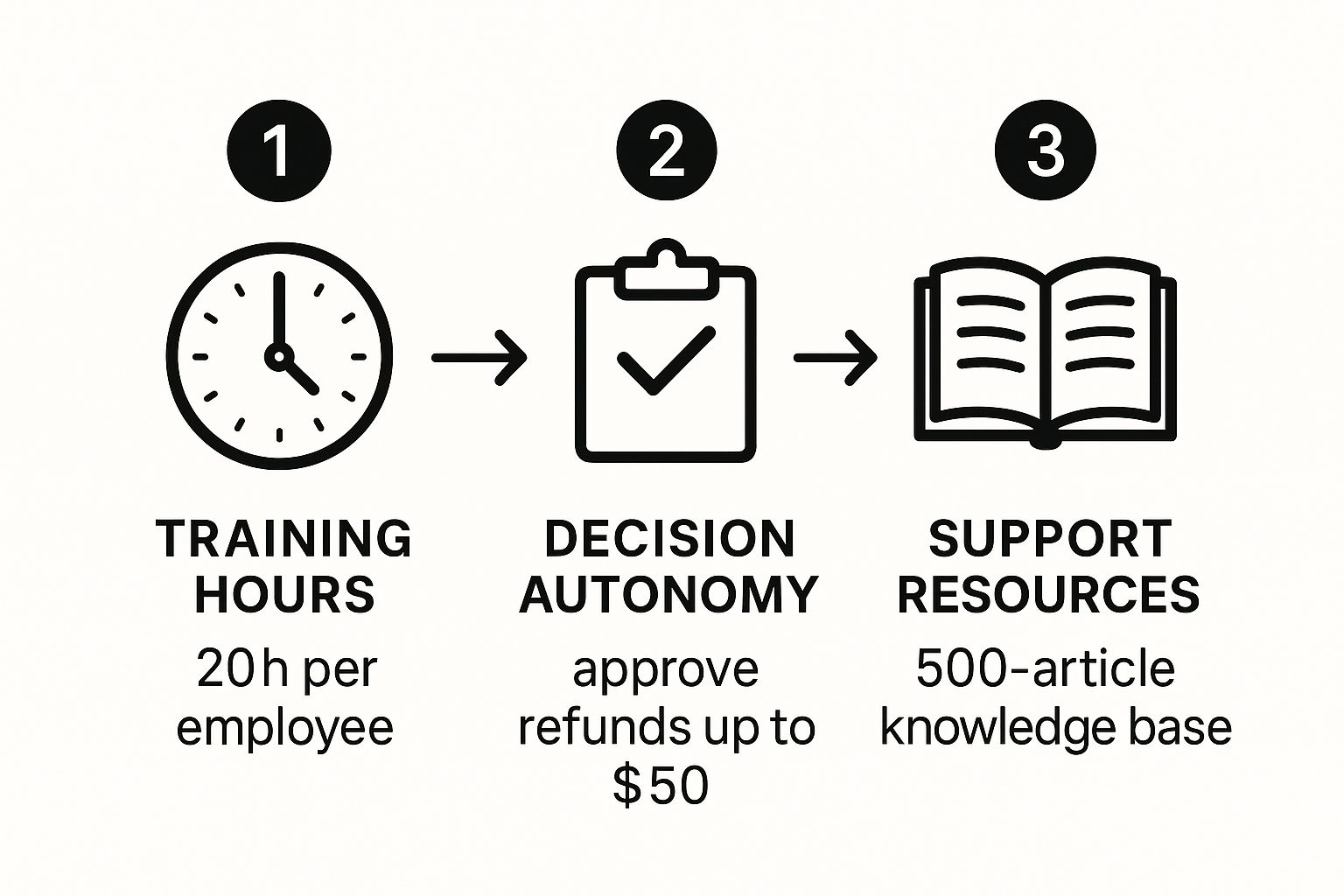
When you invest in properly training and empowering your support agents, they can investigate complaints thoroughly and make smart decisions on the fly.
Propose a Fair Solution
Now that you have the full picture, you can propose a solution. The sweet spot is an offer that feels generous to the customer but is also sustainable for your business.
Remember, loyalty is on the line. When customers feel their complaint wasn't handled well, their loyalty can plummet by 12%. What's more, a whopping 75% of customers expect a personalized touch when they're having an issue. You can discover more about these customer experience trends that highlight why a one-size-fits-all approach just doesn't work.
"Our goal isn't just to solve the problem. It's to restore the customer's confidence in our brand. A great solution shows we stand behind our promises."
A huge part of this is mastering the art of the response itself. Looking at real-world negative review response examples can give you fantastic, field-tested ideas for de-escalating tough situations and rebuilding that crucial trust.
Follow Up to Amaze
After you've delivered the solution, your job isn't quite done. This is where you can go from good to great. A quick follow-up message a few days later can completely transform the customer’s perception of the entire experience.
It’s a simple check-in that shows you genuinely care about their satisfaction, not just about closing a ticket. Try something like:
- The Check-in: "Hi [Customer Name], I just wanted to circle back and make sure everything is working as it should be now. Please let me know if there's anything else I can do for you!"
- The Extra Mile: "I'm so glad we could get that sorted out. As a small thank you for your patience, here's a credit for you to use on your next purchase."
This final step solidifies the positive interaction and has the power to turn a once-unhappy customer into one of your most loyal brand advocates.
Let Technology Add the Human Touch, Not Replace It

This might seem backward, but hear me out: the right technology can actually make your customer support more human. Instead of hiding behind automation, smart tools can help you deliver faster, clearer, and surprisingly personal responses. This is a huge advantage when you're trying to turn a customer complaint around.
Think about the last time you tried to explain a technical problem over email. The endless back-and-forth is draining for everyone involved. For the customer, it’s frustrating. For your team, it’s a time sink.
Now, picture this instead: you send a quick screen recording that personally walks the customer through the exact steps to solve their problem. You’ve just cut through all the confusion in one go. It’s a powerful way to show, not just tell, and it feels infinitely more personal than a dry wall of text.
Go Beyond Text with Asynchronous Video
Asynchronous video—basically, sending a recording instead of trying to connect live—is a real game-changer for support teams. It respects everyone’s schedule while still delivering incredibly clear instructions.
When a customer complains that a feature is confusing, you can use a tool like Screendesk to record your screen and voice, creating a mini-tutorial just for them. This one simple action can head off a dozen follow-up emails, solve the issue on the first try, and make that customer feel like you truly heard them.
This isn't just about being efficient. It's about showing empathy at scale. A personalized video demonstrates you took the time to understand their specific problem and craft a solution just for them. It’s a small effort with a massive emotional impact.
This move toward more visual, personal solutions is more than just a nice idea; it's a smart business strategy. The market for complaint management software was valued at $1.93 billion in 2018 and is on track to hit $8.29 billion by 2026. That explosive growth tells you something: companies are investing heavily in tech that helps them handle complaints better. You can read more about these complaint management trends and see the numbers for yourself.
Use Your Helpdesk for Deeper Insights
Your helpdesk and CRM are goldmines. They're far more than just glorified ticket trackers; they hold the entire history of your relationship with a customer. When a complaint comes in, that context is everything.
Before you even start typing a reply, take 30 seconds to look at their history.
- Previous Interactions: Have they reached out before? What for? Was it resolved?
- Purchase History: Are they a brand new customer or a long-time loyalist?
- Account Notes: Did anyone else on the team leave important notes about them?
This quick background check changes everything. Your response goes from a generic template to a thoughtful, personal conversation. It shows the customer you see them as a person with a history, not just another ticket number.
When you pair this deep customer knowledge with modern tools, you create a support experience that is both efficient and deeply human. This is a core part of building a solid proactive customer service strategy that gets ahead of problems before they even start.
Turning Complaint Data into Your Best Intel
Solving one customer's problem is a win. That’s what we’re here for. But what if you could use that one conversation to prevent hundreds of future problems? That's when your support desk transforms from a reactive fire-fighting unit into a source of priceless business intelligence.
It all starts with a system. Your goal is to move beyond just closing tickets and start spotting the patterns hidden within them. Are customers always getting stuck at the same checkout step? Is one specific feature causing a constant spike in frustration? Without a system, these are just isolated incidents. With one, they become a roadmap for improvement.
Tagging Complaints to Uncover Themes
The simplest and most effective way to start is with tagging. Most modern helpdesks let you add tags to every conversation, and this is the foundation for turning messy, unstructured feedback into clean, organized data.
You'll want to create a clear, consistent set of tags that your whole team understands and uses. Think beyond generic labels like "bug" or "question" and get granular.
- Feature-Specific Tags: Instead of just "bug," try
dashboard-export-errororbilling-invoice-missing. This immediately pinpoints the exact problem area in your product. - Process-Related Tags: Is the problem not in the product itself? Use tags like
shipping-delayoronboarding-confusionto highlight friction points in the customer journey. - Sentiment Tags: Even simple tags like
frustrated-customercan help you track overall sentiment and identify which issues are causing the most emotional pain.
When you tag every single complaint, you’re building a powerful database of customer pain points. Over time, you'll see which tags pop up most often, giving you a clear, data-backed priority list of what needs fixing first. This methodical approach is the bedrock for truly improving overall customer satisfaction because you're finally addressing root causes, not just putting out fires.
From Data to Actionable Reports
Of course, collecting data is only half the job. The real magic happens when you bundle those insights into clear, actionable reports for other teams. Your support team is on the front lines, giving them the most direct pulse on the customer experience.
Don't just tell your product team, "People are complaining about the dashboard." Show them. Present a report that says, "Over the last 30 days, we've had 47 separate complaints tagged with
dashboard-export-error, which is a 35% increase from last month."
This is how you get things done. Specific, data-driven feedback transforms support's anecdotal observations into undeniable proof that a real problem exists.
Set up brief, regular meetings with leaders from product, engineering, and even marketing to share what you're seeing. Present the top three to five complaint themes from the past month. This consistent communication loop proves that customer support isn't just a cost center—it's a critical engine for company-wide improvement. You're giving the rest of the business the intelligence it needs to build better products and create happier customers.
Navigating Tricky Complaint Scenarios
Even with a solid plan, you're bound to run into situations that feel like uncharted territory. When you're in the thick of it, tough questions always pop up. Knowing how to handle them confidently is what separates a good support professional from a great one.
This isn't about memorizing scripts. It's about getting the core principles down so you can think on your feet and adapt to whatever comes your way.
What’s the Very First Thing I Should Do?
When a complaint lands in your lap, your immediate priority is to listen and validate their feelings. Seriously, before you even think about solutions, you have to show the customer you hear them and understand their frustration. This is the one step you can't skip.
A simple, genuine phrase like, "I can absolutely see why you're frustrated by this, and I'm here to get it sorted out for you," can work miracles. It instantly brings down the tension and shows you're on their side. If you leap into "fix-it" mode without this, they’ll feel unheard, and things will only escalate.
How Do I Deal with a Genuinely Angry Customer?
When a customer is seeing red or using some pretty harsh language, your most powerful tool is your own calm. Stay professional, no matter what. The absolute worst thing you can do is match their anger. That's just throwing gas on a fire.
Let them vent. As long as it isn't outright abusive, give them the space to get it all out without interruption. When they finally pause for a breath, calmly acknowledge what they're feeling. Something like, "I understand how upsetting this situation must be," is a great starting point. From there, you can gently steer the conversation back to the actual problem.
By being the calm in their storm, you can often lower the emotional temperature of the entire conversation. You create an environment where you can actually solve the problem. Of course, if the language crosses into abusive territory, you need to follow your company’s policy, which might mean giving a warning or ending the call.
What if They Ask for Something I Can't Possibly Give Them?
It happens all the time. A customer demands a solution that’s just not in the cards—it's against policy, or maybe it's just technically impossible. The trick here is to focus on what you can do, not what you can’t.
Whatever you do, try to avoid a hard "no." That word is an instant conversation-stopper and puts you on opposite sides.
Instead, try a different tactic:
- Explain the "why" gently: Briefly and without a condescending tone, explain why their specific request isn't an option.
- Pivot immediately to a solution: Straight away, shift the conversation to the positive alternatives you can offer.
For instance, you could say: "While I'm not able to issue a full refund at this point, what I can do is give you a store credit for the entire amount. And for all the trouble this has caused, I'll add an extra 15% on top of that." This completely reframes the situation. It’s no longer a dead end; it's a negotiation where you're actively trying to find a fair outcome. It shows you genuinely want to help, which is often what matters most.
Turning these tough conversations around is much easier when you have the right tools. Screendesk helps your team solve complaints faster and with a more personal touch using shareable screen recordings and integrated video. Find out how you can cut down on endless email chains and make your customers happier by visiting Screendesk.
