


Understanding Video Customer Experience Fundamentals
Think of the video customer experience as the difference between reading a dense car manual and having a trusted mechanic show you exactly how to change your oil. It’s not just about making videos; it’s about using them strategically to guide, support, and connect with people at every point of their journey with your brand. This method moves past simple marketing messages and turns static interactions into helpful, two-way conversations that build real understanding and trust.
Essentially, a strong video customer experience predicts what a person needs and offers a clear, visual answer before they even have to ask. It's about making complicated information easy to understand, which reduces customer effort and frustration.
What Does a Video Customer Experience Look Like?
Instead of just one marketing video, picture a continuous flow of helpful visual content woven throughout the customer's journey. This connected strategy uses different formats, each with a specific job:
- Onboarding Videos: Welcoming new users and showing them how to get started.
- Personalized Support: Sending a quick, custom screen recording to solve a specific technical problem.
- Proactive How-To Guides: Demonstrating product features to help customers reach their goals.
- Interactive Demos: Letting potential customers explore a product's functions on their own.
This approach is quickly becoming the way people prefer to learn. In fact, video's part in customer education is bigger than ever. This chart shows the steady rise in people using video to learn about products.
The data clearly shows that watching explainer videos is a growing preference, pointing to a major shift in how consumers behave. This trend highlights why adding video is no longer just an option but a key part of a modern customer experience.
Why It’s More Than Just Content
The strength of video in the customer journey is supported by massive consumer preference. It has become a dominant force, with data confirming its impact. A remarkable 98% of people have watched an explainer video to learn more about a product or service, an all-time high for this type of content. This statistic points to a basic expectation: customers want to see things work. They appreciate the clarity and speed that video offers, making it a vital tool for any business aiming to build strong, lasting relationships. You can see the full report on the growth of video marketing from Wyzowl.com.
Why Video Creates Powerful Customer Connections

Have you ever noticed how a short video can build more trust than pages of text? The reason lies in how our brains are built. Video works with a key psychological principle called dual coding. Imagine your brain has two separate channels for taking in new information: one for sight and one for sound. Text only uses one of these, but video engages both at the same time. This makes the message stickier and easier to grasp, reducing the mental work for your customers.
When we see another person on screen, our brains activate mirror neurons, the same cells that help us feel what others are feeling. This biological shortcut is the foundation of the video customer experience, helping brands forge a human connection that static content can't match. The simple act of motion captures and holds our focus, making video a brilliant tool for explaining complex ideas or showing a solution in action.
Building Trust Through Visual Storytelling
Beyond the science, video is a master at tapping into human emotion through storytelling. A good video doesn't just list facts; it tells a story that connects with the viewer. For instance, a video testimonial featuring a real person sharing their success with a product feels much more genuine and convincing than a written review. It allows potential customers to see the emotion and conviction for themselves, creating a bridge of trust.
This connection is critical, as a brand’s credibility is often judged by the quality of its presentation. A recent survey revealed that 91% of consumers say video quality directly impacts their trust in a brand. This statistic sends a clear message: customers see high-quality, professional video as a sign of a reliable and trustworthy company. You can read the complete findings in this report on video marketing trends on Wyzowl.com.
Practical Applications of Video for Connection
Brands can use these psychological triggers in several practical ways to build stronger relationships with their customers. The right kind of video can make interactions feel more personal and less like a business transaction.
- Personalized Problem-Solving: Instead of a long, text-heavy email, a support agent can record their screen to walk a customer through a solution. Seeing the fix happen is both reassuring and empowering.
- Founder Stories: A video from a company's founder explaining their mission and values helps to humanize the brand. It shows there are passionate people behind the logo.
- Behind-the-Scenes Content: Sharing how a product is made or what a day at the office looks like creates transparency and builds a community around your brand.
Ultimately, these approaches use the power of sight and sound to make communication more meaningful and emotionally resonant. If you want to put these ideas into practice, our guide on video messaging for business provides more detailed strategies for building these connections.
Essential Elements That Make Video Experiences Shine

What separates a video that grabs your attention from one you immediately skip? It’s not just about fancy cameras or a big budget. A great video customer experience is like a well-crafted recipe: you need the right ingredients mixed in the perfect proportions to create something truly satisfying.
The most vital ingredient is a clear value proposition served up in the first few seconds. Your audience has a short attention span, and their first thought is always, "What's in it for me?" Whether you're showing a quick tutorial or a product in action, the benefit needs to be obvious from the very beginning. A video that hides its main point will lose viewers before they ever see the good stuff.
The Technical and Storytelling Mix
Once you have their attention, keeping it requires a smart combination of technical quality and compelling storytelling. This is where many businesses miss the mark. A shaky, poorly lit video can damage trust just as much as a dull, uninspired script.
To make sure your videos connect with your audience, focus on these key elements:
- Pacing and Flow: Your video should move at a comfortable speed, giving enough time for important details without dragging on. Good editing creates a rhythm that keeps the viewer watching.
- Mobile Optimization: A huge number of videos are viewed on smartphones. Making sure your content is easy to see and looks great on a small screen is essential.
- Authentic Storytelling: People connect with real stories, not aggressive sales pitches. One of the best ways to build trust is through genuine customer accounts. Consider using expert video testimonial production to capture authentic stories that add credibility to your brand.
- Accessibility: Adding features like accurate captions and descriptive audio makes your content available to everyone. This not only expands your audience but also shows that your brand is inclusive.
Ultimately, every part of your video should aim to be helpful. By designing videos with the viewer's needs and these core elements in mind, you can turn simple content into a strong tool for building customer relationships. For teams wanting to develop these skills, looking into effective customer service training videos can offer a great starting point for creating meaningful content.
Strategic Video Implementation Across Customer Journeys
To successfully use video, you need a plan that covers the entire customer lifecycle, not just random video posts. Think of yourself as a helpful guide on a long hike. You anticipate when your hiking partner might need a map, a word of encouragement, or a quick lesson on how to cross a tricky stream. Each video you create should have a specific purpose and be placed at the right moment to help your customer along their path.
Understanding where video fits into the bigger picture is essential. To create a connected experience, you need to map out these moments. You can find proven methods for this in guides on customer journey orchestration. The idea is to build a smooth path for your customer that feels helpful, not pushy.
Mapping Video to Key Journey Stages
A strong video customer experience matches certain types of videos with different stages of the customer's journey. It's like having a conversation that builds over time.
- Awareness: At the very beginning, your goal is to educate and spark interest. Short, engaging social media clips, informative webinars, or videos telling your brand's story work well here. They introduce your brand’s personality and what you offer without asking for a sale.
- Consideration: When potential customers are weighing their options, your videos should answer their specific questions. Detailed product demos, comparison videos, and FAQ videos can build their confidence and show what makes you different from the competition.
- Decision: To help customers make a final choice, use content that builds trust and offers social proof. Video testimonials from happy clients are incredibly effective at this stage. You could also offer personalized video calls to answer any last-minute questions and directly influence their buying decision.
- Post-Purchase & Loyalty: The journey isn't over after the sale. Onboarding videos that teach customers how to get the most out of their purchase are vital for their success and your retention rates. For customer service, personalized screen recordings can solve problems much more quickly than text-based instructions. Our guide on video customer support provides more detailed techniques for this stage.
Getting Started With Implementation
Putting this plan into practice requires a clear, step-by-step approach. The infographic below outlines the basic steps for adding video into your existing systems and daily work.
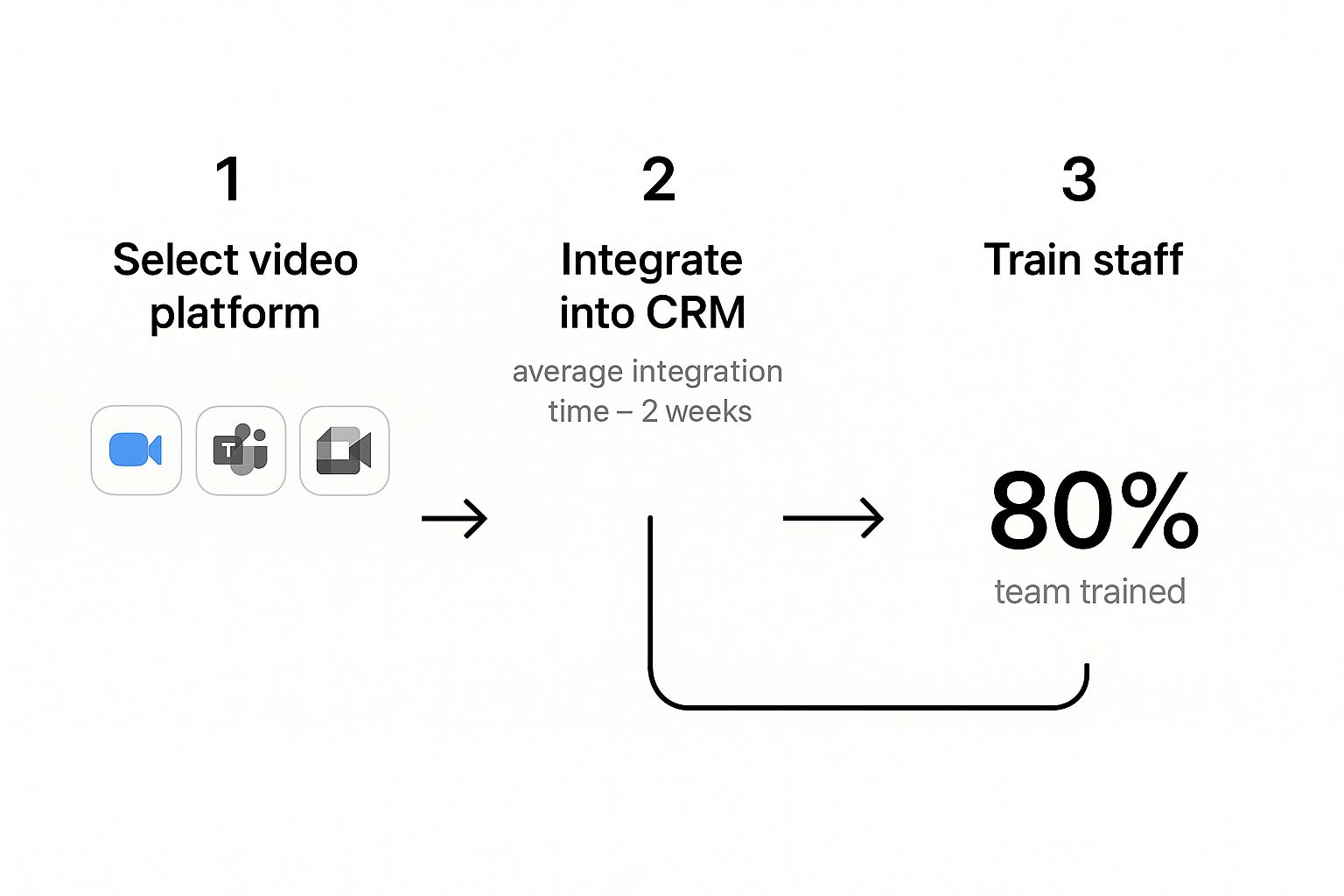
This process shows that successful setup is a blend of picking the right tools, making sure they connect with your current systems, and training your team. The growing use of video highlights its importance. It's estimated that by 2025, 89% of businesses will use video in their marketing, showing its effectiveness for both B2C and B2B companies. You can read more about these video marketing statistics on Sundaysky.com.
Personalization And Emerging Video Experience Trends
The next chapter for the **video customer experience** is being written right now, with personalization leading the way. Imagine getting a product tutorial tailored to your specific industry, or a welcome video that greets you by name and points out features you’ve already shown interest in. This isn’t a futuristic concept; it’s the new standard being set by companies using artificial intelligence.
These technologies work like a sharp assistant, looking at customer data—like browsing history or past support tickets—to assemble video content that speaks directly to an individual. This one-to-one communication makes customers feel seen and valued, which is a fantastic way to build a lasting relationship. The appetite for this kind of engagement is growing. A 2025 report found that 78% of consumers want brands to use more video, showing a clear shift toward visual communication. You can find more details in these 2025 video marketing statistics on Idomoo.com.
Emerging Formats Reshaping Engagement
Beyond just adding a name to a video, several new formats are making the video customer experience more interactive and effective. These trends are designed to draw viewers in, transforming them from passive observers into active participants.
Here are the key trends making an impact:
- Interactive Video: This format gives viewers control within the video player itself. For instance, a customer could click on different product features in a demo to explore what interests them most. It turns learning into a "choose your own adventure" experience that is more engaging and easier to remember.
- Shoppable Content: With shoppable videos, the path from discovery to purchase becomes seamless. A clickable icon can appear over an item in the video, allowing the viewer to add it to their cart without navigating away. This design removes extra steps and captures buying intent at the moment it peaks.
- AI-Generated Messages: Businesses can now use AI to produce personalized video messages in large volumes. A support team could send thousands of unique videos, each addressing a customer by name and referencing their specific problem, blending a personal touch with automated efficiency.
To keep up, businesses should watch the latest short-form video trends and adapt their strategies. The ultimate goal, however, remains constant: to use technology to create more human, helpful, and genuine connections. The trick is to balance customization with a sincere respect for customer privacy, making sure every personalized video provides genuine value.
Measuring Success And Optimizing Video Performance
Creating a great video customer experience is just the starting line. The real progress comes from understanding what’s working, what isn't, and continuously refining your approach. Think of it like a chef tasting a sauce; you don’t just serve it and hope for the best. You taste, adjust, and taste again until it's just right. To do this, you need to look beyond simple metrics like view counts to measure the true impact of your videos.
The goal is to connect video performance to real business outcomes. A video might get thousands of views, but if it doesn't help lower support tickets or boost customer satisfaction, it’s not fulfilling its purpose. This means your tracking should focus on what truly matters. Instead of just counting plays, analyze how video interactions affect customer lifetime value, ticket resolution times, and even referral rates.
The Metrics That Truly Matter
To get a clear picture of your video’s effectiveness, you need to examine engagement depth and customer feedback. Surface-level numbers can be deceptive. A high view count with a low completion rate might signal a problem with the content itself or its length.
Focus your analysis on these key areas:
- Engagement Rate: This shows how much of your video people are actually watching. A high average watch time suggests the content is valuable and holds their attention.
- Drop-Off Points: Pinpointing where viewers stop watching is like finding a weak link in a chain. This data helps you identify boring segments or confusing explanations that need to be improved.
- Conversion Attribution: Did watching a tutorial lead to a customer successfully using a feature? Tying video views to specific actions helps prove its value.
- Customer Satisfaction (CSAT) Scores: After a customer watches a support video, ask them to rate their experience. A high score is a strong signal that the video was genuinely helpful.
To effectively track these different aspects of your video customer experience, a well-organized dashboard is essential. It helps you monitor performance against your business objectives, from customer support to sales enablement.
Video Customer Experience KPIs Dashboard
Essential metrics for tracking video customer experience success across different business objectives
| Metric Category | Key Indicators | Measurement Method | Success Benchmark |
|---|---|---|---|
| Viewer Engagement | Average Watch Time, Play Rate, Re-watch Rate, Drop-off Points | Analytics from your video hosting platform (e.g., Wistia, Vidyard) | Average watch time > 50%; Steady engagement with minimal drop-offs in the first 30 seconds. |
| Customer Support Impact | Ticket Deflection Rate, First Contact Resolution, CSAT Scores after Video View | Help desk software integration, post-video surveys | 15% reduction in related support tickets; CSAT score > 90% for video-assisted resolutions. |
| Sales Enablement | Demo-to-Meeting Conversion Rate, Deal Cycle Length Reduction | CRM data linked to video views, sales team feedback | 10% increase in meetings booked from video CTAs; 5% shorter sales cycles. |
| Onboarding & Adoption | Feature Adoption Rate, Time to First Value (TTFV) | In-app analytics tracking feature usage after video view | 20% increase in adoption for features explained via video; TTFV reduced by 1 day. |
This dashboard provides a clear framework for measuring success. By focusing on these indicators, you can move beyond simple view counts and understand how video truly contributes to your company's goals, from improving support to accelerating sales.
Testing And Optimizing For Better Results
Once you have this data, you can begin to optimize your content. This isn't about guesswork; it's about methodical testing to see what connects with your audience. Think of it as a science experiment where you change one variable at a time to observe its effect.
A powerful method is A/B testing, where you compare two versions of a video to see which performs better. You could test different thumbnails to see which gets more clicks or try two different narrative styles to see which keeps viewers engaged longer. For instance, you could compare a direct, step-by-step tutorial against a more story-driven demonstration to see which format your customers prefer for learning.
The objective is to use direct customer feedback and performance data to refine every aspect of your video content. This ensures each video provides the best possible experience and drives the results your business needs.
Your Video Customer Experience Action Plan
Ready to improve your customer interactions with video? This practical roadmap outlines the first steps, no matter your team's size or budget. The journey doesn't start with a big investment, but with a simple audit. Look at your existing customer touchpoints—from the first "hello" on your website to follow-up support emails—and ask yourself: "Where could a short video make this clearer, kinder, or faster?"
This initial review will highlight immediate opportunities for quick wins. These are small-scale projects that show instant value, which makes it much easier to get support from others in your company for a larger video strategy.
Building a Sustainable Framework
After you've identified a few potential video projects, the next step is to prioritize them. A simple impact vs. effort matrix is a great tool for this. Map each idea based on how much it will improve the customer's journey versus the resources it will take. This helps you start with high-impact, low-effort tasks, like creating a two-minute welcome video for new users.
Next, think about your production process. You don't need a Hollywood-level studio; consistency is more important than perfection.
- Establish Brand Guidelines: Make sure your videos have a uniform look, feel, and tone that matches your brand. This includes colors, logos, and even the font style for on-screen text.
- Build Your Team: Find people on your team who can help. This could be a support agent who is comfortable on camera or a marketing specialist who can write clear scripts. Don't overlook the talent you already have.
- Create Reusable Templates: Develop templates for common video types like tutorials or FAQs. This simple step can drastically reduce production time and keep quality high.
Addressing Common Challenges
Two of the biggest hurdles are limited resources and skill gaps. The solution is to start small and scale smartly. You can create helpful videos with just a smartphone and good lighting. As you demonstrate the value of video, you can make a case for investing in better equipment and training.
Set realistic timelines; you won't change your entire customer experience overnight. A successful video strategy is built one helpful, thoughtful video at a time.
Ready to make your customer support faster and more personal with video? See how Screendesk can help your team resolve issues with powerful screen recording and live video tools, all integrated into your existing helpdesk. Discover Screendesk today.
